


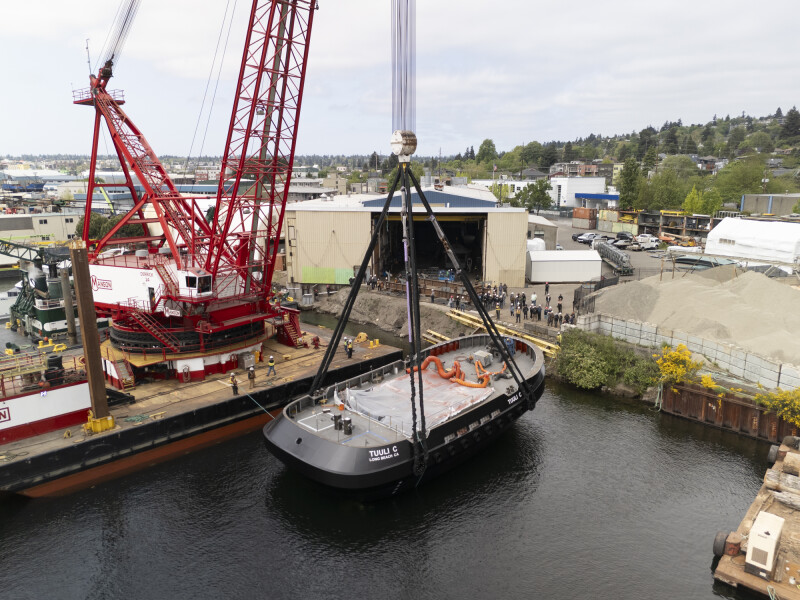
Snow & Co., Seattle, has launched the first diesel-electric hybrid ship-assist tug in an eight-vessel series being built for Curtin Maritime, Long Beach, Calif., with Los Angeles-based Arc providing the battery and battery management system integration.
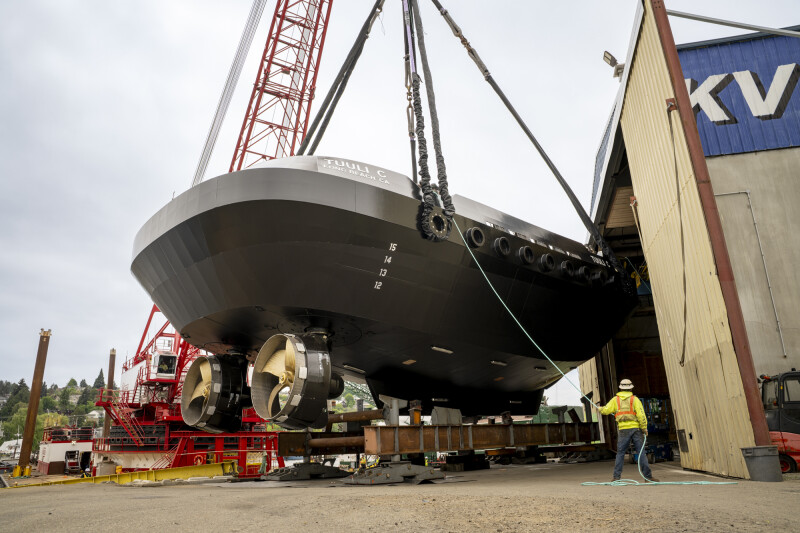
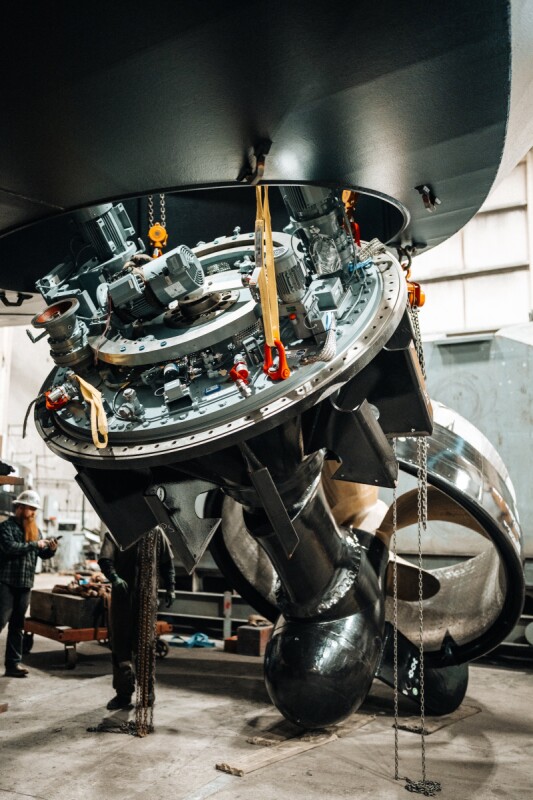
WorkBoat visited the shipyard in April as two 2,000-hp Schottel L-drive propulsion units were being installed aboard the 80’9”x42’3” tug Tuuli C, and crews prepared the vessel for launch. The tugs are too heavy for the shipyard’s traditional 1942 steam-powered crane launch system, leading Snow & Co. to develop an alternative approach to move the vessel out of the building using eight air casters.
“So that sits flat on the floor and the air blows in there. This is the manifold for the eight air casters,” said shipyard founder and president Brett Snow, pointing to the contraption in his office.
The hybrid tug series marks the first large-scale commercial marine collaboration for Arc, which is supplying a 6-MWh energy storage system integrated into the tug’s propulsion plant and is capable of producing more than 4,000-hp with a bollard pull of 55 short tons. Snow described the first vessel in the series as an iterative process between the shipyard and Arc engineers.
“It's the prototype, right?” Snow said. “So as we're designing and building at the same time, we're learning things like, ‘Oh, the electricians need an extra cabinet because there's too many breakers to fit in one.’
“We're teamed up with Arc Boats out of California that's doing the battery and battery management system, and they've been a really good partner so far,” he said. “And while they don't have a lot of experience in large commercial boats, they know the electrical system very well, and they've been really helpful doing this whole project.”
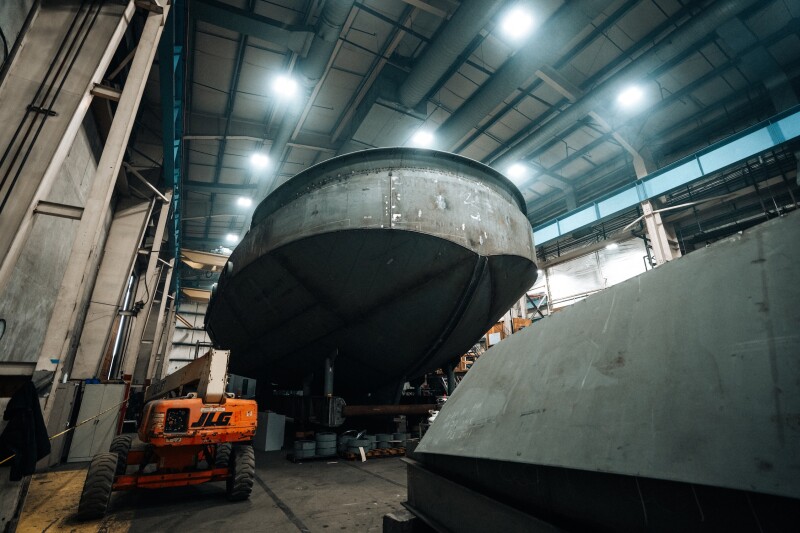
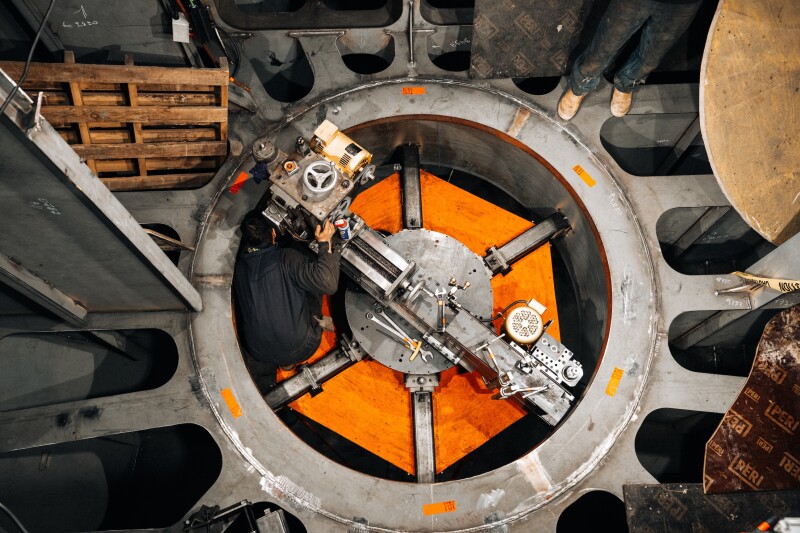
Snow said Arc engineers are regularly embedded at the Seattle yard throughout construction.
“You know, it's collaboration, right? They're building a huge electrical propulsion plant that is inside of our boat.
“So they have an engineer here every week, a different rotating engineer comes and sits in our office with us, and sometimes we have super intense meetings about all the different stuff we need to do, and sometimes they just sit at a desk and through osmosis hear what we're doing and get a better understanding of it.
“That's an important dynamic of how our design philosophy works, is get everybody in the same room as much as you can and there's peripheral conversations that you overhear snippets of, and it helps you do your job better.”
Arc characterized the relationship similarly, noting that its personnel are onsite at Snow & Co. weekly.
“We have someone on-site at Snow every week and rotate team members through depending on program needs,” Arc told WorkBoat. “This helps us to stay close with the build and rapidly clear blockers to ensure the overall program remains on track. Beyond that, we’re in constant communication with their team over Slack and on meetings.”
The company acknowledged that the tug program required adapting recreational marine experience to the operational demands of commercial towing.
“We’re partnered with Snow & Co. for a reason: they are seasoned, skilled boat builders,” Arc said. “We partner on the critical systems that interface with the powertrain, like the cooling system, ventilation, and component locations. No partnership is perfect, but we’ve built a close relationship with Snow & Co. and have learned how to blend our strengths together to keep the pace high.”
Arc said the tug’s battery system uses lithium-iron-phosphate chemistry, selected for both safety and operational durability.
“We use an LFP (Lithium-iron-phosphate) chemistry for our commercial batteries, which not only provides meaningful safety advantages but also delivers high life cycle counts and stable voltage through the depth of charge,” the company said. “It’s an ideal chemistry for commercial applications.”
The tug’s operational profile also influenced system redundancy and battery sizing.
“We looked at the typical mission profile for these tugs and sized it for them to complete a 12-hour shift with margin,” Arc said.
“System redundancy was certainly influenced by mission profile,” the company added. “That’s true not only for ABS certification, but also to guarantee to the operator that the tug will work when needed, we’ve gone the extra step with system redundancy. Not just when it comes to sensing, but also with control. Various parts of the battery system can be offline and the boat will still operate safely.”
Arc said the company has worked closely with the Coast Guard’s Marine Safety Center during development of the propulsion system.
“The Coast Guard has been a great partner,” Arc said. “We’ve been working with the Marine Safety Center in D.C. and have been having very productive conversations around our approach to battery safety.”
The company said its software and integrated powertrain background from the recreational marine sector provided advantages entering commercial tug construction.
“Our background allowed us to design the entire system together, removing components and lowering costs,” Arc said. “Typically in the tug-building industry there are many disparate teams bringing the system online. We’re able to act as one entity tackling all the scope outside of the shipyard scope, making the build more efficient, safer, and cost-effective.”
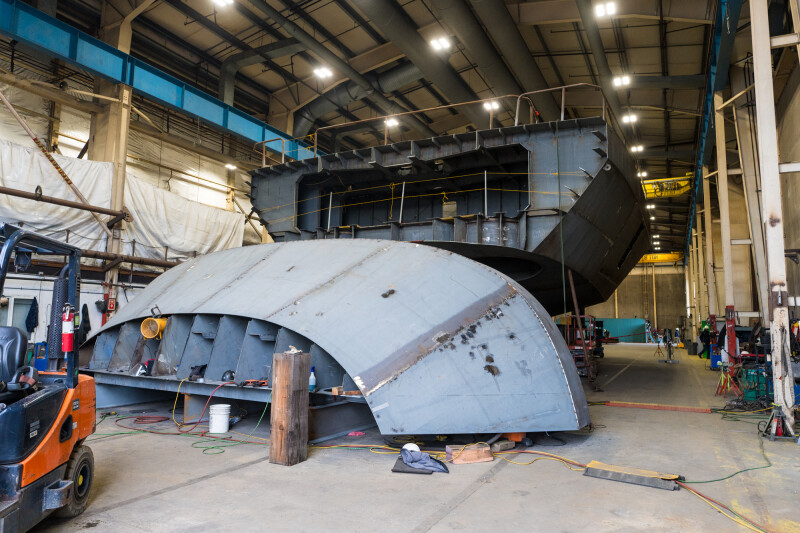
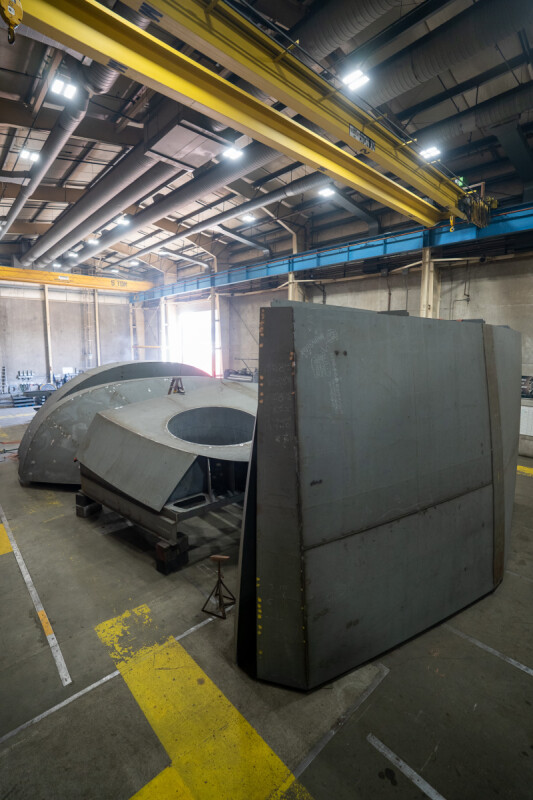
The shipyard has already begun assembling modules for the second tug in the series, Tiger C.
Both Arc and Snow said the Tuuli C is expected to be delivered before the end of the year.
