



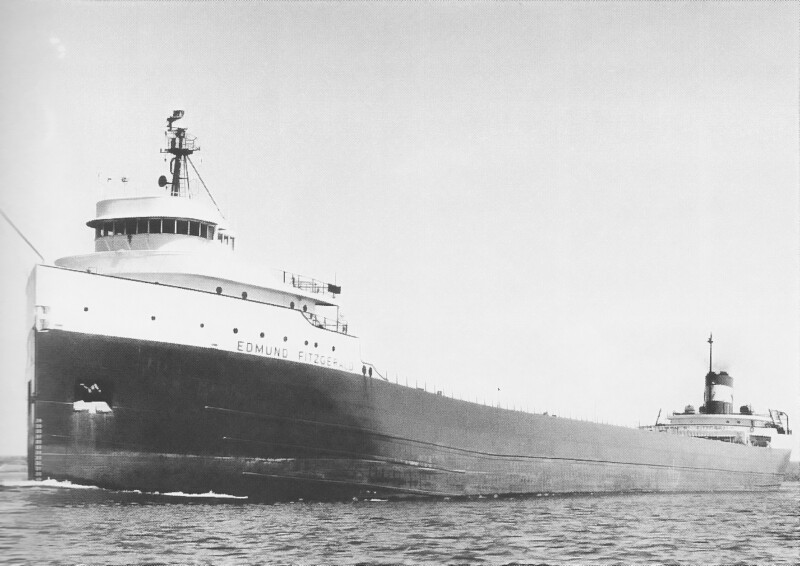
The loss of the bulk carrier Edmund Fitzgerald a half-century ago on Nov. 10, 1975, remains with us today in a way that many maritime tragedies, save those we may be personally connected with, do not.
Twenty-nine men were lost in an exceptionally violent late-fall storm on Lake Superior. The Fitzgerald’s highly respected captain, Ernest McSorley, had radioed a nearby freighter, the Arthur M. Anderson, to report, “We are holding our own,” despite a list, some damaged railings on deck, and the loss of both radars.
That is the last known transmission from the Fitzgerald. In a matter of minutes, she was gone.
There were no survivors, and no bodies were found floating.
In the space of a day, the entire world learned of the heartbreaking loss, and how the bells at the Mariner’s Church in Detroit rang 29 times.
“The Gales of November: The Untold Story of the Edmund Fitzgerald” (Liveright), by John U. Duncan, is a definitive account of an historic sinking. The 430-page book is factual and exhaustive, but by no means exhausting. It moves along at the pace of well-written fiction – no mean feat when everyone knows how things turn out. Smithsonian deemed it one of the 10 best history books of 2025.
In its essence, it is a story of men against the sea.
As someone who has fished the North Atlantic in winter, I took notice of the use of “sea” in reference to the Great Lakes, and to the idea of 25' “seas” on inland waters. Alas, the term is justified. Lake waves are steep, ragged, and travel fast – something you can begin to see on a lake of just a few hundred acres on a breezy but otherwise benign summer day. Add in a fetch of several hundred miles and storm-force winds, and a lake will produce a maelstrom worthy of the ocean — and seas close enough together that a large vessel can be compromised astride two at once, or perhaps worse, astride just one, with the bow and stern hanging over air.
Duncan delivers what good journalists and historians strive for: context. On one hand, we learn of the multitude of factors, beyond weather, that culminated in the loss of what at the time was the largest freighter on the Great Lakes. On the other hand, we are introduced to the crewmen and their communities.
People are front and center of Duncan’s book. In fact, “The Gales of November” is as much a three-dimensional portrait of the Fitzgerald’s crew, their families, and the backdrops of their lives as it is the events of Nov. 10.
Duncan also drives home two themes of modern life.
The first is that we tend to be the victims of our prosperity. Following World War II, the 20th century became known as “The American century.” The United States had established itself as the world’s foremost military power, and it would use its wealth and a newfound sense of purpose to become the world’s dominant political and economic power. So great was our faith in ourselves that we determined to put a man on the moon, and in the space of less than 10 years, we did.
Nowhere was the American ascendancy more apparent than in the Upper Midwest, home, as Duncan notes, “to vast supplies of lumber, grain, limestone, copper, and iron; the world’s best soil and climate for farming; and of course, the world’s biggest lakes,” linking the region, and in turn the nation, to markets across the globe.
Of these products, the one that put perhaps the boldest stamp on the American century is iron. When the region’s high-grade iron ore began petering out, it was replaced by once-discarded taconite — rock containing iron. In pellet form, it was an ideal cargo for a bulk carrier.
If the 1950s ushered in the Jet Age, it also ushered in the era of the interstate highway, the two-car family, muscle cars, and the preeminence, if temporary, of Detroit. Steel was the foundation on which Detroit was built, and taconite provided the iron. “America’s post-war boom would not have been possible without it,” Duncan writes.
Yet, the wealth that was produced attracted foreign competition and drove manufacturers to relocate southward to the promise of cheaper labor.
In the meantime, though, there was the Edmund Fitzgerald. Commissioned in 1957 by the Northwestern Mutual Life Insurance Co., it was named for its president (over his objections). At 729' long by 75' wide (to accommodate narrow locks) the Fitzgerald was a splinter. “Aesthetics were never a priority,” to put it in Duncan’s words. With 80% of her space dedicated to cargo, she could haul 52 million lbs. of taconite.
Thus, Duncan’s second theme: the normalization of deviance.
Like all cargo ships, the Fitzgerald had a Plimsoll line indicating the maximum depth to which she could be legally loaded.
Even so, the Plimsoll line could be cheated with simple ruses good for an inch or two — burning some fuel, moving a crane fore or aft, or dumping potable water. More deviously, first mates, aware that loading hot taconite tended to flex a ship, causing it to sag in the middle, would order the decks washed down with cold water, lifting the center of the hull — and the Plimsoll line.
An additional inch meant another 120 tons of taconite for the Fitzgerald. Do that 45 times a year, Duncan notes, “and you’ve moved an additional 12,096,000 pounds.” Talk about scale!
More taconite meant bigger bonuses.
“We ran so low that you could almost stick a fist in the water by reaching over the side,” said Tom Walton, who served as a porter on the Fitzgerald in 1963.
That was just the beginning. As fastidiously as the Coast Guard had scrutinized loading, the American Bureau of Shipping liberalized freeboard requirements three times between 1969 and 1973. For the Fitzgerald, that meant a loss of not one or two inches of freeboard, but of 39.25". The ship could now haul an extra 4,710 long tons of taconite per trip, an additional 471 million lbs. per year.
The Fitzgerald’s hull was found on the bottom of Lake Superior in two pieces. Conventional wisdom suggests she broke up. If the ship wasn’t overloaded according to the rules, it seems clear that she was certainly sailing with less freeboard than her designers intended.
Duncan is convinced that industry lobbyists pushed to liberalize freeboard guidelines. It is not hard to imagine.
It is possible that the Fitzgerald’s hatches were another source of normalized deviance. Securing all 21 hatches, each with 68 clamps, meant dogging down 1,428 clamps. During good weather — and the weather was pristine when the Fitzgerald left Superior, Wis., — the first mate, who oversaw the vessel’s loading, would be satisfied with two dogged clamps per corner and casting off: eight clamps per hatch instead of 68.
Moreover, an inspection of the ship the previous month revealed that some hatches did not seal completely. The Coast Guard deemed that repairs could wait until the season ended when Lake Superior froze over. Unsecured hatches would become the Coast Guard’s primary theory when underwater video revealed collapsed hatch covers.
However, Duncan points out that the hatches could have sprung as a result of the ship’s impact with the bottom. In addition, he writes, two former deckhands “steadfastly insist” that the first mate would not have permitted the Fitzgerald to set sail in November without all the clamps secured.
Duncan’s account of how Gordon Lightfoot came to write “The Wreck of the Edmund Fitzgerald” and his relationship to the seamen’s families is well worth the two chapters he devotes to it.
The Canadian singer-songwriter was a recreational sailor who had raced on the Great Lakes. He was deeply moved by the tragedy but reluctant to record a song about it, thinking it would seem exploitative. For days, Lightfoot and his band had been working on the album that would be “Summertime Dream.” Every night, he would strum a little of this sea chanty he was working on, then stop. It wasn’t right, he believed.
About the time everyone thought they were done with the album, Duncan writes, the recording engineer said, “What about that shipwreck song?” Lightfoot relented and let the band play it as he sang. Some things are meant to be. The very first take went on the album.
Lightfoot became close to the families of the Fitzgerald’s crew. In 2015, well into his seventies, Lightfoot, accompanied by his bass player, traveled to Whitefish Point, Mich., the land nearest where the Fitzgerald went down, to attend a memorial with the families on the 40th anniversary of the sinking.
