



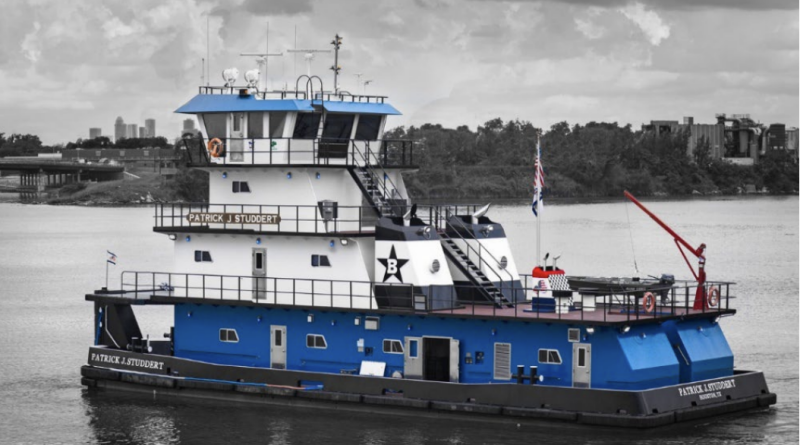
A captain was distracted by his cell phone use before his 84’ towboat collided with a 738’ bulk carrier on the Lower Mississippi River in December 2024, the National Transportation Safety Board said in a report on the accident.
The towing vessel Patrick J Studdert and bulk carrier Clara B collided while underway at mile 122, near Luling, La. Dec. 29. The towboat sank, forcing all five crewmembers to abandon the vessel into the water, where they were rescued by a nearby vessel; four crewmembers sustained minor injuries.
The Patrick J Studdert was considered a total constructive loss valued at over $2.3 million. The Clara B sustained minor damage to its hull, estimated at $250,000 to repair.
In its report the NTSB found the probable cause of the collision “was the Patrick J Studdert captain’s distraction due to his cell phone use, which resulted in him not maintaining a proper lookout and navigating the towing vessel directly into the path of the upbound Clara B.”
Built in 2011, the towboat was owned by Shamrock Marine and operated by Buffalo Marine Service, Inc., typically working in a line-haul service between Houston and New Orleans. At 6:10 p.m. Dec. 29 the Patrick J Studdert was moored at Magnolia Fleet 122 docks near mile 122 on the right descending bank, taking on fuel with five crewmembers on board: the captain, pilot, two tankermen, and a deckhand.
The crew “prepared to get underway to return to their moored barges at the fleeting area across the river,” according to a narrative in the NTSB report. “There, they would await orders from the operating company regarding where to take the barges.”
Around 7:29 p.m. the bulk carrier Clara B was transiting upriver in darkness, and passed under the Hale Boggs Memorial Bridge (Luling Bridge), located about 0.8 miles downriver from the Magnolia Fleet 122 docks, at a speed of 8.1 knots.
A New Orleans-Baton Rouge Steamship Pilot Association (NOBRA) pilot was aboard the Clara B and had the conn, along with a pilot-in-training. As the vessel transited upriver, the NOBRA pilot made passing arrangements via VHF radio with the operator of the Bold Venture, a downbound towing vessel pushing barges with an overall length of 820’. They agreed to a starboard-to-starboard passing near mile 122, between the Luling Bridge and the Magnolia Fleet.
As the Bold Venture tow passed the Magnolia Fleet 122 docks, the on-watch tankerman and deckhand of the Patrick J Studdert took in the lines, and at 7:32 p.m. the vessel got underway with the captain at the helm in the wheelhouse. The tankerman and deckhand then congregated on the second deck exterior walkway, forward on the vessel.
“The captain also told investigators that he checked the radar while getting underway,” the NTSB report states. “The captain stated that he was aware of the upbound Clara B and had planned to loiter above the fuel dock until the Clara B passed clear and then cross the river to give the ship extra room.”
“However, when investigators reviewed automatic identification system data from the Patrick J Studdert, it showed that the vessel proceeded directly across the channel toward the fleeting area immediately after getting underway.”
Around 7:33 p.m. the Clara B maneuvered toward the right descending side of the channel as it passed the Bold Venture tow. Audio from the Clara B’s voyage data recorder showed the ship’s NOBRA pilot “saw the Patrick J Studdert underway about 1933:32. About 1933:38, he attempted to hail the Patrick J Studdert over VHF channel 67 but did not receive a response,” the NTSB report says.
“About 1933:45, the pilot on the Clara B, recognizing the danger of collision, requested the bridge crew sound the danger signal on the ship’s whistle and repeated his request several times with increasing urgency. The pilot also ordered the rudder to starboard 20°. The pilot again attempted to hail the Patrick J Studdert over VHF radio but did not receive a response.”
“About 1934:18, 32 seconds after the pilot’s initial request to sound the Clara B’s whistle, the chief officer sounded one short blast, followed by a continuous blast of the ship’s whistle. (The captain of the Patrick J Studdert told investigators that he was unsure when or whether he heard the Clara B’s whistle.)”
The pilot ordered the ship to stop engines and hard port rudder., but seconds later the bow of the Clara B struck the starboard quarter of the Patrick J Studdert, about 380 feet away from the docks. The Patrick J Studdert’s hull and pilothouse hit the bow of the Clara B before passing down the starboard side of the ship.
Unable to stop and turn in the narrow channel, the pilot of the Clara B called out on VHF radio to request assistance from any nearby vessels for the stricken towboat.
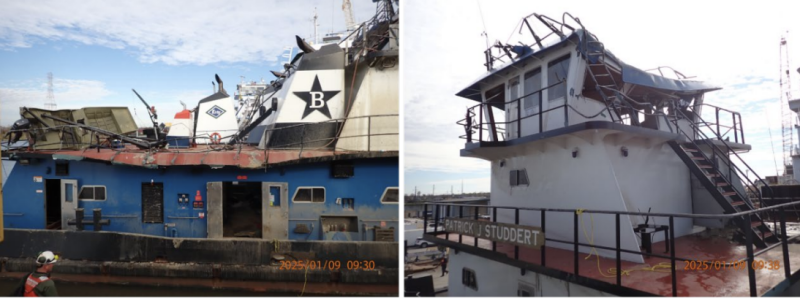
Meanwhile the stopped Patrick J Studdert listed toward the port quarter, and began to flood. The off-duty tankerman, in the galley at the time, attempted to exit from the forward door on the main deck and told investigators he saw “water pouring through on the hinge side” of the door and turned around. He reached an office room on the starboard side when the boat “rolled real hard” to port.
“As water began to flood the office, a personal flotation device (PFD) floated up next to him, and he grabbed it. He was able to escape by breaking a sliding window in the office and climbing out onto the starboard side. The on-duty tankerman went inside to alert the pilot, who had been asleep in his room. The pilot had awoken as a result of the collision, and he and the on-duty tankerman were able to escape from inside the sinking vessel.”
The crew donned PFDs and entered the water as the towboat continued to sink in 96’ of water, with about 29,000 gals of fuel on board and a visible sheen downriver. They were rescued by the crew of the tug Mary Moran, who saw the collision and were underway within minutes, returning the crew to the Magnolia Fleet docks.
The captain of the Patrick J Studdert told investigators he did not use his personal cell phone, but they cited telephone records to “indicate he made an outgoing call beginning about 1931, just before getting underway at 1932. The call lasted until 1935, moments after the collision, meaning he was on the phone the entire time he was operating the vessel to transit across the river.”
The towboat company’s safety management system “allowed crewmembers to use a personal cell phone if it did not distract from navigating,” the NTSB noted. “However, when an operator engages in non-navigational or secondary tasks, such as making a call on a cell phone, there is a risk that performance of the primary task will suffer or that the operator will become distracted from their primary task of navigation (which can persist even after the secondary task ends, in the form of cognitive distraction).”
“The Clara B’s lights were visible in the darkness, and the vessel could have been identified on radar. Despite having the tools to detect the upbound Clara B, the Patrick J Studdert captain got underway and maintained a consistent course that crossed into the path of the bulk carrier.”
Because of cell phone use distraction the captain “was not maintaining a proper lookout and, therefore, lacked situational awareness of the imminent risk of collision with the Clara B,” the investigators concluded. “The nonoperational use of cell phones while operating a vessel is a distraction from a mariner’s primary duties and has been cited numerous times as a causal factor to major marine accidents in NTSB reports.”
