


We are, without a doubt, a visually oriented species. We tend to learn best through graphical means. You can talk about something all day, but seeing is believing — and there’s no substitute. Very occasionally, the universe serves it up, in your face, as if to say, “So you doubted me?”
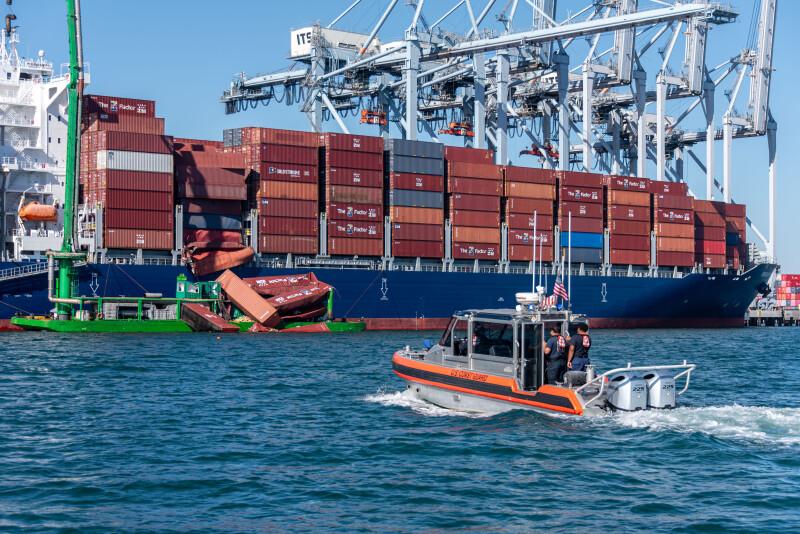
As we motored into Southeast Basin in Long Beach Harbor, Calif., on the morning of Sept. 9 for a bunker delivery to a freighter in the adjacent Six Basin, the presence of the containership Mississippi at Pier G was notable for only one thing beyond its massive size: an abnormally large list to starboard, away from the dock and toward the bright green STAX Engineering Inc., Long Beach, Calif., emissions-reduction barge spudded down alongside. My seaman’s eye estimate was around 7° to 8° — enough to make me wonder what might be going on with them, stability-wise. Typically, I would expect to see no more than about a 5° list when they’re working cargo, and usually much less. This was the most I’d ever seen.
I thought to myself that if our bunker delivery was for the Mississippi, given the significant list combined with a full load of containers on deck and the fact that they were actively working cargo, I would decline to go alongside, report the circumstances, and await further instructions (in other words, drop back 10 yards and punt).
A few moments later, the universe abruptly provided that graphic example as a slow-motion avalanche of several dozen containers toppled off the ship into the basin and directly onto the STAX barge. I immediately reported the event to the Long Beach Pilots, who activated the emergency response.
The containers continued to topple in waves, spreading out into the basin in every direction. The water they displaced was considerable, throwing out a mini-tsunami ahead of them.
My immediate concern was for the personnel on the STAX barge. It didn’t look good. In fact, I assumed the worst. Thankfully, no major injuries were reported.
