



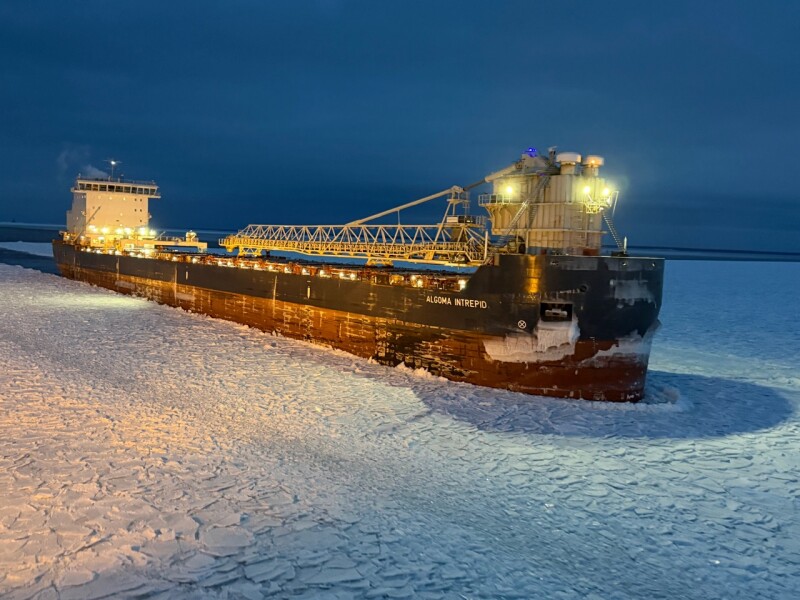
In many parts of the United States, winter hit early and hard at the end of 2025, and the Great Lakes region was no exception. The rapid onset of colder-than-average temperatures presented challenges for the U.S. and Canadian coast guards when it came to breaking ice to keep shipping channels open.
“The U.S. Coast Guard is focused on their acquisition of Arctic Security Cutters, yet they can’t even keep our internal domestic waters open,” Jim Weakley, president of the Lake Carriers’ Association (LCA), said in a statement on Jan. 2.
The LCA is a trade group that represents the U.S.-flag Great Lakes fleet, which moves more than 90 million tons of cargo annually.
“This is a major national security problem if steel mills in the U.S. cannot have a reliable supply chain during the winter,” Weakley added.
Each fall, the Coast Guard conducts its annual aids-to-navigation (ATON) work, removing approximately 1,220 lighted summer buoys and replacing them with smaller, ice-resistant winter buoys. Known as Operation Fall Retrieve, the effort takes place from October through December, with schedules varying by region and ice conditions.
Eric Peace, LCA’s vice president, said that the extended time spent on navigational aid work, combined with the Coast Guard’s decision to take a two-week break before beginning icebreaking operations, significantly disrupted commercial shipping due to ice buildup.
“We lost out on the first part of the season because of the aids to navigation and the two-week policy between them and icebreaking,” said Peace.
SIX CHALLENGING WEEKS
The icebreaking season on the Great Lakes starts in December and ends around Jan. 15, when the Soo Locks in Sault Ste. Marie, Mich., close. Commercial ships go into drydock until the locks reopen on March 25. As of mid-January, Peace said western Lake Erie was iced in.
In an email, David Micallef, deputy public affairs officer for the Coast Guard’s Great Lakes District, wrote, “The Coast Guard does not have a policy that mandates two weeks of maintenance/logistics time following completion of ATON for our multipurpose platforms. That two-week transition period is an internal best practice developed over the years that provides the absolute best balance of performing mechanical preparations, crew rest, and logistics, which is essential to not only mission readiness but longevity during the entire ice season.”
On the Great Lakes, the Coast Guard has a fleet of four cutters that are capable of icebreaking, five that can break ice and conduct ATON work, and one dedicated to navigation aids.
Micallef added that when a polar vortex brought early ice formation the week of Dec. 8, the port of Duluth, Minn., began freezing first. The 225' buoy tender Spar, which is also an icebreaker, immediately started breaking ice as part of the launch of Operation Taconite, named for the iron ore pellets transported throughout the Great Lakes. The operation encompassed Lake Superior, Lake Michigan, the St. Marys River, the Straits of Mackinac, and Georgian Bay. Ice was also impacting the western basin of Lake Erie, including Ohio ports like Toledo and Sandusky. The St. Marys, the 75-mile major artery between Lake Superior and the lower lakes, was reportedly closed due to shifting ice dragging navigation aids off station.
When the cold persisted the week of Dec. 15, the port of Green Bay began icing, and the 140' icebreaking tug Biscayne Bay was on station with the Spar to support commercial traffic flow. Both vessels were joined the following week by the icebreaking tugs Mobile Bay and Katmai Bay, and all worked to keep Duluth, Green Bay, the Straits of Mackinac, the Soo Locks, and the St. Marys River open. The 240' heavy icebreaker Mackinaw and the Bristol Bay, another icebreaking tug, were the last two cutters retrieving ATONs into December. They joined the rest of the icebreaking fleet the first week of January to combat colder regional temperatures and subsequent ice growth.
On Jan. 2, the Coast Guard initiated Operation Coal Shovel, led by Sector Detroit, to manage ice on the lower Great Lakes. The work covered southern Lake Huron, Lake St. Clair, the St. Clair and Detroit River systems, and Lakes Erie and Ontario.
“We suffered until all the boats came back in January,” said Peace.
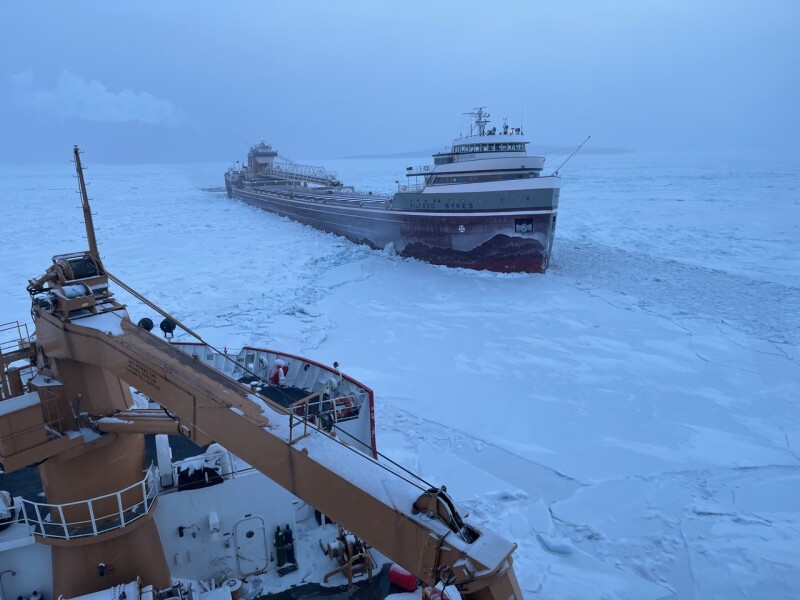
In addition to wanting an earlier start to the season, the LCA is pressuring the Trump administration to fund construction of another heavy-duty class icebreaker, along the lines of the 240' Mackinaw.
“The cutter schedule is deliberately managed to ensure safe and efficient flow of commercial traffic while maintaining maritime navigational safety,” wrote Micallef. “Our priority remains safely and efficiently facilitating navigation of the Great Lakes Maritime Transportation System that serves a vital $36 billion annual shipping industry.”
POSSIBLE SOLUTION
Being able to predict the ice pack ahead of time could give the Coast Guard and commercial ship operators vital information that would help the former better schedule and position icebreaking vessels.
Last year, the Michigan Office of Defense & Aerospace Innovation held the 2025 MiSpace Hackathon, a first-of-its-kind competition that challenged Michigan college students to use satellite data and aerospace technology to provide the Coast Guard with a predictive “spatial field” of ice formation on the Great Lakes.
“The Coast Guard gave us a real problem set,” said Mark Ignash, director of strategic initiatives and ecosystem development at the Office of Defense & Aerospace Innovation at the Michigan Economic Development Corp. “They and others struggle with predicting ice pack. There are only so many cutters that can address the ice. They need to be positioned best to accommodate the needs, so they gave us the problem set.”
Ignash continued, “We identified publicly available remote-sense data and raw data. They bought it and said, ‘Okay, students, here’s the problem set. Here’s the data we’re providing. Go forth and develop solutions. Find ways to do this more efficiently, better, and they did.”
The winning team, IceScope GL, represented the University of Michigan and took home $15,000 for its predictive user interface that gives icebreakers a four-day head start on shifting formations. The second-place team earned $10,000, and third grabbed $5,000.
“The top three awardees came through with some innovative projects,” said Ignash. “And the Coast Guard said if they could implement it today, it would be game-changing.”
IceScope GL team member Vishnu Yadagani, an aerospace engineering major, said, “We created a machine learning algorithm using a linear regression model. We needed an optimized route planner so the ships have the route where they want to go without having to encounter the worst ice.”
The other three team members were Joani Kaleshi, a computer science major, Efaz Rahman, a computer engineering major, and John Akladus, who is in aerospace engineering.
An attractive attribute of the winning entry was that it was developed to work as an app on a smartphone or computer, which most ships plying the Great Lakes have on the bridge. When a vessel is en route to a destination, the app would give the user constant alerts on changing ice conditions.
In addition to the University of Michigan, participating schools included Michigan State University, Grand Valley State, Lake Superior State, among other institutions. When the contest was announced, more than 114 participants responded. “That whittled down to 36 respondents, and that worked down to six full projects,” said Ignash.
The timing of the competition played a role because it ran before, during, and after the Thanksgiving holiday. In addition to working with the data, the teams developed their own machine learning algorithms. While participation from engineering students was expected, one of the top three teams came from a business school.
“What this does for the Coast Guard is give the information on where they need to be or wherever there’s traffic on a given day based on need to make sure there’s a clear path,” Ignash said. “What elevated the top three is the four-day prediction and the methodology of how they got there.”
Shipping companies on the Great Lakes will take any help he can get. “Predictions would be helpful if they’re accurate,” LCA’s Peace said. “You could make a risk decision based on those models if they’re good.”
