



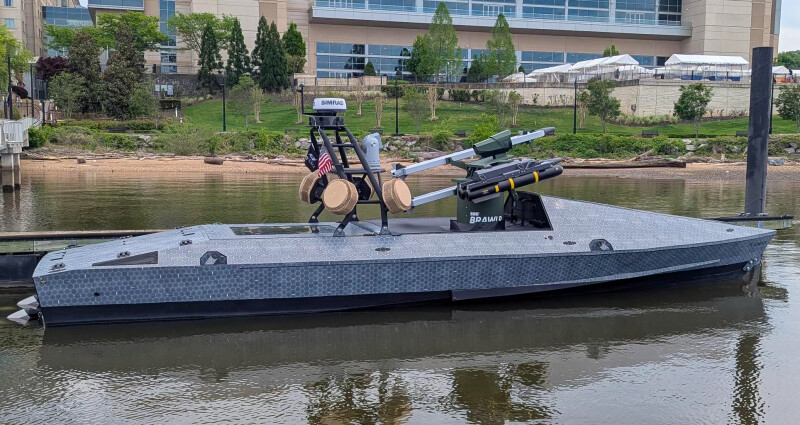
BlackSea Technologies, Baltimore, on Monday unveiled two new small unmanned surface vessels: a compact modular craft called Chaser and a larger, high-speed combat platform called Comet.
Both vessels were unveiled and are on display waterside at Sea-Air-Space 2026, the Navy League of the United States' annual maritime exposition in National Harbor, Md.
The launches come as BlackSea holds an established position in the unmanned surface vessel market. Its Global Autonomous Reconnaissance Craft (GARC) has seen more than 350 units delivered and logged tens of thousands of operational hours across real-world Navy deployments, according to the company.
Chaser is designed for modular maritime operations and fits within a standard 20' shipping container, meeting a Navy transportability requirement. Built on a foundation the company says has accumulated thousands of fleet hours, Chaser supports missions including maritime domain awareness, distributed ISR, communications relay, surface operations support, and contested logistics. Most payloads can be swapped within a few hours.
Mission partners contributing to the Chaser launch include Lockheed Martin for the JAGM launcher, Echodyne for maritime domain awareness radars, Current for perception camera systems, and EOS Defense Systems USA for the gun system.
Comet is BlackSea's larger offering, measuring 13.1 meters and capable of exceeding 45 knots. The vessel can carry a 10,000-lb. payload including fuel and is designed to support counter-UAS, mine countermeasures, surface warfare, anti-submarine warfare, electronic warfare, maritime domain awareness, and high-value unit escort missions. BlackSea describes it as bridging the gap between small tactical USVs and larger unmanned combat craft.
Partners on the Comet include Sierra Nevada Corp. with its BRAWLR system, Leonardo DRS RADA with the RPS-42 MHR array radar, Seakeeper for gyro stabilization, Volvo Penta for propulsion, and DECPT for a signature management wrap intended to improve survivability.
Bob Pudney, president of BlackSea Technologies, said, "Chaser and Comet reflect our focus on giving operators scalable, mission-ready platforms that can adapt quickly to evolving threats and mission demands."
"BlackSea had been leading innovation of autonomous vessels for decades. We built the first military uncrewed hydrofoil, USSV-HS in 2006, and the prototype for the Common USV, CUSV-001 in 2008," said Todd Greene, BlackSea's director of advanced technologies. "Today, we introduce Chaser an enhanced version of the first American-made USV, that was produced at scale and is being tested in combat. We also are unveiling Comet, evolved from the robust and proven USSV-HTF we delivered in 2005; now capable of going faster, and carrying more mission payload than any other sUSV.”
