



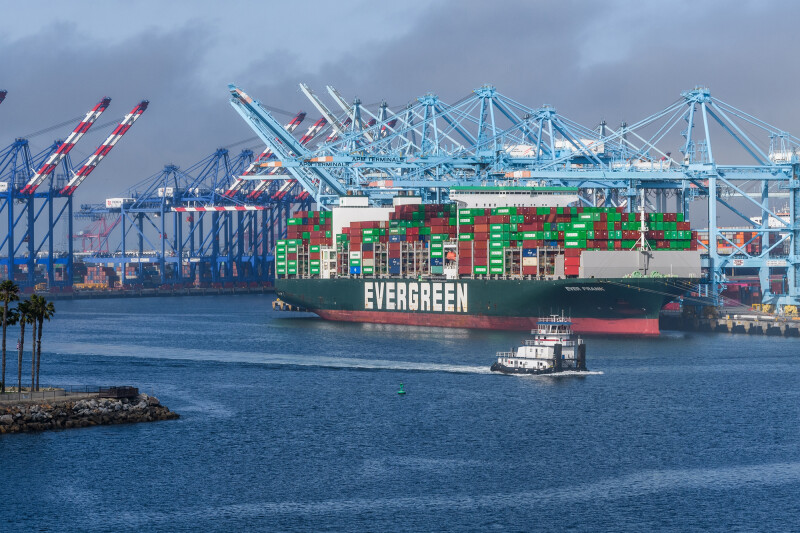
California's Port of Long Beach has created a $1 million award for the first oceangoing vessel to commercially bunker methanol at the harbor, in what port officials are calling an unprecedented effort to accelerate the maritime industry's shift to lower-carbon fuels.
The Long Beach Harbor Commission approved the Clean Fuel Bunkering Challenge on May 26.
"We know the shipping industry is considering moving toward adopting methanol marine fuel for some great reasons — they want to reduce greenhouse gas emissions and improve air quality. Today, we're giving them 1 million more reasons to embrace clean fuels," said Port of Long Beach CEO Noel Hacegaba. "This is about demonstrating that we're serious about creating a North American market for methanol bunkering, and giving the industry an incentive to invest. We're also seeing how rising fuel costs are strengthening the case for energy diversification and greater energy independence."
"The Port of Long Beach has been advancing the commercial availability of clean technology and sustainability solutions for decades," said Long Beach Harbor Commission President Frank Colonna. "This is the most direct and practical lever we can pull to demonstrate the feasibility of bunkering methanol fuel in San Pedro Bay."
Compared with conventional marine fuel, methanol significantly cuts harmful emissions — reducing nitrogen oxide output by up to 50%, sulfur oxides by 95%, and particulate matter by 90%. Major shipping companies have been heavily investing in dual-fuel methanol vessels, some of which already call at Long Beach, one of the busiest container ports in the United States. The obstacle, however, is a supply gap: methanol is not currently available at the port, forcing methanol-capable ships to depart on conventional bunker fuel.
The economics of the challenge reflect that gap directly. Bunkering a vessel with methanol at current pricing runs approximately $1.5 million per call, compared to roughly $1 million for conventional fuel. The $1 million award is structured to offset that price differential while directing the remaining $500,000 toward additional costs, including development of operational and safety procedures, coordination with fuel providers and distributors, and local permitting work.
The challenge was partly inspired by the commercial availability of methanol at the ports of Shanghai and Singapore, both of which participate in Green Shipping Corridors with the San Pedro Bay ports. Green Shipping Corridors are bilateral or multilateral agreements between ports to collaborate on deploying zero- or near-zero-emission fuels and technologies along specific trade routes.
Within the next year, the port also plans to update its Green Ship Incentive Program to encourage more routine cleaner ship visits, a move officials say could further develop the methanol market. Proposed revisions include updated scoring and incentive metrics developed in collaboration with other international ports.
Environmental advocacy group Pacific Environment, while welcoming the award, urged the port and shipping companies to prioritize green methanol — produced from renewable sources — over fossil-derived alternatives. "Not all methanol pathways are equal, and long-term investments should focus on truly green methanol solutions that deliver the strongest climate and public health benefits," said Davina Hurt, climate policy director for Pacific Environment.
