



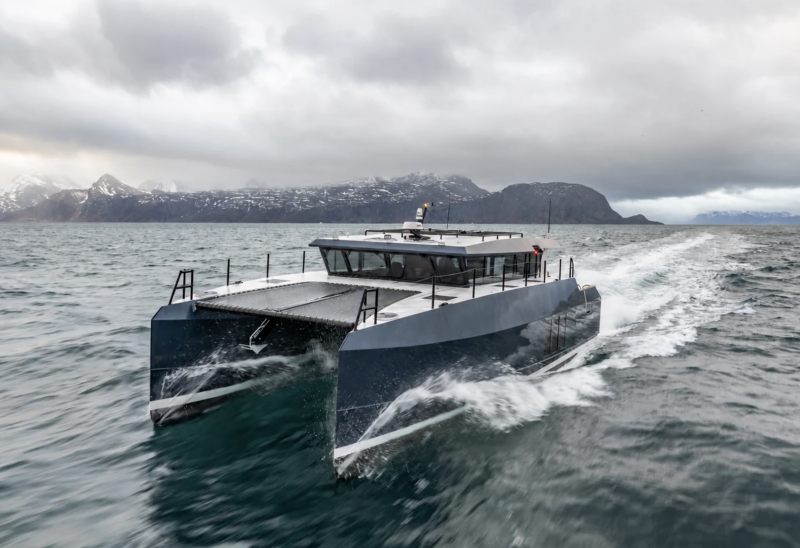
Robosys Automation, Providence, R.I., has integrated forward-looking sonar technology from FarSounder, Warwick, R.I., with its VOYAGER AI autonomous navigation system, adding real-time underwater hazard detection to the platform’s navigation and vessel-control capabilities.
The integration is aimed in part at uncrewed surface vessels operating in poorly charted or shallow waters, where underwater hazards may not be detected by conventional above-water sensors.
Robosys said the system combines VOYAGER AI’s route planning, COLREGs collision avoidance, and autonomous vessel control functions with FarSounder’s three-dimensional forward-looking sonar. Sonar data can be incorporated into the autonomy system’s decision-making, allowing a vessel to detect and navigate around both surface and subsurface hazards.
“Integrating FarSounder's proven forward-looking sonar with VOYAGER AI represents another important step towards intelligent maritime operations,” said Aditya Nawab, CEO of Robosys Automation. “The ability to combine above-water sensor data with real-time underwater subsea awareness enhances navigation safety and provides operators with greater confidence when operating in challenging environments.”
FarSounder’s sonar generates a three-dimensional view of the seabed and underwater objects ahead of a vessel. Robosys said incorporating that information into the VOYAGER AI autonomy stack can provide a more complete picture of navigational risks than charts and traditional echo sounders alone.
The capability is particularly applicable to autonomous and remotely supervised vessels, which may operate without a crew aboard to visually identify changing conditions or intervene when a vessel encounters an unexpected underwater hazard.
Robosys said forward-looking sonar data can improve mission safety, route optimization, and operational resilience for USVs operating in areas where shoals, underwater structures, or other subsurface obstacles pose navigational risks.
“The maritime industry is increasingly recognising the importance of sensor fusion in both crewed and uncrewed vessels,” said FarSounder CEO Matthew Zimmerman. “Integrating our forward-looking sonar with VOYAGER AI allows operators to leverage underwater awareness as part of a wider intelligent navigation solution.”
The companies are also targeting the technology toward crewed vessels, including superyachts and expedition vessels operating in remote anchorages, poorly charted waters, and complex coastal environments. In those applications, the sonar information serves as an additional decision-support tool for bridge crews.
VOYAGER AI is designed for use aboard crewed, remotely operated, and autonomous vessels. The platform provides autonomous route planning and replanning, mission execution, vessel control, and collision avoidance based on the International Regulations for Preventing Collisions at Sea.
Headquartered in Rhode Island, Robosys also operates offices in the United Kingdom and Canada. FarSounder develops forward-looking sonar systems used aboard recreational, commercial, expedition, and government vessels.
