



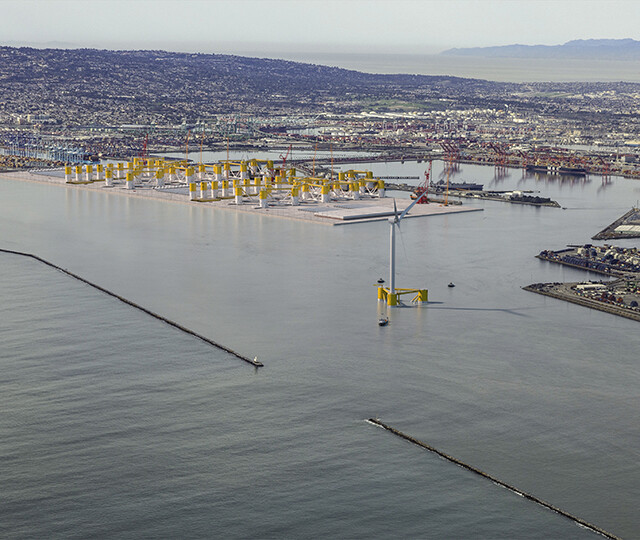
The Port of Long Beach has received a $20 million grant from the California Energy Commission to advance engineering, environmental review, and community engagement for its proposed Pier Wind terminal. The project entails a 400-acre facility designed to assemble and deploy floating offshore wind turbines.
The award, announced Oct. 8, makes Long Beach the largest recipient of funds under the state’s Offshore Wind Energy Waterfront Facility Improvement Program, supported by Proposition 4, the $10 billion climate bond approved by California voters in 2024. The port will contribute an additional $11 million in matching funds to complete preconstruction work on the estimated $4.7 billion project.
“Pier Wind will ensure California’s offshore wind energy goals are achieved,” said Port of Long Beach CEO Mario Cordero. “This first phase of funding allows us to move forward with essential planning and engineering to deliver on that vision.”
Pier Wind is intended to support California’s target of producing 25 gigawatts of offshore wind power by 2045, which the port states is enough to supply about 25 million homes. The terminal would handle staging, storage, and assembly of floating wind turbines, which could reach lengths up to 1,000’. Once assembled, the turbines would be towed to lease areas 20 to 30 miles off the coast of Central and Northern California.
According to the port, the project could create more than 6,000 jobs and generate $14.5 billion in economic output through 2045. Construction could begin as early as 2027, with the first 200 acres completed in 2031 and full buildout expected by 2035, the port said.
The CEC funding comes amid broader state efforts to coordinate offshore wind development and port infrastructure. In 2024, the commission adopted a strategic plan for offshore wind, authorized by Assembly Bill 525, which identifies key ports such as Long Beach and Humboldt Bay for turbine assembly and deployment.
The California State Lands Commission, along with the ports of Long Beach and Humboldt, signed a memorandum of understanding in December 2024 to align permitting, community engagement, and tribal consultation in support of a multiport deployment strategy.
In 2024, Gov. Gavin Newsom signed legislation allowing the port to use alternative construction delivery methods to accelerate Pier Wind’s design and development.
