


Operating in some of the nation’s most challenging waters, pilot boats safely transfer state-licensed maritime pilots to and from containerships, tankers, bulk carriers, and other deep-draft vessels that move roughly 90% of U.S. overseas trade by volume. Those pilots then guide ships through local waterways, relying on their knowledge of tides, currents, and navigation hazards to ensure the safe movement of commerce.
Although pilot boats are generally exempt from the Jones Act’s U.S.-build requirement because they do not engage in coastwise trade, American shipyards continue to produce many of the world’s most capable designs. While each vessel is tailored to its operating environment, their machinery selections often overlap, with many operators relying on the same propulsion systems, engines, electronics, and other proven equipment.
For this vessel report, WorkBoat spoke with builders and operators in the Northeast, Gulf Coast, and Alaska to examine how regional operating conditions continue to shape the latest generation of pilot boats.
NORTHEAST
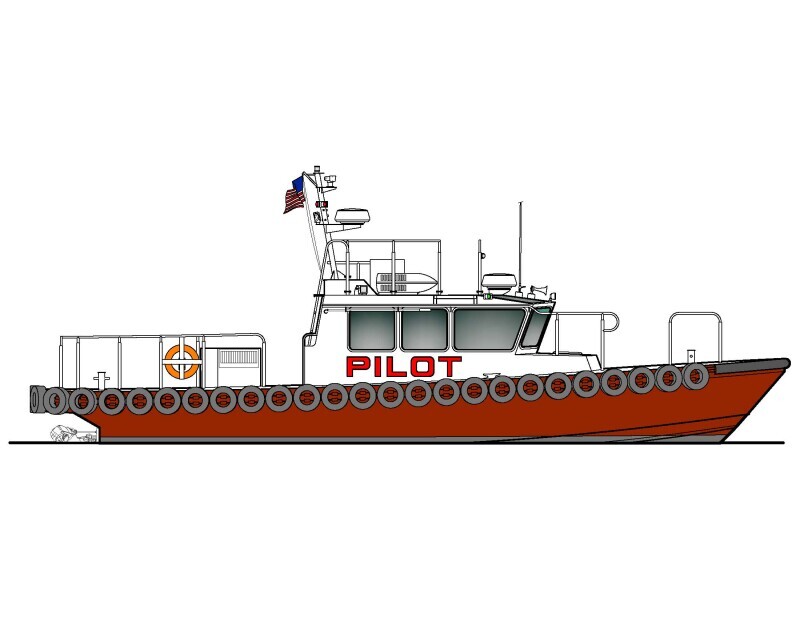
The Staten Island, N.Y.-based Sandy Hook Pilots Association is adding a new purpose-built pilot boat to its fleet with the delivery of the Scotland, a 36'6" aluminum monohull under construction at Snow & Co., Seattle, for delivery in October.
Designed by Thrushworks LLC, Bellevue, Wash., the vessel will expand the association’s operational capabilities by serving a specialized role inside New York Harbor.
“We have four 56-foot pilot launches, and then we have one 75-foot shuttle boat that we use to run pilots from our office out to sea,” association president James Mahlmann told WorkBoat.
Unlike those vessels, the Scotland will primarily operate within the harbor, transporting pilots to anchored ships, terminals and other stationary locations.
“This is an additional asset which will…primarily run around inside the harbor,” Mahlmann said. “It can put pilots on stationary vessels in the anchorage or at terminals.”
While the boat can transfer pilots to vessels underway, Mahlmann said that will not be its primary mission.
Powered by twin 476-hp Caterpillar C9.3 diesel engines driving Hamilton HJ322 waterjets through ZF 305-3 marine gears, the vessel is expected to reach approximately 28 knots. It will carry two crew members and up to four pilots.
The Scotland also marks another step in the association’s transition to waterjet propulsion. The pilots took delivery of their first jet-powered boat last year when they acquired the former pilot boat Georgia, originally built by Kvichak Marine, Seattle, and completed a comprehensive overhaul.
“This is our second jet boat,” Mahlmann said. “The only equipment that’s new to us on this boat will be the Humphrees.”
The vessel will be fitted with Humphree X450 interceptors for trim control, along with Hamilton Jet auxiliary express steering, Furuno NavNet electronics, a 6-kW Northern Lights generator, and a Webasto hydronic deck-heating system. Built of 5086 aluminum, the boat measures 36'6"x12'9" with a 2'4" draft, and 228-gal. fuel capacity.
GULF
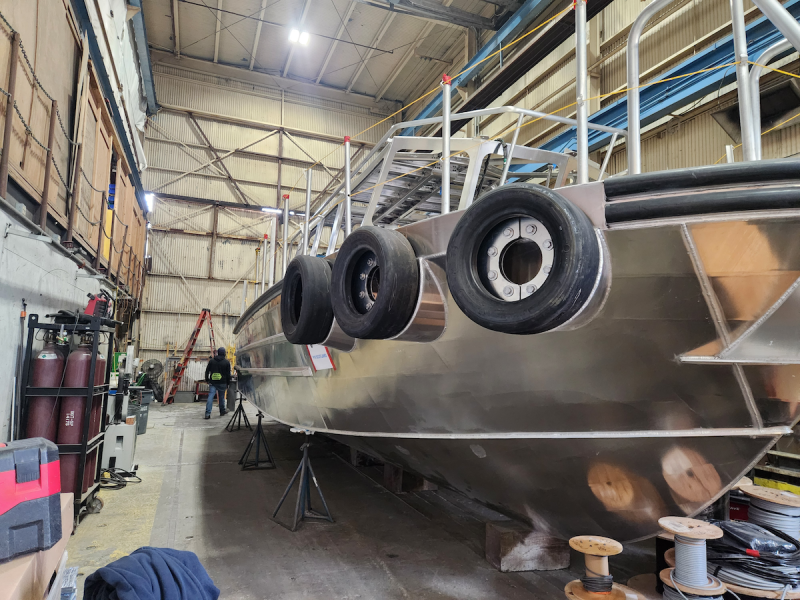
Gladding-Hearn Shipbuilding, Somerset, Mass., is building two 44'3" aluminum pilot boats for Delta Launch Services to move pilots and personnel along the lower Mississippi River rather than conduct offshore transfers.
Designed by Ray Hunt Design, New Bedford, Mass., the Venice-class boats represent a departure from the larger offshore pilot boats Gladding-Hearn has previously delivered to the Louisiana operator. Instead of serving ships in the Gulf of Mexico, the new vessels will shuttle pilots between Delta Launch Services’ base in Venice, La., and Pilot Town, about 15 miles downriver.
Gladding-Hearn president Peter Duclos said the operational shift stems from changes made after Hurricane Katrina destroyed much of the infrastructure at Pilot Town and moved the primary station upriver. The association has since relied on its larger 50' offshore boats to transport pilots between Venice and the pilot-transfer point near the river’s mouth.
“They came to the conclusion, ‘Why don’t we just build a smaller, faster, more efficient boat that we can run up and down the river and move pilots back and forth?’” Duclos said. “That’s what these boats are all about.”
Each boat measures 44'3"x13'10"x5'5" and draws 2'8", allowing them to operate in shallow water. Twin 476-hp Caterpillar C9.3 diesels, coupled to Twin Disc MG-5082SC gears and Hamilton HTX30 waterjets, will provide a top speed of approximately 35 knots. Each boat will carry one crew member and up to six pilots and have a 6'x6' aft cargo deck.
Duclos said debris and vessel wakes influenced nearly every aspect of the design.
“There's a lot of debris in the river, especially after a high water,” he said. “You get trees floating down the river, and it's a rough place.”
Unlike offshore boats that contend primarily with ocean swells, Mississippi River boats operate amid wakes generated by deep-draft ships and high-speed crew boats.
“There’s just no speed limits down there,” Duclos said. “You get ships ripping up and down the channel there, throwing huge wakes. It’s like a big washing machine.”
The shallow draft and waterjet propulsion are suited to those conditions. Heavy stern fendering also allows the boats to back into their slips so their bows can ride incoming wakes.
“The transom is heavily fendered,” Duclos said. “That’s kind of a unique thing for them down there.”
Geography also influences vessel size, accommodations and machinery selection. Duclos said remote pilot groups need reliable service partners and common spare parts.
“Pilot groups, in many cases, are as far away from civilization as you can get,” he said.
“That drives the equipment decision because they have to have good partners that are going to service their equipment, and they want commonality of spares.”
Construction on both vessels is underway, with the hulls currently being framed. The boats are about two months apart in production, and deliveries are expected during the first quarter of 2027.
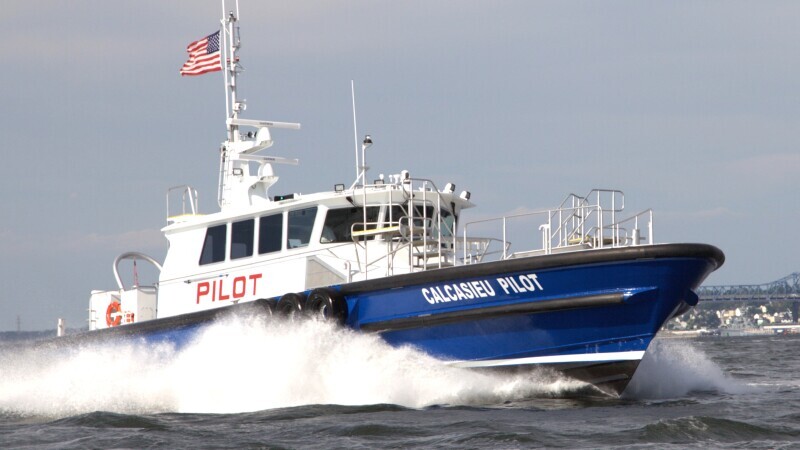
In June, Gladding-Hearn delivered the 73'x23.3' Calcasieu Pilot to the Lake Charles (La.) Pilot Association Also designed by Ray Hunt, the vessel is outfitted with twin 1,300-hp Cummins QSK38-M1 Tier 4 diesel engines, providing a loaded speed of more than 27 knots.
ALASKA
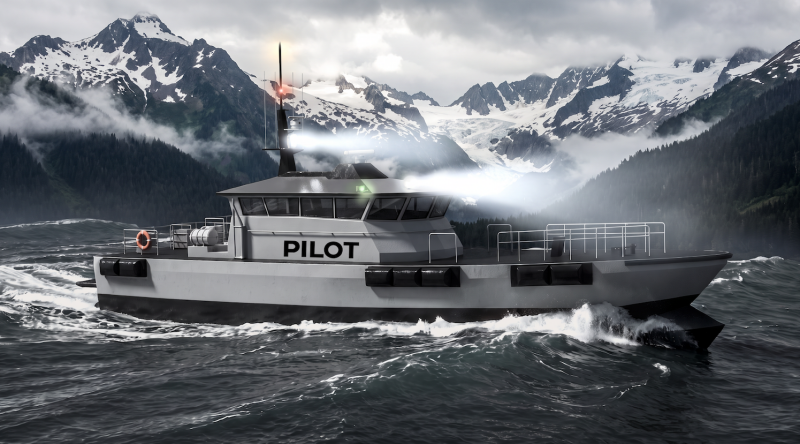
Southwest Alaska Pilots is adding a 90.5'x26.75' aluminum pilot boat designed for longer runs and year-round operations in Prince William Sound as changing tanker traffic could require pilots and crews to travel farther from Valdez.
Bay Weld Boats Inc., Homer, Alaska, is building the boat for Middle Rock Inc. The vessel was designed in-house and will be powered by four 800-hp Cummins QSK19-M diesels driving HamiltonJet HTX42 waterjets through ZF 665 gears.
The 3,200-hp boat will have a 30-knot cruise speed and maximum speed of 31 to 33 knots, depending on fuel load.
Brad Conley, Bay Weld general manager, said the vessel’s design reflects the demanding operating conditions of Prince William Sound, “which challenges our team to innovate at every stage of design and construction.”
Conley also noted the significance of building the boat in Alaska for an Alaskan operator, supporting local jobs and businesses. The project marks Bay Weld’s entry into the pilot boat market, expanding a portfolio that includes patrol, commercial fishing, passenger and private vessels.
For Middle Rock President Capt. Ron Ward, partner at Southwest Alaska Pilots Association, the newbuild represents another step in an evolution that has seen the pilots’ operation move from relatively short transfers near Valdez to increasingly long runs into Prince William Sound.
When oil shipments from the Trans-Alaska Pipeline System were at their peak, pilots operated from a station boat at Rocky Point, outside Valdez. That changed following the Exxon Valdez grounding in 1989 and subsequent regulatory changes that pushed pilot boarding farther into Prince William Sound.
As oil production declined, Southwest Alaska Pilots eventually eliminated the station boat and shifted its operation back to Valdez, increasing the distance its pilot boats had to travel.
The association currently operates a 76' Gladding-Hearn-built pilot boat, Emerald Island, delivered in 2018, and a 50' Kvichak-built boat. The smaller vessel works well during the summer, Ward said, but winter conditions in Prince William Sound require a larger platform.
Anticipated increases in North Slope oil production could change the operation again, potentially bringing more foreign-flag tankers to Valdez. U.S.-flag tanker captains can hold pilotage that allows them to take their vessels to anchorage without a Southwest Alaska pilot aboard. Foreign-flag vessels create a different operational requirement.
“The foreign ships can't do that, so that means we're going, instead of 27 miles one way, we go 27 miles to get on, but then the boat's got to go another 14 over there to get us off, and then run all the way back,” Ward said.
Those longer runs helped drive the decision to add another large boat.
“We needed another big boat, because we’ve only got the Emerald Island,” Ward said. “I mean, the 50-footer’s great in the summer, but in the winter, it can get very sloppy out there.”
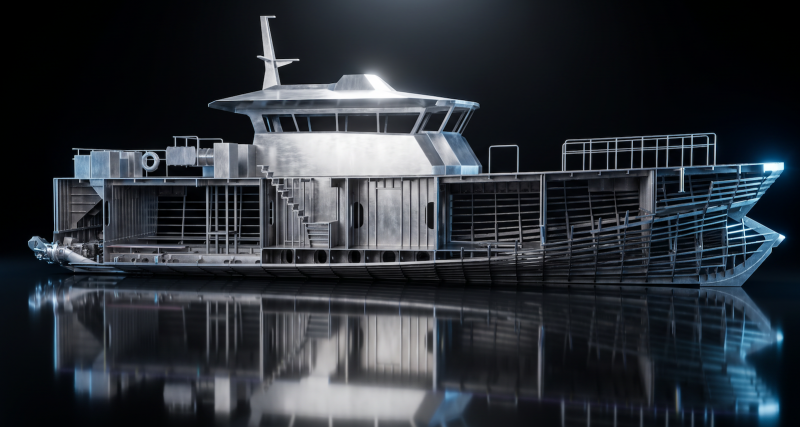
Ward said the new boat’s dimensions were driven in part by the decision to install four engines.
“The reason is, we need the length-to-breadth ratio because of the width required to have four engines, and the only way to get Tier 3 is to go with four engines of under 800 horse,” Ward said.
“The maneuverability, the longevity, the maintenance and repair — we’re big fans of the jets now for this operation,” he said.
Two Kohler 32EKOZD 32-kW generators will provide electrical power. The vessel will carry 4,000 gals. of diesel in four 1,000-gal. tanks.
A Seakeeper 40 gyro stabilizer, one of the most significant additions from the pilots’ existing boats, was selected for the changing operating profile.
“It was a very expensive option, and if you look at Prince William Sound, we’re running either with it or against it most of the time,” Ward said.
“But in this case, it’s going to be different because we’re going to be running east-west over to Knowles Head to the anchorage, and then we’re going to have to try to maneuver alongside a vessel that’s stopped, which is completely different than boarding and disembarking underway.”
That distinction is important during pilot transfers. With a U.S.-flag vessel, Ward said pilots can effectively communicate with the captain to use the ship’s propulsion to swing the vessel, creating a lead and better conditions for the transfer. Ward said the operators can’t rely on having the same ability in every foreign-flag transfer.
“So we decided, all right, we'll do the Seakeeper. We’ll go big. We’ll make sure it’s got the power,” Ward said.
The Seakeeper will be complemented by a Humphree HA-Series interceptor trim system.
Year-round operation from Valdez also requires systems designed for Alaska winters. The boat will have heated windows, exterior decks and handrails, along with cabin heating.
“It snows 600 inches in a year in Valdez,” Ward said. “I can’t have my guys that are making runs all hours of the day and night shoveling snow half of their life. We need heated decks.”
The vessel will feature Norsap shock-mitigating seats, twin-element searchlights, two hydraulic man-overboard recovery davits, a Fireboy fixed fire-suppression system, high-flow emergency bilge/fire pump and a custom pilot-transfer fender system.
The electronics package includes a full Furuno suite, Class A AIS, sounder and autopilot, along with three Icom M510 EVO VHF radios.
For Ward, who has been involved with three generations of Southwest Alaska Pilots newbuilds, the Bay Weld project comes as the operation prepares for another potential shift in Prince William Sound tanker traffic.
“It’s a big boat, but it’s coming at the right time,” Ward said.
