



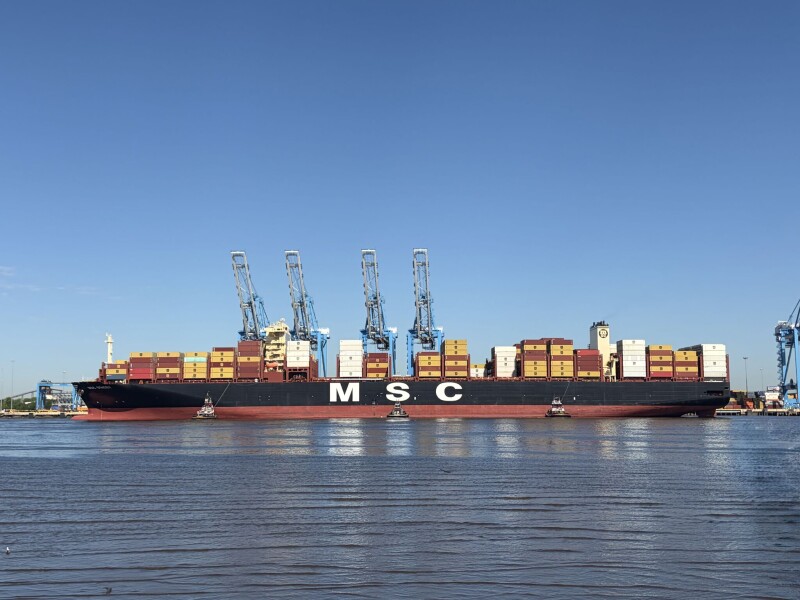
The Port of Philadelphia (PhilaPort) is planning an $837 million expansion, the largest in its history, backed by $371.5 million in state capital funding that officials say will unlock $466 million in additional private and federal investment.
Gov. Josh Shapiro and Pennsylvania Department of Transportation Secretary Mike Carroll announced the funding Tuesday at the port. Over $200 million of the additional money would come from the private sector and $266 million from the federal government. PhilaPort will use the state funding to leverage two U.S. Department of Transportation grants, officials said.
The project would increase container capacity across PhilaPort’s facilities by 122% and auto capacity by 18%, the governor’s office said. State officials project it will create more than 6,000 jobs and generate $45 million in state and local taxes.
The centerpiece is a new 2,000' berth at Southport Marine Terminal, the first built there in 50 years. The port will also buy the 152-acre Mustin Yard parcel for auto and container cargo.
The state’s capital funding includes $31 million for dredging at Southport Berth I, $145 million for reclamation work at Southport Berth II and the North Wharf, $109.4 million for land acquisition, and $58.1 million for cranes and equipment.
PhilaPort will also acquire and develop more properties in its Southern Port District to add container capacity. Separately, it will improve the Tioga Marine Terminal berth to better handle liquid bulk barges and breakbulk vessels.
PhilaPort has been named the country’s most productive container port three years in a row. In 2025, it supported more than 8,000 jobs and contributed nearly $1.2 billion in economic output statewide, according to the governor’s office.
Shapiro described the funding as a historic commitment that builds on the port’s long role in trade and his administration’s economic agenda.
“PhilaPort has a long and storied history that spans back over 300 years to the very founding of our Commonwealth,” Shapiro said. “It was here where goods produced in Philadelphia embarked for destinations around the globe, and today, the port remains a major player in global trade and a critical piece of our economy. My administration is making a historic investment in PhilaPort to support the largest expansion in its history, allowing the port to significantly expand its capacity and create more than 6,000 jobs. This is a game changer for PhilaPort, and it builds on our work to grow the economy and create real opportunity for Pennsylvanians.”
PhilaPort CEO and Executive Director Rich Lazer said the funding would let the port grow its business and create lasting jobs.
“Governor Shapiro’s continued investment in PhilaPort will help us expand operations, attract new business, and increase market share — while creating thousands of family-sustaining jobs over the long haul,” Lazer said. “With this historical investment in our infrastructure, combined with our skilled union workforce, and room to expand, our future has never been brighter.”
Mike Pearson, the port’s board chair, said the money would fund the infrastructure called for in PhilaPort’s long-range plan.
“The Governor’s investments will help PhilaPort implement our Destination 2040 Strategic Plan — with strong capital investments for new port infrastructure,” Pearson said. “Today, Governor Shapiro is making that happen.”
Scott Cornell, CEO of Glovis America, the U.S. arm of South Korea’s Hyundai Glovis, said the expansion gives the vehicle carrier the terminal capacity it needs to meet customer demand and shows what the port can become.
“As the world’s largest ocean carrier of finished vehicles, we needed to match with best-in-class terminal capacity, and most importantly, we needed to match the customer demand,” Cornell said. “Today’s announcement shows what we believe PhilaPort can become, and what we can achieve together as we build it into a premier ocean terminal.”
Leo Holt, president of Holt Logistics, said the project would provide work for years and leave behind lasting infrastructure.
“This is a job multiplier that will go on for the better part of a decade and the machines, roadways, and buildings that will be assembled will last for generations,” Holt said. “And it isn’t magic. It’s people coming together to get the job done — quickly, efficiently, safely, and ready to go for the next generation.”
Labor leaders also welcomed the announcement. Bill Hamilton, Eastern Region vice president of the International Brotherhood of Teamsters, said the project would bring thousands of jobs, including for workers without a college degree.
“The unions in this town don’t fight against each other; we fight for each other,” Hamilton said. “This important investment is going to bring thousands of jobs across the area, and it’s a dream come true for some people without a college degree.”
Dan Duffy, a member of International Longshoremen’s Association Local 1291, said the investment would preserve the waterfront’s role as a source of work for local families.
“This waterfront has supported generations of Philadelphia families, and this investment and continued support will help make sure it continues to provide those same opportunities to our children and grandchildren,” Duffy said. “We’re proud of what we do, and we’re ready for what’s next.”
State Rep. Ed Neilson, majority chairman of the House Transportation Committee, said the expansion would help keep Pennsylvania competitive.
“Maintaining our facilities, expanding capacity, and building two of the first new berths in more than 50 years will help keep Pennsylvania competitive, support good-paying jobs, and move more goods through our port,” Neilson said.
State officials said Pennsylvania has invested more than $600 million in PhilaPort’s growth over the past 10 years. Among recent state-backed projects, PennDOT provided about $10 million for construction that began in January to ease congestion at the intersection outside the Packer Avenue Marine Terminal. The Department of General Services has provided $11 million over two years for annual maintenance dredging.
PennDOT also extended the Pennsylvania Intermodal Cargo Growth Incentive Program through July 2027. The state has awarded $1.3 million in incentives to cargo carriers under the program, resulting in 1.8 million units of cargo moving through Pennsylvania ports.
