



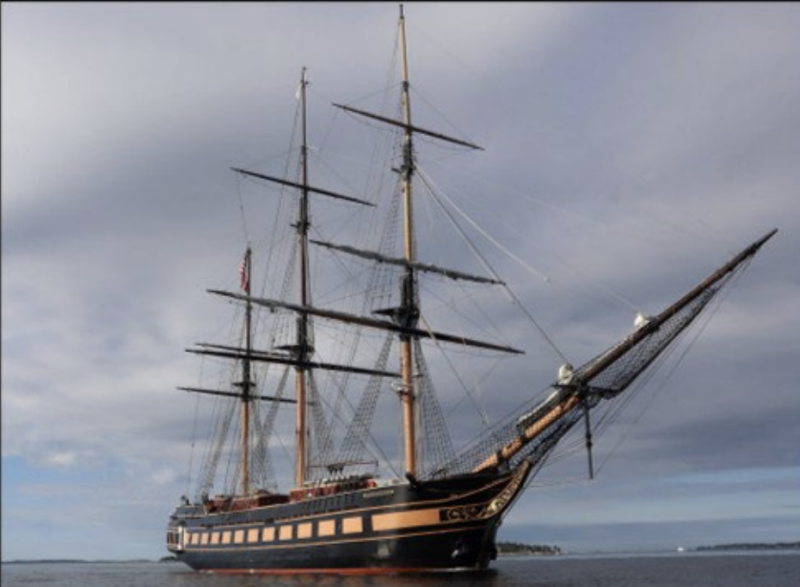
A 128’ square-rigged sailing school vessel flooded at its berth in Newport, R.I., after a seawater cooling supply pipe for a diesel generator failed due to corrosion, according to a report by the National Transportation Safety Board on the May 11, 2025 incident.
The steel-hulled Oliver Hazard Perry, launched in 2015, was docked at its summer berth at Fort Adams State Park with the bosun aboard and the port generator running, according to a report issued April 9 by the NTSB.
New shore power breakers had recently been installed on the pier, and the crew had been troubleshooting the vessel’s electrical system due to the shore breakers tripping. The vessel’s generator was running, cooled by seawater, and supplying electrical power to the vessel.
Around 9 p.m., the bosun received a freshwater tank level sensor alarm. Responding to the alarm, he conducted a visual inspection of the engine room, “found everything in good order, so he retired for the evening to his stateroom,” according to a narrative by NTSB investigators.
At 7:35 a.m. the bosun “awakened to a faint audible ‘AC [alternating current] power fault alarm’ coming from the fire alarm panel in the ship’s office.”
In their conclusions, investigators noted that “the lack of a bilge alarm annunciator in the accommodation spaces to alert onboard crewmembers to the flooding and a watertight bulkhead and watertight door that did not prevent progressive flooding” contributed to incident.
At that point electrical power was out throughout the vessel. In the darkness, the bosun went to the engine room and discovered seawater covering the base of the port generator., mounted on a raised platform about 3’ above the deck plates and 5’ feet above the sea chest that fed the seawater cooling system.
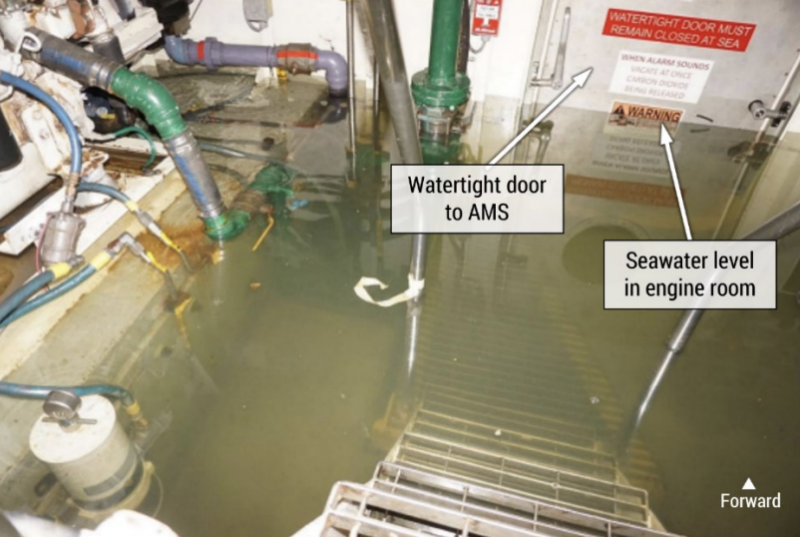
The bosun called the captain, notified the park manager who in turn called the local fire department. With the vessel power out bilge pumps could not be used to dewater the flooding spaces.
Around 2:30 p.m. a salvage team arrived and at 5:15 p.m. began removing water from the auxiliary machine space using a vacuum truck on the pier. After more holding tanks arrived overnight pumping was completed and the vessel dewatered by noon May 12. The bosun told investigators that about 21,000 gallons of water had been removed from the vessel into tank trucks for disposal.
During the dewatering process on May 11 and on May 15, a marine surveyor inspected the engine spaces where flooding in reached a few inches above the tops of the main engines and covered the reduction gear sets.
“Both electrical generators and the emergency generator were partially submerged,” the NTSB report notes. “Several batteries, chargers, wires, and switches in the engine room were submerged. The seawater supply pump, air compressors, and fuel/water separator were damaged by flooding. The flooding in the AMS submerged in seawater and damaged several pumps for the water maker system, HVAC system, firefighting system, and marine sanitary device.” Damage was estimated around $1 million.
The marine surveyor determined the cause of the flooding was due to a failed seawater cooling supply pipe for the portside generator, where the threaded portion of the 2” steel pipe was corroded at the connection point with the bronze strainer.
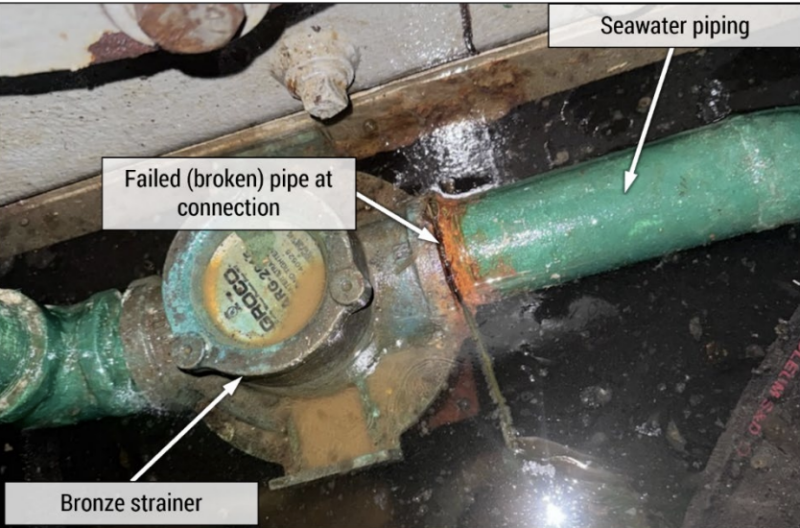
“According to the bosun, a ship’s engineer had replaced a pipe nipple and shutoff valve on the starboard-side generator seawater supply piping about a year before the casualty,” the report states. “Since then, the Oliver Hazard Perry had not had a dedicated engineer aboard the vessel. Investigators observed that the removed shutoff valve from the starboard generator showed similar corrosion to the failed port generator piping.”
The NTSBU summarized its findings as “a failed seawater cooling supply pipe for a diesel engine–driven generator due to corrosion. Contributing to the extent of the damage was the lack of a bilge alarm annunciator in the accommodation spaces to alert onboard crewmembers to the flooding and a watertight bulkhead and watertight door that did not prevent progressive flooding.”
In its customary “lessons learned” postscript, the board recommends:
“Alarm or other notification systems should be configured such that crewmembers, even in accommodation spaces, are notified immediately in case of flooding or other emergency.”
