
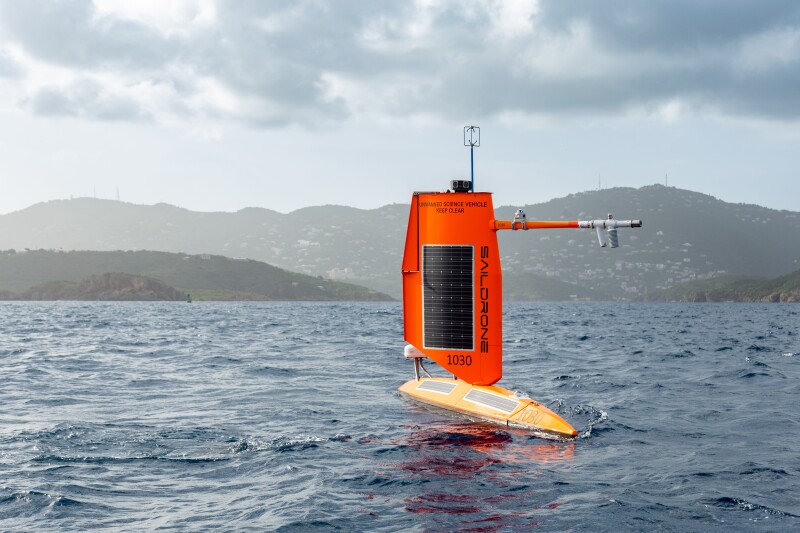
Saildrone says it will deploy 10 of its Explorer unmanned surface vehicles (USVs) during the 2026 hurricane season to support the National Oceanic and Atmospheric Administration’s forecasting and warnings missions.
The 23’ Explorers will be positioned in the western tropical/subtropical Atlantic Ocean, Caribbean Sea, and Gulf of Mexico from July through November. “As tropical cyclones develop, Saildrone mission operators will coordinate with NOAA to position the USVs in and around storms,” company officials said in a May 21 statement.
NOAA and Saildrone began collaborating in 2021. NOAA scientists define the operational objectives and provide mission tasking as tropical storms develop. Saildrone operators based at Alameda, Calif., will command and navigate the USVs to deliver in-situ oceanographic and meteorological data in real time.
With data transmitted by Saildrone, NOAA scientists at the Atlantic Oceanographic & Meteorological Laboratory (AOML) and the Pacific Marine Environmental Laboratory (PMEL) will study how exchanges of heat, moisture, and momentum between the ocean and the atmosphere influence storm intensity.
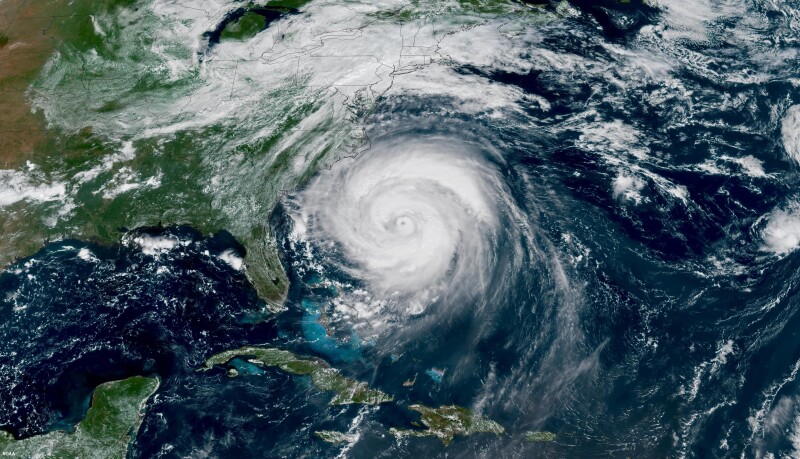
“Rapid intensification,” defined as an increase in a hurricane’s maximum sustained winds of at least 30 knots (35 mph) in 24 hours, is a subject of extreme interest among forecasters and emergency managers in recent years. Intensification is one of the most difficult hurricane behaviors to predict, and sudden increases in wind speed and storm motion just before landfalls along the U.S. Gulf coast can dramatically boost dangers to life and property.
“This multi-year mission between NOAA and Saildrone is helping to improve our understanding of how hurricanes intensify, including when they strengthen rapidly before landfall,” said Greg Foltz, an oceanographer at NOAA and one of the principal investigators on the mission. “Each storm we observe gives us more data to evaluate and improve prediction models, which is critical for increasing forecast confidence, extending warning lead times, and strengthening the nation’s preparedness for high-impact weather events.”
Each Saildrone Explorer will be equipped with a suite of meteorological and oceanographic (metocean) sensors to measure wind speed and direction, air, surface, and sub-surface temperature, relative humidity, barometric pressure, salinity, and wave height and period. Additionally, two USVs will carry NOAA ASVCO2 sensors to measure carbon dioxide exchange between the ocean and the atmosphere. These observations will support NOAA’s hurricane research and modeling efforts.
“The NOAA hurricane mission is one of Saildrone’s longest-running and most successful partnerships, and also one of the most technically demanding,” said Matt Womble, vice president of government relations at Saildrone. “This mission reinforces the value of mature, long-duration uncrewed systems for operating in environments where persistent data collection is otherwise impossible by traditional means.”
“Better hurricane data supports better forecasts, and better forecasts strengthen national resilience – protecting lives, infrastructure, commerce, and critical operations. Saildrone is tremendously proud to continue this work with NOAA.”
According to NOAA’s National Centers for Environmental Information (NCEI), between 1980 and 2004, tropical cyclones accounted for 52.9% of all billion-dollar disasters in the United States—more than wildfires, drought, flooding, freeze, severe storms, and winter storms combined. The estimated total damages (CPI-adjusted) from tropical cyclones over that time period exceed $1.5 trillion.
Recent storms, including hurricanes Idalia in 2023, Ian in 2022, and Harvey in 2017, have rapidly intensified just before landfall, underscoring the need for better observations in the ocean regions where storms gain strength. NOAA aims to improve weather forecasting models, ensuring that state and local officials, and by extension the general public, receive longer lead times to prepare and evacuate accordingly.
Saildrone’s support for NOAA hurricane research has grown steadily from five USVs in 2021, seven in 2022, and 12 in both 2023 and 2024. “To date, 21 different USVs have been used in these missions,” according to the company. “Since 2021, Saildrone has intercepted 21 named hurricanes and tropical storms on 46 occasions.”
The Explorer vehicles used for the hurricane monitoring mission are equipped with a shorter, ruggedized “hurricane” wing, designed for extreme wind and sea state conditions inside a tropical cyclone.
In addition to the 2026 hurricane mission, Saildrone will operate more than 75 USVs globally this year, supporting national and homeland security, ocean mapping, and research.