



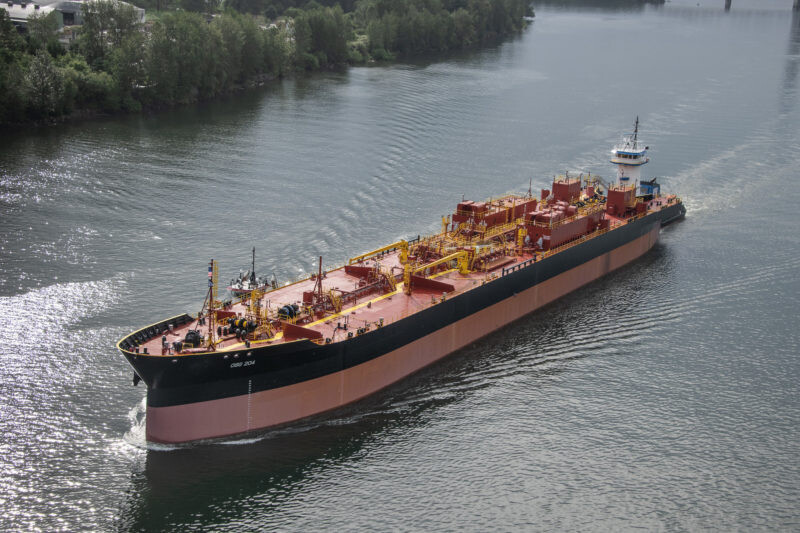
The American Maritime Podcast recently released an episode featuring Overseas Shipholding Group CEO Sam Norton in conversation with Jennifer Carpenter, president and CEO of the American Waterways Operators, covering the Jones Act tanker market, U.S.-flag fleet growth and emerging energy opportunities.
Norton, whose company is now part of the Saltchuk family of companies, spoke to how Jones Act tankers support domestic energy distribution, sustain a skilled U.S. mariner workforce and provide assets and personnel that support national defense needs.
“I often say I really have no qualifications for the job that I do,” Norton said. Norton entered shipping through finance, starting at the First National Bank of Boston, where maritime lending introduced him to the industry. He later joined an oil tanker company based in Hong Kong that moved to Singapore, where he lived for 15 years. After returning to the U.S. in 2004, Norton said he launched a regional container shipping company in 2006, then joined OSG’s board in 2014. He became CEO at the end of 2016 after OSG’s international business was spun off into International Seaways.
What was presented as a short-term assignment, “maybe a year or two,” turned into “a 10-year gig,” Norton said.
Why Jones Act tankers matter
Norton framed the Jones Act tanker fleet’s value in three buckets: moving energy cargoes between U.S. ports, sustaining a pool of skilled mariners, and supporting defense logistics.
On the domestic energy side, he said Jones Act tankers are critical to moving refined products along the coasts and crude from Alaska. On the West Coast, Norton pointed to refinery centers in Puget Sound, San Francisco Bay, and Los Angeles/Long Beach supplying markets up and down the coast, as well as Alaska crude moving to West Coast refineries.
In the Gulf, Norton described the core Jones Act energy trade as moving refined products from refining centers in Texas, Louisiana and Mississippi to consuming regions, including Florida, which he noted is not connected to those refining centers by pipeline.
“Florida is a country,” Norton said. “It’s nearly 23 million people. It consumes about 750,000 barrels of refined petroleum product every day.” Much of the gasoline and jet fuel used in the state, he said, reaches Florida by sea on Jones Act tonnage.
Beyond cargo movement, Norton said those vessels provide platforms for careers that require time and expertise to develop, from navigation to cargo operations and engineering. “The most critical resource for our country is the human resources,” he said, arguing that once specialized skills disappear, they are difficult to rebuild.
He also tied the domestic fleet and workforce to national defense needs, pointing to the Maritime Security Program and the Tanker Security Program as sources of militarily useful commercial vessels and trained mariners that can support logistics in a conflict.
Responding to Jones Act critiques
Carpenter asked how Norton responds to arguments that foreign-flag ships should be allowed to carry cargo between U.S. ports.
Norton said removing Jones Act protections would cause U.S. jobs and skills to disappear, forcing the U.S. to depend on foreign labor and shipping capacity. He compared the cost of maintaining a domestic maritime capability to funding a fire department: taxpayers accept the cost of keeping trained responders close at hand rather than relying on ad hoc help.
He also argued that the per-consumer cost is small. Norton said studies have found the Jones Act portion of gasoline prices is less than one cent per gallon, “a lot less than your credit card fee to swipe at the pump,” Carpenter added.
New England winter waivers
The episode also addressed recurring calls for Jones Act waivers during cold snaps in New England to move gas from the Gulf Coast to the Northeast.
Norton said New England’s winter constraints stem from limited pipeline capacity and competition for natural gas between home heating and power generation during peak cold periods. Historically, he said LNG storage capacity in Boston helped buffer those peaks, but changes in regional infrastructure and utilization have complicated that role.
Norton disputed claims that waiving the Jones Act would significantly lower LNG costs in New England. He said LNG imports supplying the region today often come from Trinidad and Tobago, and the sailing distance to Boston is roughly comparable to the distance from the mouth of the Mississippi River to Boston. In his view, the policy debate is frequently used as a proxy for broader arguments against the Jones Act, while the underlying issues are infrastructure and energy policy choices.
He said the region’s longer-term solutions involve expanding pipeline capacity and/or building reliable alternative energy resources and storage, which are decisions made harder by uncertainty around future demand for natural gas.
Carbon capture and liquefied CO₂ transport
Carpenter also asked about new markets for Jones Act operators, including OSG’s work related to carbon capture.
Norton said OSG sees Jones Act opportunities extending beyond fossil fuels to any liquid bulk cargo that needs coastal transportation, including liquefied CO₂. He pointed to early activity in Europe and said he expects a U.S. liquefied CO₂ transport market to develop.
Norton said Florida’s geology creates a specific challenge: power plants primarily burn natural gas, producing CO₂ emissions, but the state’s porous reef geology is not well suited for local underground storage. That, he said, turns carbon capture into a transportation problem.
OSG is developing a concept to build a liquefaction hub in Tampa and move captured CO₂ on specially designed ATBs to discharge points in Texas or Louisiana, where existing CO₂ pipeline systems could route it to enhanced oil recovery or long-term geological storage. Norton said OSG has received Department of Energy grant funding tied to early development work and described an initial target of 2 million tons per year, against what he characterized as roughly 25 million tons per year of emissions from power generation facilities within 45 miles of Tampa.
Growing the U.S.-flag international fleet
On international shipping, Norton said the near-term path to increasing the U.S.-flag fleet involves cargo and programs that create economically viable demand.
He highlighted the Tanker Security Program, which currently includes 10 ships and has congressional authorization to expand to 20. Norton said growth will require additional cargo, and he described advocacy efforts for the Defense Logistics Agency to commit a percentage of Department of Defense fuel cargoes to U.S.-sourced product carried on U.S.-flag vessels. Regular movements, he said, would help “practice like you’re going to play” by establishing repeatable supply chains and signaling readiness to potential adversaries.
Norton also discussed other cargo-preference concepts, including possible movements of Venezuelan crude to U.S. refineries, refined product imports into the West Coast as California refinery capacity declines, and the growth of U.S. LNG exports. He said planned export volumes could require an additional 80 to 100 LNG carriers by the end of the decade, creating another avenue for U.S.-flag participation if a portion of exports were structured to support U.S.-flag operations.
Paying for mariner pipelines
Norton said fleet growth depends on expanding the mariner pool, and he focused on the cost of training licensed officers.
While the U.S. Merchant Marine Academy at Kings Point is federally funded, Norton said state maritime academies are the primary pipeline for new officers and can cost more than $200,000 for a four-year degree. He said that sticker price can stop prospective mariners despite strong starting wages.
Norton said OSG provides financial support to students and works with the Seafarers International Union on training and cadet opportunities. He also argued for broader government-and-industry programs that tie financial support to service, similar in concept to other public service pathways.
“We invest in steel and engines and facilities,” Norton said. “We need to invest in human resources that are going to be necessary to be able to run our business.”
Nuclear propulsion on the horizon
In closing, Norton said he was in Washington that week for discussions about commercial marine applications of nuclear power. He described a future where International Maritime Organization regulations make it increasingly costly to operate with conventional fuels, driving interest in alternatives such as ammonia, methanol, hydrogen and LNG.
Norton argued nuclear, particularly small modular reactors, could become a viable long-term zero-carbon propulsion option, pointing to decades of U.S. naval experience and the historical example of the nuclear-powered merchant ship Savannah. He said major hurdles remain, including updating regulatory regimes, proving new technologies at scale, and training mariners to operate in nuclear environments, but called the work “a real possibility” and “super exciting.”
