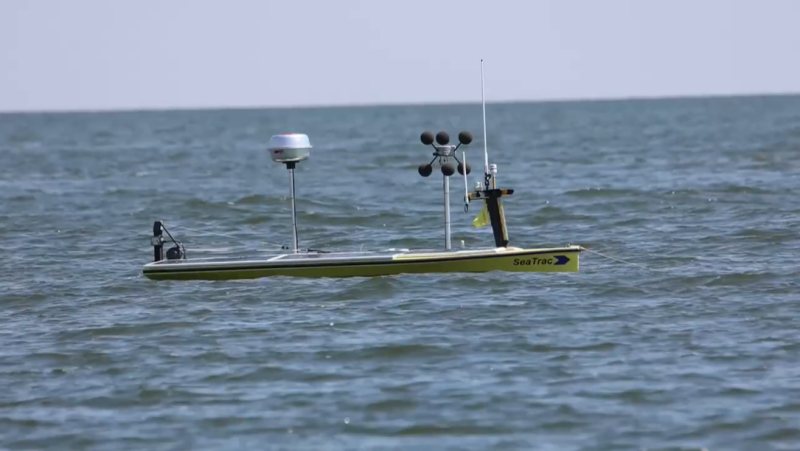
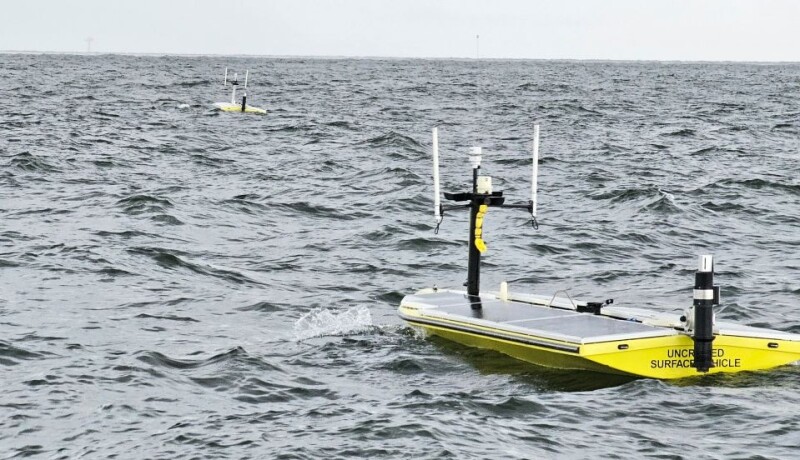
SeaTrac Systems, Marblehead, Mass., and the University of Southern Mississippi completed a second phase of a remotely commanded offshore monitoring mission in the Gulf of Mexico to demonstrate “scalable, multi-vehicle hypoxia mapping with minimal manpower.”
Using a remotely operated SeaTrac SP-48 uncrewed surface vehicle (USV), researchers collected real-time data, transmitting it from sensors over cellular and satellite connections, according to a summary from the group.
Hypoxia zones – also familiarly known as dead zones to fishermen and mariners – are ocean waters areas where oxygen levels in water are decreased due to nutrient pollution. Research from phase one of the mission demonstrated the USV's “ability to collect and transmit data with the accuracy of a crewed effort, thereby greatly reducing cost and increasing operational efficiencies,” according to the team.
The second phase expanded the operational scope by deploying two SP-48 USVs simultaneously, both managed by a single shore-based operator. The vehicles collected conductivity, temperature, depth (CTD) and dissolved oxygen (DO) data to map low-oxygen zones critical to fisheries and ecosystem management.
The second phase of the mission also introduced extended battery capacity, two wireless-charging AML sondes, and refined power-management strategies. This required the vehicles to be deployed from USM’s Marine Research Center harbor instead of the Louisiana Universities Marine Consortium (LUMCON) in Cocodrie, La., as was done in the first phase. The location change allowed for longer time on-station and increased spatial coverage. Both USVs maintained over-the-horizon connectivity for near-real-time data transmission and quality control.
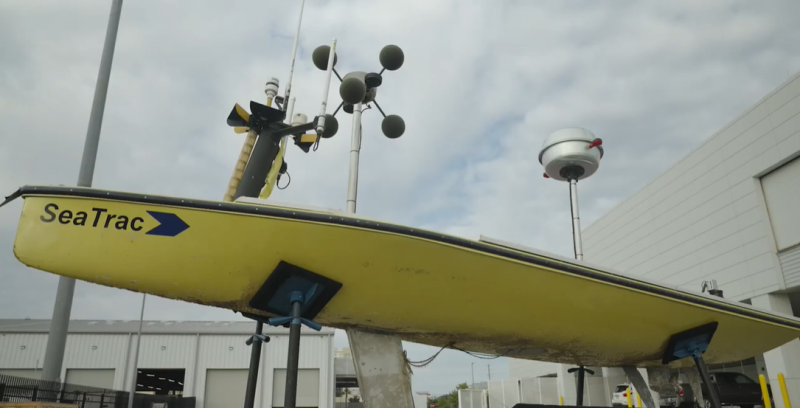
“The offshore mission yielded 123 verified hypoxia data points while operating without onboard crew, reducing fuel use, cost, and personnel exposure compared to traditional survey vessels,” according to the mission summary. “Despite a passing tropical weather system, the platforms maintained operations and safe power margins.”
“Phase two proves that USVs are fully operational tools in challenging offshore environments, particularly when multiple are used,” said Hobie Boeschenstein, director of operations at SeaTrac Systems. “Remotely commanding a fleet of USVs from a shore-based control station with a single operator demonstrates a scalable model that reduces demands on traditional vessels, with reduced fuel consumption and offshore risk – all while delivering high-quality scientific data. This represents a meaningful shift in how long-duration ocean monitoring and offshore missions can be executed.”
“From a research standpoint, the ability to collect 123 verified hypoxia data points without putting a crew offshore is significant,” said James Thompson, a University of Southern Mississippi research engineer. “The extended endurance, wireless sensor integration, and near-real-time QA/QC allowed us to adapt sampling as conditions evolved. We’re gaining higher spatial resolution data while operating more efficiently than traditional survey methods allow.”
During both phases, SeaTrac and USM "validated USVs as practical tools for sustained offshore monitoring, offering a pathway to safer, lower-cost, and higher-density ocean data collection in dynamic environments," according to the team.