



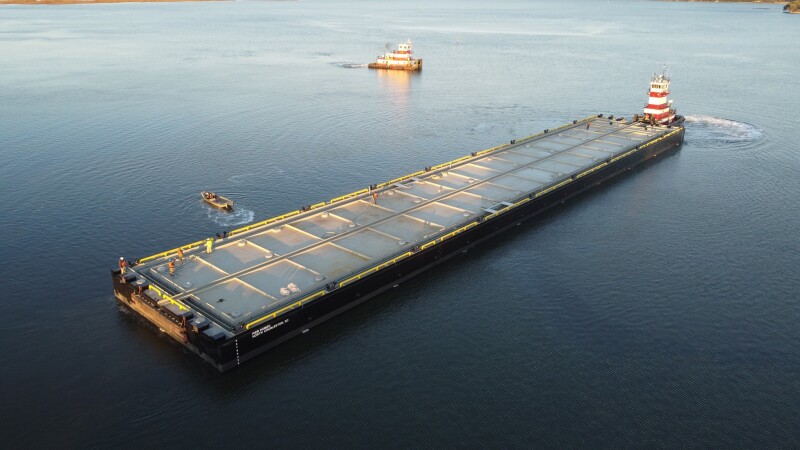
The National Oceanic and Atmospheric Association (NOAA) has completed the installation of a new floating pier and supporting shoreside infrastructure at its Charleston, S.C., facility, marking a key milestone in the agency’s ongoing investment in operational waterfront capacity.
The project included demolition of an existing pier and construction of a new 62'x360' floating pier, along with shoreside improvements such as power distribution systems, a warehouse, seawall upgrades, and related support infrastructure. The facility is designed to support vessels including NOAA ships Nancy Foster and Ronald H. Brown, as well as NOAA Corps officers and civilian mariners operating from the site.
The floating pier, Pier Romeo, was launched Dec. 30, 2025, at KEEL (formerly Metal Trades Inc.) in Meggett, S.C. The structure was reported to be level at launch, with a draft of approximately 21". Following launch, the pier was transported to a Cavier’s drydock where more than 300 cu. yds. of fiber-reinforced concrete were placed on the deck to enhance durability and structural performance.
Installation activities continued in February with the delivery and placement of key structural components. The floating pier was towed to its final location beginning Feb. 11 and positioned using marine survey equipment to within one foot of its intended alignment. Barges were used to stabilize the structure during positioning while a pair of tugs assisted with final placement.
On Feb. 12, crews installed a 490,000-lb., 30'x160' gangway, completing the lift after approximately eight hours of coordinated operations between shoreside and marine teams. A 30'x80' trestle weighing approximately 220,000 lbs. was installed Feb. 17, completing the primary structural elements of the project.
NOAA credited prime contractor Manson Construction, along with designers Corbin Collier and Weldment Design, and engineering firm COWI, for their roles in delivering the project.
The completed facility is intended to improve the safety, reliability, and operational readiness of NOAA’s Charleston-based fleet and support future mission requirements.
