



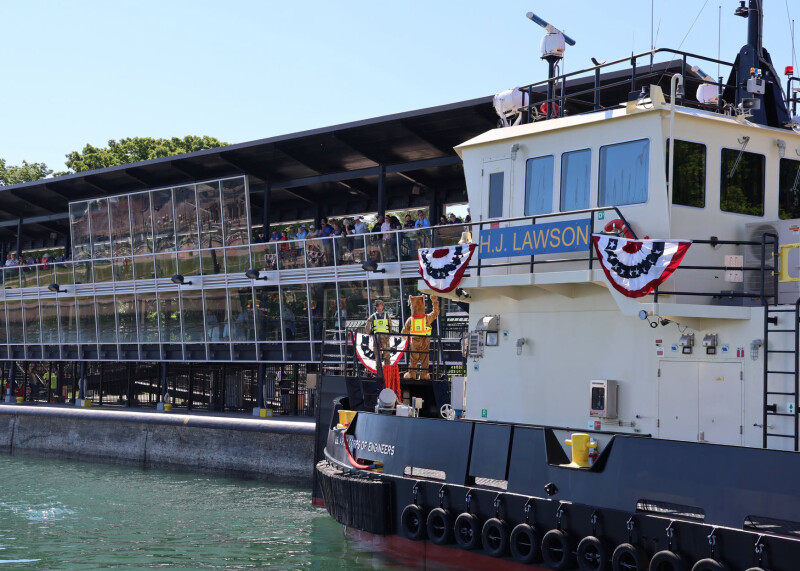
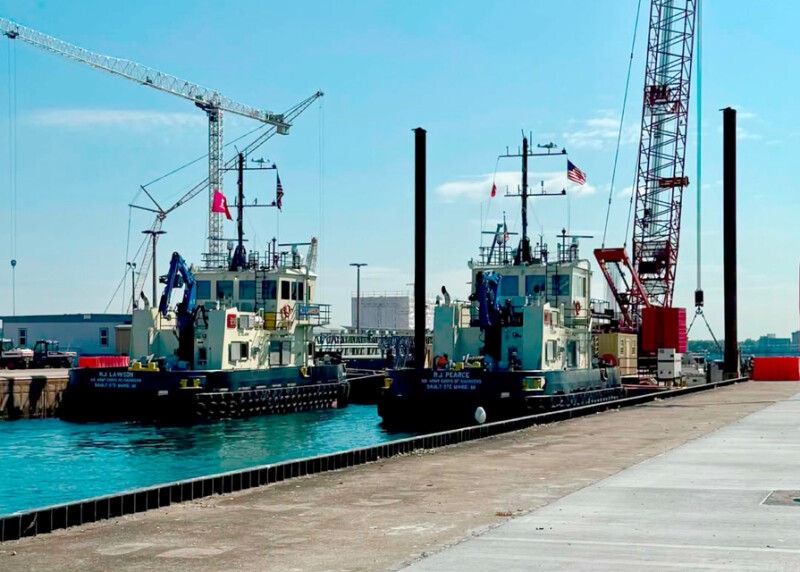
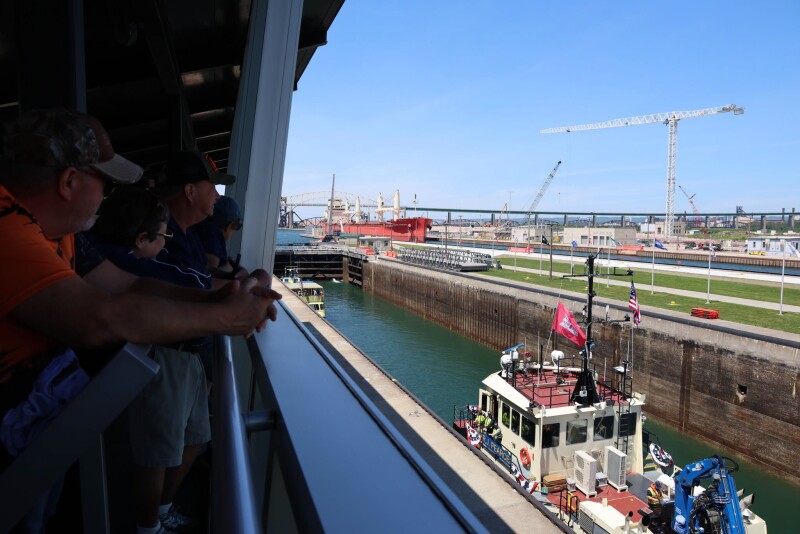
The U.S. Army Corps of Engineers’ Detroit District in May took delivery of two new icebreaking tugboats, the H.J. Lawson and the R.J. Pearce, which are now plying the St. Marys River in Michigan. The vessels’ primary responsibility is to keep the Soo Locks in Sault Ste. Marie, Mich., free of ice. They also tow barges and assist in maintenance operations.
Built at Conrad Industries’ yard in Morgan City, La., the all-steel tugs measure 76'x28'. They’re powered by twin 800-hp Caterpillar C32 diesels, and each has a Hydromaster bowthruster to improve maneuvering in close quarters, with Reintjes gearboxes supplied by Karl Senner LLC. Both boats are built to Ice Class C0 standards and are Subchapter M compliant.
The R.J. Pearce is named for Ronald Johnston Pearce, who dedicated his career to the Sault Ste. Marie maritime community. Pearce began working as a messenger at age 13, delivering mail to troops stationed at the Soo Locks. He spent his 35-year career with the Corps and retired in 2009.
Harold J. Lawson was a lifelong resident of Sault Ste. Marie who dedicated his career to the Corps. After graduating from Michigan Technological University in 1955 with a degree in civil engineering, Lawson served in the Army at Fort Belvoir, Va., and continued his service in the Army Reserves for eight years. He then worked with the Corps for more than three decades. He died in 2018.
Justin Proulx, chief of the Corps’ St. Marys River Section, generously praised the two vessels’ namesakes. “Two amazing gentlemen that really shaped the Corps of Engineers, but really more importantly right here in the Soo and the Eastern Upper Peninsula area, the gentlemen worked on Poe Lock construction, new vessel builds and you know what we really see today as a responsibility to the Corps of Engineers,” he said.
The new tugs replace one vessel that was built in 1942 and another constructed in the 1950s. “They’re [built] out of the necessity to sustain Subchapter M compliance and the evolution of our plant that services the St. Marys River and the Soo Locks,” said Proulx.
Vessels built to ABS Ice Class C0 must be able to withstand 12" of “first-year” ice. The ice that builds up in navigation channels is considered first-year ice, but the tugs also see plate ice that builds up, gets broken by waves and vessels and then refreezes.
“The requirements go beyond hull structure,” Proulx said. “They include the construction of rudders and shaft and propeller design.”
The new tugs do not break ice for commercial traffic, Proulx explained. The Coast Guard handles that. Instead, they support operation of the Soo Locks, which close for winter Jan. 15 and reopen March 25.
During downtime, the locks are dewatered, and maintenance work is performed.
The H.J. Lawson and the R.J. Pearce, which both have twin engines and bowthrusters, have a significant maneuverability advantage over the old single-screw tugs. Additionally, the new tugs have ice scrapers on their push knees. They’re needed because some vessels that enter the locks are so wide that they push the limits of the opening. If ice were to build up and a barge loaded with iron ore couldn’t enter, it would negatively impact area steel mills.
Both new tugs have a full suite of Furuno electronics, including twin solid-state X-band radars, communications and weather-monitoring equipment. “It was a challenge to get it all integrated into the pilothouse, but Conrad did a great job,” said Proulx.
The tugs are equipped with Airmar ice-rated transducers for high-fidelity depth sounding. The same transducers are used on the Coast Guard’s icebreaking cutter Mackinaw.
The new tugs are steered by joystick and a jog lever, and the bowthrusters have their own separate controller.
Typically, a crew of four is on board. Most of the time, the vessels return to port each night.
