



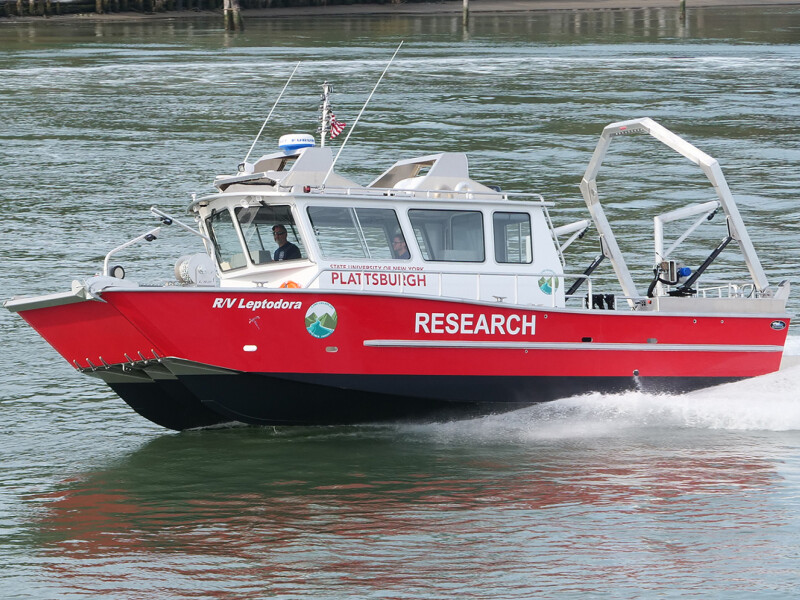
SUNY Plattsburgh’s Lake Champlain Research Institute (LCRI) in upstate New York has taken delivery of a new research vessel, the Leptodora, replacing a 30-year-old workboat and giving the institute’s research and monitoring programs a substantial capability boost.
The aluminum catamaran, built by Munson Boats, Burlington, Wash., arrived May 5 and spent the following month on the water for shakedown runs and crew training ahead of a June 9 dedication ceremony at the Valcour Inn and Boathouse in Peru, N.Y., according to Timothy Mihuc, distinguished service professor in the university’s Center for Earth and Environmental Science and LCRI director.
The Leptodora — named for a nearly transparent, less-than-an-inch-long planktonic predator native to Lake Champlain — measures 36' with a 12' beam, larger than its 32'x10' predecessor, the Gruendling.
“The new vessel is faster, larger, much more maneuverable, and better equipped,” Mihuc said. “It has all the features we needed and more.”
Where the Gruendling ran on a single inboard diesel and single propeller, the new boat is powered by twin Volvo Penta D4 diesel engines, each rated at 270 hp, paired with Volvo outdrives. On-station joystick controls let the vessel maneuver precisely, and Mihuc said the twin-drive setup allows the boat to “spin on a dime.”
The catamaran hull design adds stability over the Gruendling’s monohull, according to Mihuc.
The vessel is outfitted with a custom A-frame research boom and center-mounted hydraulic deck winch, both built by Munson, along with hydraulic side davits rated for 1,000 lbs. A bow ramp allows the Leptodora to also function as a landing craft. The pilothouse includes on-station GPS controls, a Furuno DFF side-scan sonar for lake-bottom mapping, and a Fireboy fire suppression system.
Mihuc said the added deck space, winch and davit systems give the crew more room and lift capacity for sampling work, including trawl-net gear.
The new vessel is intended to expand LCRI’s work into deeper sections of Lake Champlain, such as sampling at sites more than 400' deep. It will continue the institute’s Lake Champlain long-term monitoring program and its data-buoy and weather-station research, and support deep-lake ecology studies tied to thermal dynamics and climate change, Mihuc said.
During its first weeks in service, the Leptodora crew used the boat to install seasonal monitoring buoys.
The boat will also be used for instruction, supporting Mihuc’s freshwater ecology course and other classes in which students train as deckhands and learn vessel operation and sampling techniques.
Mihuc said he expects the Leptodora to serve the institute for more than 30 years. The Gruendling, built by Thomas Marine in 1995, is being retained by the institute as a backup vessel.
The replacement process began in fall 2022, when the Great Lakes Fishery Commission (GLFC) — one of LCRI’s primary funders — requested a summary of the institute’s research needs. Mihuc’s submission included a proposal for a new boat.
“The Gruendling was aging and in need of major repairs, so it was the right time to replace it,” Mihuc said.
In early 2023, the GLFC allocated $750,000 for the new vessel, along with $650,000 for a separate multiyear, deep-lake ecology project. Additional funding for change orders during design and construction came from NOAA’s Sea Grant program, the Lake Champlain Basin Program, and the GLFC. The total cost of the vessel was $850,000.
