



A patrol boat that can only patrol is already behind the mission.
Routine can disappear quickly on the water. A sheriff’s deputy may leave the dock for enforcement and wind up assisting a disabled boater, while conservation crews can face debris, search-and-rescue calls, dive operations, or other emergencies. The boat must be ready to follow wherever the mission goes.
That makes versatility essential. Geography, weather, currents, water depth, traffic, crew size, and mission all shape the finished boat. Rough Great Lakes water can favor enclosed cabins and crew protection, while strong currents and crowded waterways put a premium on maneuverability. Shallow water, submerged hazards, dive work, and recovery missions drive choices in hull materials, deck layouts, access points, and equipment.
For this vessel report, WorkBoat spoke with builders and operators behind several recent patrol boat projects to see how mission and operating environment are shaping the latest public-safety vessels.
LAKE ASSAULT
Lake Assault Boats, Superior, Wis., recently delivered two groups of patrol boats that were designed around markedly different operating environments and agency needs.
The Washington County Sheriff’s Office in Minnesota received three identical 24'x9' aluminum RIBs, two delivered in April and a third in July.
David Turnipseed, custom boat sales and sales engineering for Lake Assault Boats and sister company Fraser Shipyards, said the boats were part of an effort to expand the department’s presence on the water.
The open T-top configuration gives officers easier access around the boat when coming alongside other vessels or working over the side than a full-width cabin would, Turnipseed said. In northern waters, T-top boats can be fitted with snap-up Isinglass curtains for additional cold-weather protection.
Each boat is powered by twin Mercury 200XL FourStroke DTS outboards and carries 75 gals. of fuel. The boats have a 29" draft, a top speed of 45 mph and a cruise speed of 32 mph.
Turnipseed said local service support was an important consideration in the propulsion selection.
“Use what you know you can service locally,” he said. “It does you no good if you get something that you can’t find service for.”
The Washington County boats also carry shock-mitigating seating and a Fell Marine MOB+ man-overboard system that can shut down the boat if an operator goes overboard. Night-operation equipment includes a Teledyne Flir system, while navigation electronics include a Humminbird Helix 15 CHIRP Mega DI+ GPS G4N.
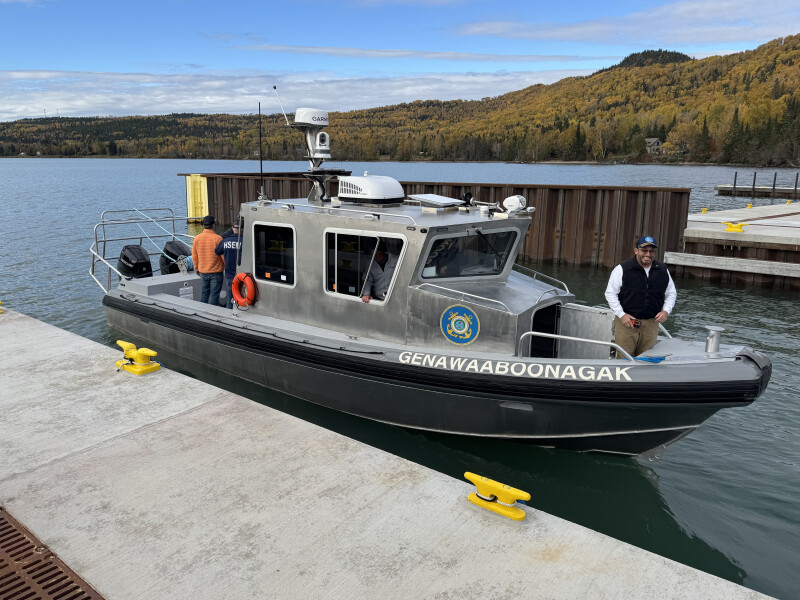
Farther north, Lake Assault delivered three substantially larger 33'x10' full-cabin patrol RIBs under a program involving the Grand Portage Band of Lake Superior Chippewa, Cook County Sheriff’s Office, and Lake County Sheriff’s Office.
Turnipseed said the program grew out of concerns about water-safety and emergency-response capabilities along a remote section of Lake Superior near the Canadian border, where recreational boat traffic includes vessels traveling toward Isle Royale National Park.
All three patrol boats are essentially identical and use twin Mercury Verado 350XL outboards. They carry 200 gals. of fuel, draw 20", and have a top speed of 53 mph and cruise at 34 mph. Electronics include Garmin multifunction displays, 4-kW xHD radar and Reactor autopilot, along with a Flir M364C thermal camera and Starlink.
The enclosed cabin and greater horsepower reflect the Great Lakes environment, Turnipseed said.
“The waters on Superior are kind of unforgiving,” he said. “It’s a very harsh place to operate.”
Lake Assault discussed lower-horsepower options with the customers, but Turnipseed said the company favored additional power given the conditions crews could encounter.
“You could get away with less horsepower, but if you’re in these harsh conditions, I think it would always be better to lean towards the side of having the horsepower to get out of a situation than finding yourself lacking,” he said.
A fourth 33' boat built for Grand Portage uses a similar hull but was configured as an expeditionary workboat rather than a dedicated patrol vessel. Its cabin was extended to provide additional seating, with roof storage for kayaks used in fisheries and youth programs. The boat retains emergency and rescue equipment so it can also support response operations when needed.
SILVER SHIPS
Nearly 30% of Bay County, Mich., is water, giving the sheriff’s office a broad marine patrol area that includes Saginaw Bay, the Saginaw River, and Kawkawlin River. Conditions on the bay can change quickly, and crews may find themselves working miles from shore in rough water.
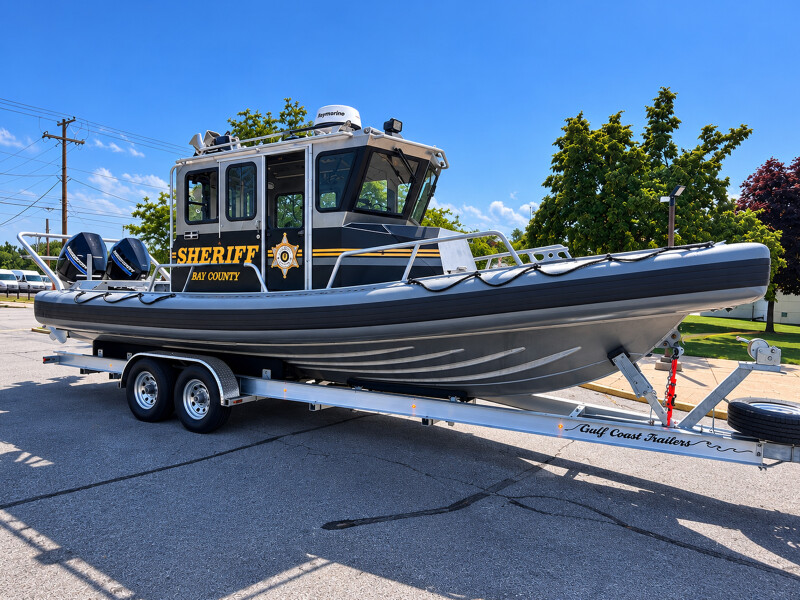
To expand its capabilities on those waterways, the Bay County Sheriff’s Office added an Ambar 800 patrol vessel from Silver Ships, Theodore, Ala., in May. The 8-meter (26'3") boat, acquired through federal earmark grant funding, is an addition to the department’s marine fleet rather than a replacement for an existing vessel.
Bay County Sheriff Troy Cunningham and Undersheriff Chris Mausolf said the platform gives the department added capability for routine marine patrol, emergency response, search and recovery, dive-team operations, assistance to distressed boaters, special events, and other public-safety missions.
“Vessel capability, stability, reliability, and protection from the elements are extremely important,” Cunningham and Mausolf said in written responses.
Those requirements factored into the selection of an enclosed-cabin boat capable of handling Saginaw Bay while giving personnel enough room for patrol, dive, search-and-recovery, and emergency-response equipment. The cabin was particularly important for crews that may spend extended periods on the water in extreme heat, cold, or other adverse weather.
“The enclosed cabin provides protection from those elements and allows our first responders to operate for extended periods without unnecessary exposure to potentially hazardous weather conditions,” Cunningham and Mausolf said.
Silver Ships Director of Business Development David Hunt said the configuration was developed around both the local operating environment and the sheriff’s mission.
“The Bay County configuration began with the operating environment — Saginaw Bay’s shallow, wind-driven Great Lakes conditions and the Sheriff’s Office patrol, search-and-rescue and dive-support missions — and worked forward from there,” Hunt said.
The AM800 Walk-Around Cabin configuration gives crews a fully enclosed, climate-controlled pilothouse while retaining side decks, dive cut-outs, and an open-rung dive ladder for boardings and diver recovery. The boat is equipped with a 12,000-BTU HVAC unit and heated windshield fans.
Twin 300-hp Mercury SeaPro outboards provide a top speed of 44 knots. The engines are installed as a counter-rotating pair with digital throttle and shift. Hunt said the arrangement was “chosen for commercial-duty reliability and low-speed control in close-quarters patrol work.”
Bay County also cited the power, maneuverability, and redundancy provided by the twin-engine configuration.
The electronics package includes a Teledyne Raymarine Axiom Pro multifunction display, Raymarine Quantum radar, Flir M332 thermal imaging, and a Standard Horizon GX6000 VHF radio with hailer. The sheriff’s office also cited side-scan and down-scan sonar, police-radio communications, emergency lighting, and searchlights among the equipment supporting navigation, search, and situational awareness.
Since entering service, the boat’s combination of size, power, technology, and crew protection has stood out to Bay County as it expands what the Marine Patrol can safely handle on the water.
MOOSE BOATS
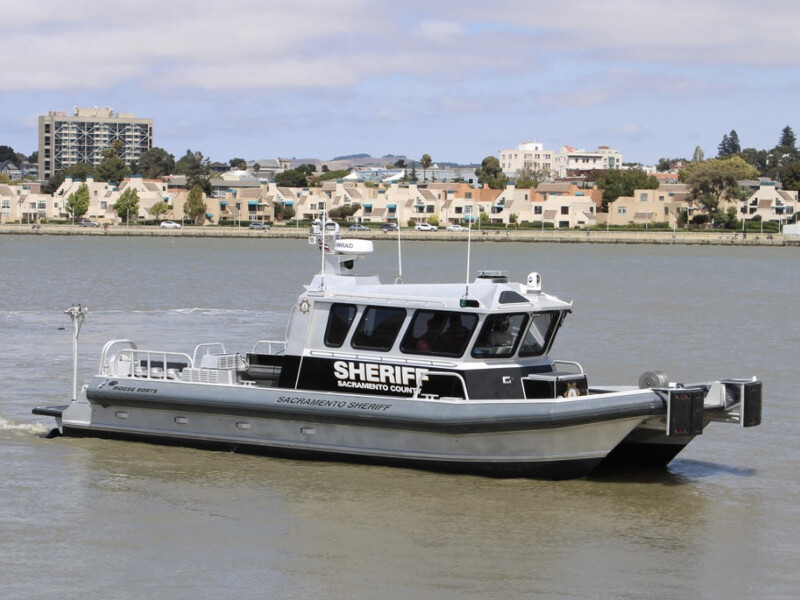
Sunken objects are a recurring problem in Sacramento County’s rivers and delta waterways, leaving the sheriff’s Marine Enforcement unit with a growing list of underwater recovery jobs.
“Our main goal with the new boat is to clean up the Sacramento and American River to make the water better for our community,” Sacramento County Sheriff Sgt. Sam Flores said. “We have a list of sunken vessels and vehicles that grows pretty much every week.”
Sunken vehicles typically result from theft, abandonment, or insurance fraud.
To expand that capability, the department recently took delivery of an M2-38 patrol vessel from Moose Boats LLC, Vallejo, Calif. The 38' aluminum catamaran is powered by twin 480-hp Volvo Penta D6 diesels that drive HamiltonJet waterjets. The purchase was funded largely through a state grant.
The new boat gives the department greater capability than its existing patrol vessels for locating, resurfacing, and removing submerged cars and boats from Sacramento County waterways. Much of the vessel’s layout was built around that dive and recovery mission.
A dedicated sonar station helps crews locate submerged objects, while a Simrad electronics package built around a 12" multifunction display incorporates chartplotter, radar, AIS, and sonar.
At the stern, a 1,000-lb.-capacity davit can be used from either the port or starboard side of the swim deck. A flush-mounted dive ladder folds into the deck when not in use, while dive-bottle racks and bench seating along both cockpit gunwales give divers space to don and remove equipment.
The vessel also carries an electric drum anchor winch and a hydraulically operated bow door. The opening assists with victim recovery and allows crews and equipment to move aboard during beaching operations.
Together, the sonar, dive access, recovery gear, and work areas give the sheriff’s dive team a platform built around jobs that can extend well beyond routine patrol.
“It’s a constant battle to clean up boats and vehicles dumped in the rivers and delta waterways,” Flores said.
TIDEMAN
Before New York State Department of Environmental Conservation (NYSDEC) Forest Rangers selected their next patrol boats, prospective builders were invited to two separate water trials, one in salt water on Long Island and another on a large upstate lake.
Rangers were able to operate the boats themselves and evaluate how the different designs performed. Patrick Cahill, vice president of sales and business development at Tideman Marine, North Andover, Mass., said Tideman took notes from those sessions and carried them into design discussions with naval architecture firm TMM Services.
“We believe in designing and outfitting a boat to meet an application, not offer a boat you adjust your needs to the environment,” Cahill said.
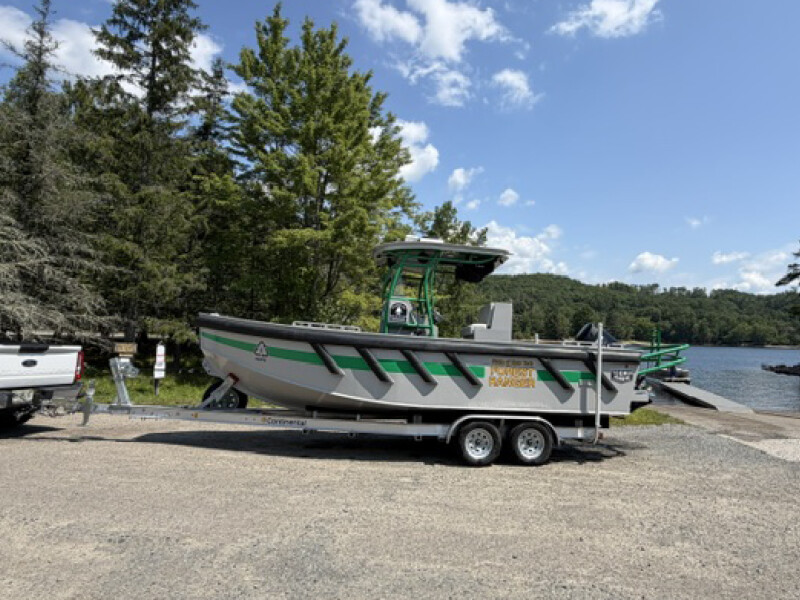
The resulting program calls for eight 22' Tideman HDPE (high-density polyethylene) Inland Series patrol boats, followed by a ninth vessel configured for broader utility work. The Inland is a V-hull platform offered in 2' increments from 20' to 34', with utility, patrol, and landing-craft bow options. NYSDEC selected the patrol-style bow for the first eight boats.
Those boats will support conservation enforcement, patrol, and other duties performed by state forest rangers. Their operating environments can range from calm water to more demanding conditions, with the design accounting for low-draft operations, floating debris during disaster response, rescue access, a 34" removable dive door, and open working room aboard.
“HDPE is also quieter and provides a more forgiving ride in higher sea states,” Cahill said, adding that HDPE absorbs wave and impact energy differently than aluminum or fiberglass and avoids the oil-canning that can occur with aluminum hulls.
“A key factor is Tideman builds their boats like a wooden or metal boat,” he said. “They are designed from marine-grade HDPE sheet material, which is CNC cut into kits and hand-and-extruded-poly-welded hulls. This allows for both easy repair and modifications.”
The boats are fitted with Tideman’s full-length, high-impact resistant (HIB) HDPE welded fendering. NYSDEC also specified additional HIB fenders mounted vertically along the hull to help protect other boats during contact without relying on conventional bumpers.
Each patrol boat includes an HDPE high console and a Tideman-designed folding T-top with an aluminum frame and added storage. Cahill said the folding arrangement reduces height for highway transport while also allowing the boats to pass beneath lower bridges.
Outfitting includes an HDPE leaning post, locking long-rifle cabinets, a custom handheld-radio holder, and a smartphone charging platform. Garmin equipment provides navigation and radio functions, while the first-responder package includes SoundOff Signal LED lighting, a 36" low-profile light bar, M-Power lights, a SoundOff control panel, and a siren.
Propulsion consists of a 250-hp Suzuki DF250 outboard supplemented by a Suzuki kicker for emergency backup or trolling. The boats measure 26'8" overall with an 8'5" beam and a minimum draft of 12" with the engines raised. They carry 79 gals. of fuel and have a maximum speed of 40 knots.
The ninth boat will depart from the patrol configuration used on the first eight. Cahill said it is being designed specifically for utility needs on New York waterways, with an enclosed cabin intended to extend its seasonal operating window and a broader role encompassing enforcement, rescue, and waterway maintenance.
NORTH RIVER
Strong currents, heavy vessel traffic, and quickly changing weather can make the 17.4-mile Cape Cod Canal a demanding patrol environment. In August, the Army Corps of Engineers’ New England District placed two new patrol boats from North River Boats, Roseburg, Ore., into service with its Cape Cod Canal Marine Operations Section.
Crews patrol the canal and its approaches in support of safe and efficient navigation. Their missions include assisting disabled or distressed commercial and recreational vessels, enforcing Cape Cod Canal navigation regulations, responding to marine emergencies, removing floating debris and other hazards to navigation, inspecting canal infrastructure, investigating pollution and other marine incidents, and supporting security and safety operations. The boats also work with the Coast Guard and state and local marine agencies during larger incidents and special operations.
That varied workload required a durable, highly maneuverable platform capable of moving between routine patrol, vessel assistance, emergency response, debris removal, infrastructure inspection, and other missions while giving crews good visibility, deck access, and a safe working environment.
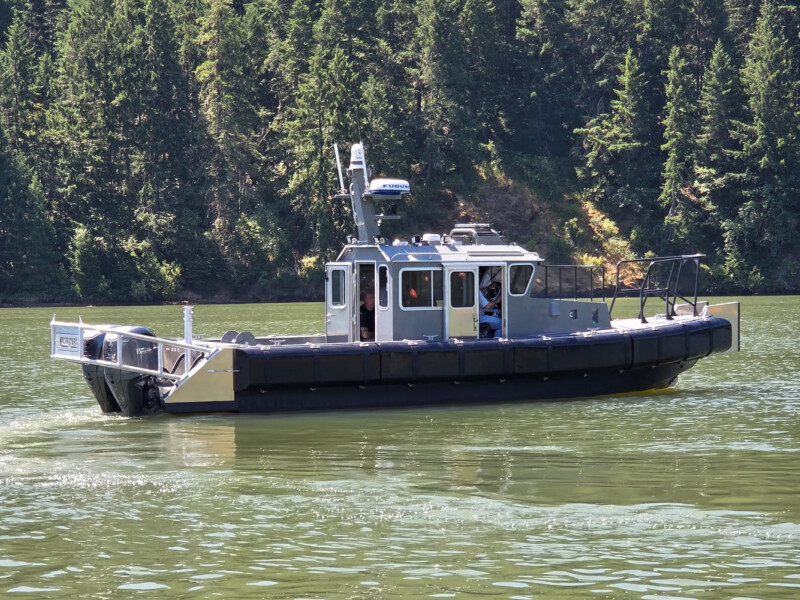
The boats measure 39'2" with an 11' beam and carry 220 gals. of fuel. Twin 350-hp Yamaha F350 outboards are paired with Helm Master joystick control, providing additional maneuverability for close-quarters work in the canal’s strong currents and congested traffic.
An 8' cabin includes sliding doors to port and starboard and a hinged aft door, allowing crews to move quickly between the enclosed space and working deck. A Webasto Air Top 55 diesel furnace provides cabin heat. Shoxs 6300 seats are fitted at the operator and navigator positions, with four Shoxs 3200 bucket seats aft.
Operator feedback emphasized the boats’ intuitive layout and ease of access. The full-size side doors were singled out as making entering and leaving the cabin easier, while crews also reported that the boats handle well in heavy sea conditions and are easy to maneuver.
The electronics package is built around Furuno TZT16F and TZT12F multifunction displays, with a Furuno FA170E AIS, SCX20 GPS antenna, DFF3D sonar, and DRS4DNXT radar. A Flir M364c dual-payload thermal camera adds low-visibility and nighttime capability, while a Standard Horizon GX2410GPS VHF handles marine communications.
Lighting includes Imtra LED scene lights and a Vision-X 30" LED light bar, along with Whelen blue strobes and a Mini Edge lightbar. A Whelen public-address system is also installed. The cabin has 120-volt AC shorepower and an onboard battery charger.
North River’s Mike Blocher said Cape Cod Canal operators have been enthusiastic in their praise of the boats’ quality control and attention to detail as well as their heavy-sea handling, maneuverability, crew access, and the flexibility of the layout for the canal’s varied missions.
VOLTARI
For lifeguard crews, speed matters before they reach an emergency, but what happens once they arrive can place very different demands on a patrol boat.
Voltari Electric is adapting its electric patrol platform for those missions as multiple lifeguard units move through procurement or production. Dan Kreeger, vice president of government relations and business development for Voltari, said rapid acceleration, reduced noise, lower maintenance requirements, and deck accessibility have emerged as advantages for public-safety operators.
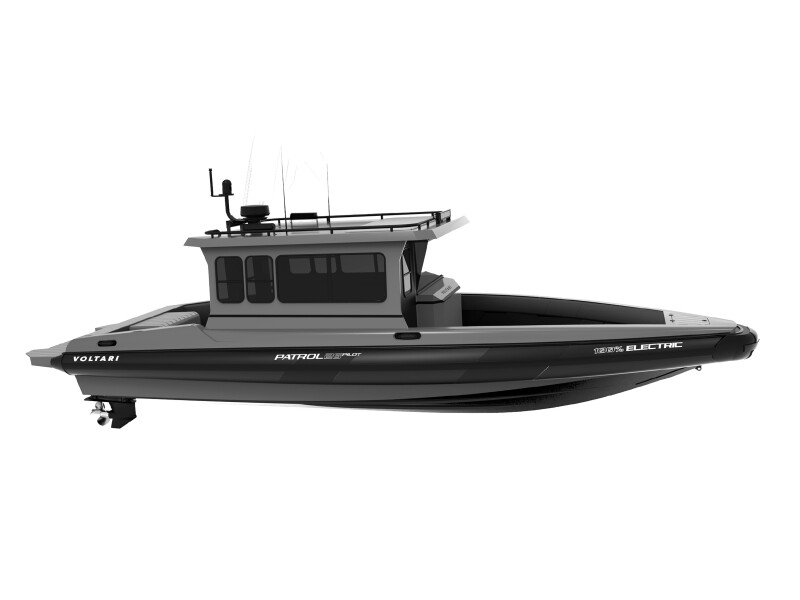
The Patrol 26 is powered by a 740-hp electric motor producing 1,007 lb.-ft. of torque. Kreeger said the immediate torque gives crews quick response when someone is in distress, while the electric drivetrain avoids many of the maintenance demands associated with internal combustion propulsion.
Once crews reach the scene, quieter operation can be helpful. In a search-and-rescue situation, personnel may be listening for someone in the water while communicating with each other aboard the boat.
“A vessel whose acoustic signature is virtually zero or substantially reduced from a combustion alternative is a really important tool for improving this situational awareness,” Kreeger said.
Voltari has also altered the pilothouse layout for lifeguard customers. Earlier configurations used a fully enclosed, four-wall house that could accommodate heating and air conditioning, but rescue crews wanted more direct access between the protected helm area and the working deck. Their missions can involve recovering people from the water and handling rescue boards and other equipment.
“We can shorten the pilothouse. We can make the space more accessible while still giving you the protection from the elements,” Kreeger said.
The propulsion layout creates another benefit at the stern. With no outboard engines occupying the transom, the boat has a recovery platform positioned about 4" above the water. During a lifeguard exercise, crews practiced bringing a person aboard on a rescue board. Kreeger said one participant noted that a recovery normally handled by three people could be completed by one person using the platform.
The arrangement was not developed specifically to create that recovery advantage, Kreeger emphasized. Rather, it emerged as a benefit of the electric propulsion layout.
“It changes the ease and the facility and the effectiveness of their function,” he said.
Voltari is now preparing a successor to the Patrol 26. Kreeger said the forthcoming Patrol 29 grew in part from an innovation project with the Canadian Coast Guard, which operated a Patrol 26 for a season and returned with requests for changes including seating and equipment placement, greater durability in higher sea states, and ISO Category B certification.
Rather than retrofit those requirements onto the existing platform, Voltari developed a new model around them.
The Patrol 29 will also incorporate the company’s next generation of battery technology, although Kreeger said final dimensions, capacity, range, and other specifications were still being worked out.
