


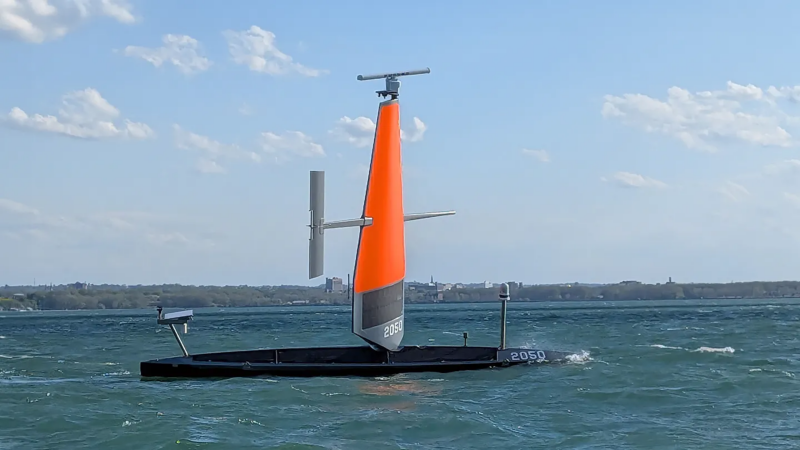
The Coast Guard is pulling six Saildrone Voyager unmanned surface vessels from the Great Lakes ahead of winter icing after a seven-month evaluation, with another test period planned for spring 2027.
The 33' Voyagers, supplied by Saildrone, Alameda, Calif., were deployed between April and November across the Great Lakes, providing Coast Guard command centers and boat stations with real-time weather data and operational information over thousands of square miles.
The evaluation examined how autonomous vessels could supplement cutters, boats, and aircraft on missions including search and rescue, maritime domain awareness, fisheries enforcement, and monitoring along the U.S.-Canada maritime boundary.
“Our scheduled seasonal deployment of six Saildrone unmanned surface vehicles on the Great Lakes provided valuable insight into how autonomous platforms support Coast Guard missions in a freshwater environment,” said Rear Adm. Russell Dash, commander of the Coast Guard’s Great Lakes District.
Each Voyager is primarily propelled by wind and carries a 4-kW auxiliary electric motor. The vessels are equipped with marine radar, an Automatic Identification System transceiver, meteorological instruments, and an optical camera.
Saildrone describes the Voyager as a 33' autonomous platform designed for long-duration coastal surveillance and mapping missions. The company says the vessels can operate for as long as 100 days between stops.
During the Great Lakes deployment, the vessels measured wind speed, wave height, water temperature, and barometric pressure to provide offshore conditions for search-and-rescue crews. They also monitored vessel traffic to help Coast Guard watchstanders identify disabled vessels, navigation hazards, and other unusual activity.
The USVs were also used to support fisheries enforcement and monitor activity around the international boundary.
Despite operating autonomously, the Voyagers were remotely monitored and piloted around the clock by human operators working from mission control centers across three time zones, according to the Coast Guard.
The vessels’ cameras captured periodic still images rather than continuous video, and the Coast Guard said the systems do not use facial recognition or target recreational vessel hull numbers.
The Great Lakes work is part of a broader Coast Guard push to integrate robotics and autonomous systems into its operations. The service established a dedicated Robotics and Autonomous Systems Program Executive Office in 2025 and later announced plans to invest nearly $350 million in robotic and autonomous technologies.
Saildrone vessels have also been evaluated by the Coast Guard in the Northeast, Southeast, and Southwest.
The service said testing across different operating environments is intended to determine where autonomous systems can extend coverage and allow crewed assets to concentrate on higher-priority missions.
