



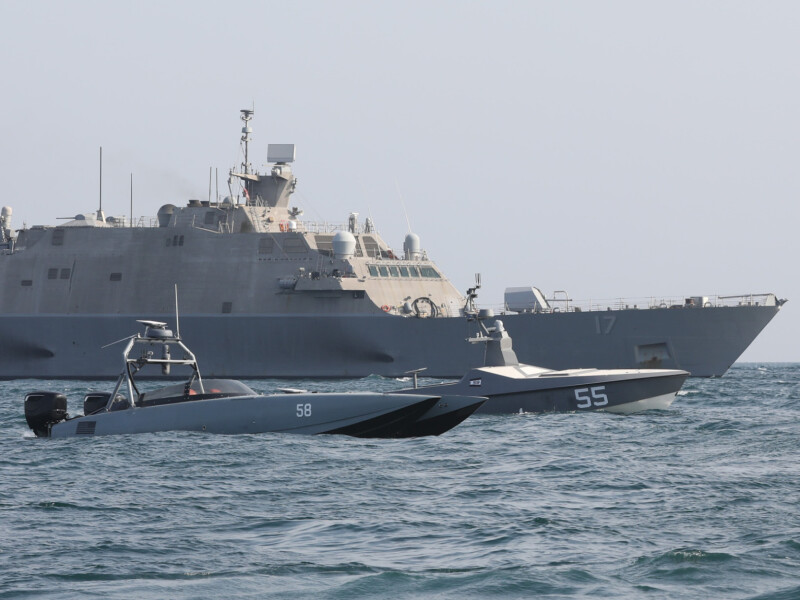
The announcement from the Department of the Navy largely eluded national headlines, but the news was nonetheless noteworthy for the future of the Navy and for the nation’s maritime industrial base.
Late last year, the Navy, shifting gears from its long-employed “Defense Acquisition System” model for building its fleet, began rolling out a new Portfolio Acquisition Executive (PAE) strategy. Faced with an aging, dwindling fleet and a call from Secretary of Defense Pete Hegseth for all branches of the military to adopt a more nimble and aggressive posture, the Navy initiated the change in acquisition strategy in December with the launch of PAE Robotics and Autonomous Systems (RAS). Then in March, the Navy rolled out five additional PAEs: Industrial Operations, Marine Corps, Maritime, DPRM (direct reporting program manager) Strategic Systems Programs, and Undersea/DPRM Submarines.
“Our acquisition workforce is critical to our warfighting capability, and not being deployed does not excuse us from having a warfighting ethos,” Vice Adm. Seiko Okano, principal military deputy assistant secretary of the Navy for research, development, and acquisition, said when the Navy announced the PAEs. “Each PAE will operate with a digital-first mindset. We will align on data and eliminate non-value-added layers of program reviews and bureaucracy to identify risks earlier and enable faster and more informed decision-making.”
Rather than a project manager reporting to a variety of stakeholders throughout the life of a project, the acquisition executives will be responsible for executing and directing projects. According to Navy officials, the aim of the PAE model is to establish a single senior leader responsible for each portfolio and to move the service’s acquisition strategy from one that is compliance-based to one that is outcome-focused.
The ultimate outcome, as laid out in the Navy’s shipbuilding plan for fiscal year 2027, is a “golden fleet” that will add numbers to the Navy’s fighting force — both manned and unmanned vessels — while also igniting “a renaissance in American shipbuilding,” according to the Navy’s announcement of the plan.
“A strong industrial base is not just an economic goal,” Acting Secretary of the Navy Hung Cao said when the shipbuilding plan was released. “It is a national security imperative.”
SHRINKING THE TIMELINE
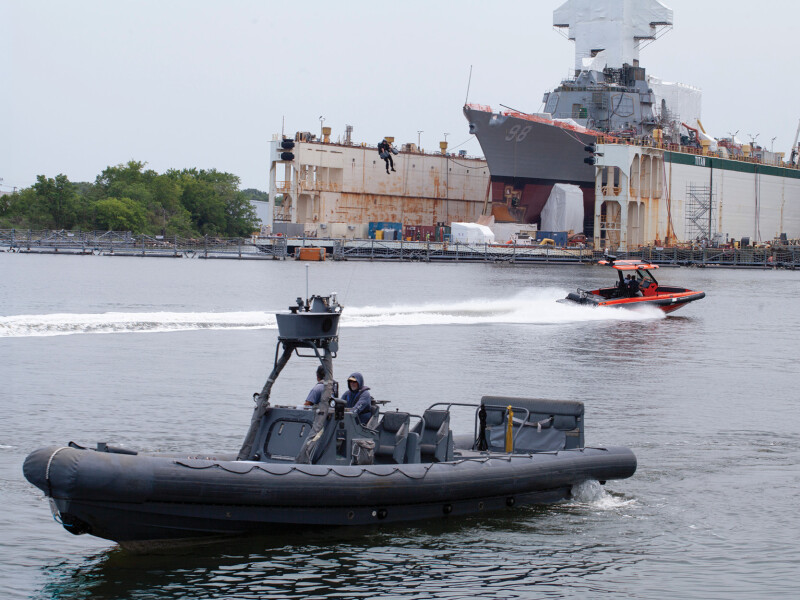
The Navy’s shift in acquisition strategy was a point of focus at this year’s Multi-Agency Craft Conference (MACC), held July 14–16 in Portsmouth, Va., practically in the shadow of the Norfolk Naval Shipyard, General Dynamics’ Norfolk yard, and BAE Systems’ facility on the Elizabeth River.
Sam Taylor, acting deputy PAE for Expeditionary and Mine Warfare, offered the keynote address at the conference, during which he outlined the Navy’s current situation, the force’s long-term goals, and the status of the acquisition strategy rollout.
Taylor opened with a reference to the old joke about the two happiest days in the life of a boat owner being the day a boat is bought and the day it’s sold.
“Well, for Navy acquisition, our two happiest days are the day we sign a contract and the day the craft hits the water,” Taylor said. “Our shared mission this week is to ruthlessly shrink the timeline between those two days.”
Such a shift in mindset and strategy will be no easy task, Taylor said, but it’s a necessary one.
“We are shifting from a bureaucratic, peacetime administration to an agile, responsive warfighting procurement engine,” Taylor said. “We are streamlining decision-making because our competitors are not waiting for us to finish paperwork or check those milestone documents off.”
To accelerate projects, PAEs have been given decision authority over projects within their respective portfolios, and they also serve as the head of contracting activities for those portfolios.
“This is a crucial one because it gets to the change in mindset,” Taylor said. “[The PAE] is the one that approves the contract.”
Agility is a key discipline of the PAE model, with individual portfolio acquisition executives empowered to remove barriers and identify ways to accelerate projects, Taylor said.
The Navy’s intrepid shipbuilding plan for the next 30 years demands a new approach to project funding and project management, Taylor said.
“The scale of our task is huge,” he said.
From a current fleet of around 291 vessels, the Navy intends to grow its fleet to 398 vessels by 2056. Accomplishing that will require both the Navy and its industry partners to stay committed to the task. Taylor said the Navy will need industry to execute contracts, to “tell us the truth early,” to move with urgency, and follow through with commitments in order to deliver the Navy’s sought-after “golden fleet.”
“Your workforce is a warfighting asset,” he said.
INDUSTRY WEIGHS IN
MACC attendees made the most of face time with Taylor and the other Navy officials present, with process-focused questions asked from the floor during multiple Q&A times. Daniel Kreeger, vice president of government relations and business development for Voltari Electric LLC, a designer and builder of electric craft with bases of operation in Ontario, Canada, and Panama City, Fla., said it’s understandable for questions to remain about how the PAE system will work.
“It is just a few months old for most of the portfolios,” Kreeger said. “Nobody should expect it to be fully settled, and to the Navy’s credit, nobody there is claiming it is. They were very clear during the recent industry day events that these are works in progress, but they are also showing some early fruits.”
Structure is important, Kreeger said, yet so is capacity.
“The reform asks the government to do more, not less,” he said. “Move faster, engage a wider set of vendors, run more demonstrations, evaluate more technology. Consolidating authority makes decisions cleaner, but it does not by itself create more hours in the day for the people making them. Structure and capacity are two different problems, and I think the second one is going to determine whether the first one delivers.”
Jason Marshall, executive vice president of programs for Jeanerette, La.-based Metal Shark Boats, part of Magnet Defense LLC, posed a question following a panel discussion at MACC that pertained to how contracts that have already been awarded will function under the PAE model versus new contracts.
“In the execution of existing work, our historical experience is that certain decisions or actions usually take several to many months to execute,” Marshall said. “Thus far, we haven’t seen much change in our line of support in this regard in our segment of boatbuilding.”
With Metal Shark building vessels for multiple government agencies, Marshall said he’s seen how the PAE approach at other agencies has led to faster execution.
“If execution of awarded work does accelerate as intended, it would bring contracts in this area up to the normal speed of doing business with other federal, state, and local governments we currently support,” he said.
The encouraging aspect, Marshall said, is that he and his Metal Shark colleagues have noted markedly improved processes with new work.
“With respect to bidding, we are currently partway through one effort out of PAE Maritime that has one of the most aggressive schedules to award I’ve seen in my three-plus decades in the industry, and it’s tracking on time,” he said. “It’s a truly impressive undertaking that’s really cool to be part of. At the same time, another [request for proposal] we are working concurrently is on a more traditional timeline. It appears to be a work in progress for the impact of implementation to take hold and a program-by-program implementation.”
Marshall, who spent more than 30 years at Naval Sea Systems Command before coming to Metal Shark, said the desire at the Navy — and more broadly within the government — to improve project delivery timelines is nothing new. With other agencies seeing improved timelines with a similar approach, Marshall said he’s hopeful the same will be true for the Navy.
“Really good people can achieve positive results in any system, but a really difficult system can stymie the best of people,” he said. “It’ll be interesting to see if other related constraints not related to alignment in the Navy are also relieved to help improve the process.”
UNMANNED SYSTEMS
Besides the Navy’s new acquisition strategy, a repeated topic of discussion at MACC was the role that unmanned and autonomous craft will play in naval warfighting both today and in the future. Much of that focus is born from innovation and changing tactics from around the world.
“Our adversaries can procure or develop inexpensive drones that pose a significant threat to traditional sea power lines,” Marshall said. “Additionally, the ability to have great persistence over longer times, or engage in a higher threat environment without requiring human presence on-site, represents a huge force multiplier potential for the Navy.”
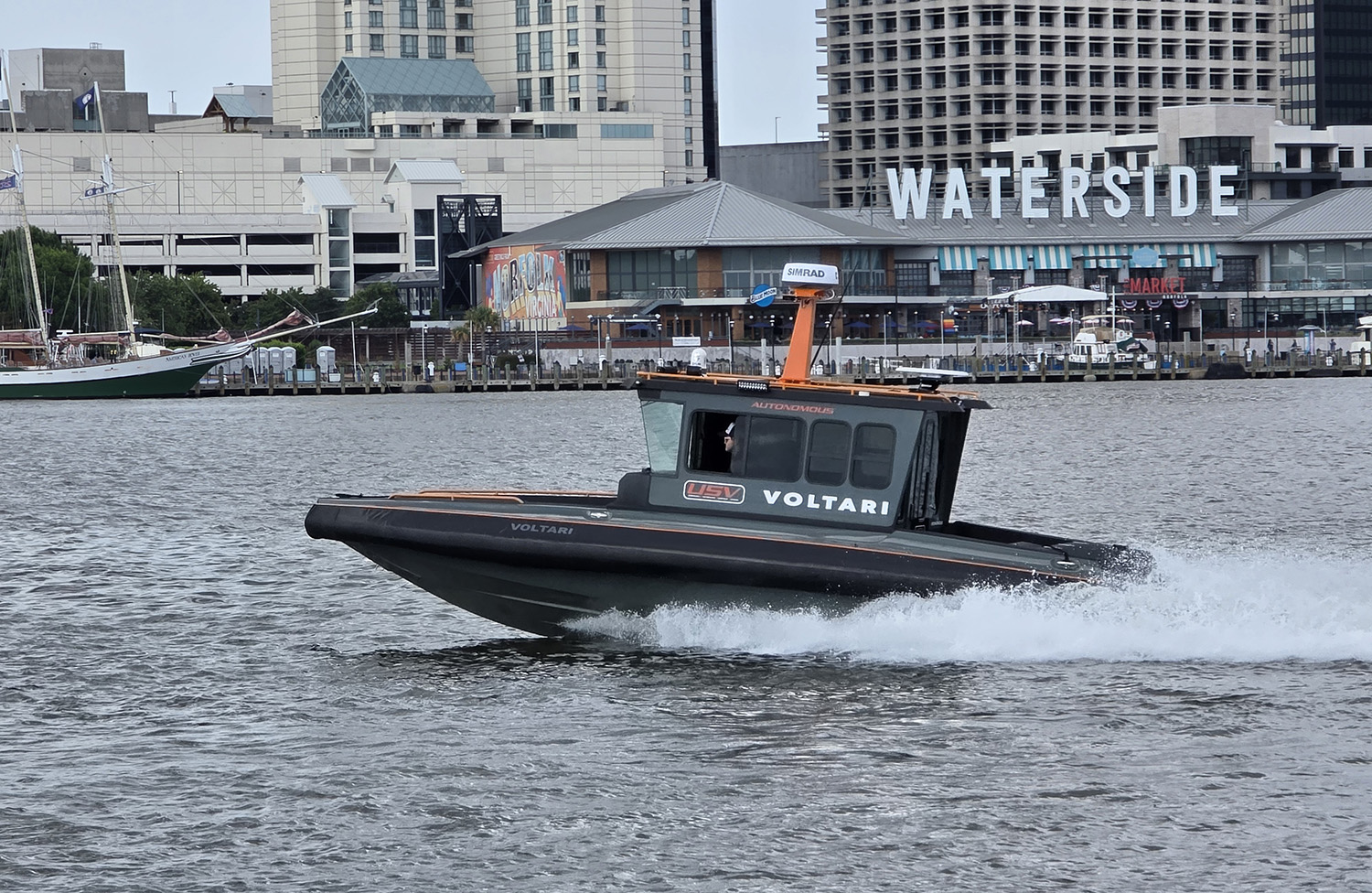
In the case of Voltari Electric, which specializes in electric vessels designed and built in-house, the platform is highly customizable, meaning the same hull design can be outfitted for particular missions and even reconfigured to meet changing needs.
“Autonomous control wants throttle and steering that respond precisely and predictably,” said Cam Heaps, CEO and cofounder of Voltari Electric. “Voltari’s electric powertrain gives that to our customers directly. There is no gearbox and no lag between the command and what the boat does, which makes the boat an easier machine for software to drive.
“Additionally, our platform is quieter and runs cooler than a comparable combustion boat, with far less vibration,” he added. “Quiet and cool matter for the mission. Low vibration matters for the payload, because sensitive sensors do not like being shaken. And these onboard systems need power.”
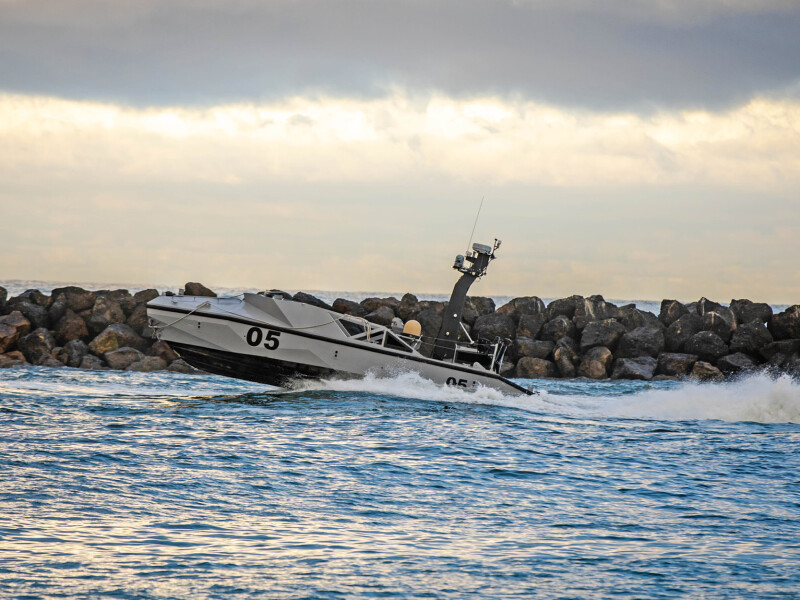
Metal Shark, Marshall said, has been involved in unmanned vessels in the United States and around the world for close to 20 years, with unmanned surface vessels delivered of late to the Marine Corps, NATO, and under a DARPA (Defense Advanced Research Projects Agency) program. Metal Shark has autonomy and vessel design teams under the same roof.
In a crowded field of remote and autonomous vessels, Marshall said he believes the United States can still innovate and excel.
“Our Constitution protects fundamental rights, and the pioneering spirit that founded this country is still in full force,” Marshall said. “From the work of Lewis and Clark, Daniel Boone to Henry Ford and Thomas Edison, to now reusable rockets reinvigorating the space travel industry, Americans have what it takes to excel in this area.
“When once asked a similar question, one of the best boatbuilders I know looked at me, smiled, and said, ‘We are Americans, not American’ts.’”
