



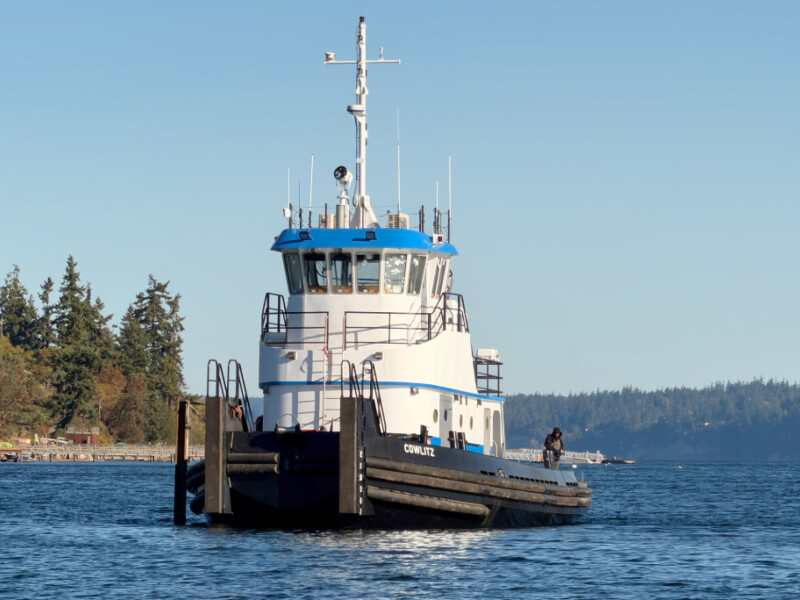
The Port of Portland in Oregon in December took delivery of the Cowlitz, a 69'x27'8" dredge tender, constructed at Nichols Brothers Boat Builders, Freeland, Wash.
While developing the vessel, the design team at Glosten, Seattle, worked to include feedback from the tugboat’s future operators. That included letting the helmsmen don virtual reality goggles so they could see what their view would be from the helm and throughout the boat.
“It gave us a first glance at what the vessel was going to look like and how the operators would feel,” said Chet Thomas, engineering manager for the Port of Portland.
The port had “some lofty goals” for reducing noise in occupied spaces, Thomas said. With assistance from Glosten subsidiary Noise Control Engineering LLC (NCE), Billerica, Mass., decibel levels were limited to 65 dBA in the day room and 62 dBA in the pilothouse.
To achieve those low levels, the Cowlitz was designed and built with various noise control treatments. Pyrotek Decidamp SLC (self-leveling compound) and SP-150 damping and adhesive coatings were strategically applied to bulkheads and decks in various compartments. The SLC material is poured on the deck and then covered by a constraining layer such as a steel plate or poured concrete, while SP-150 can be sprayed on. Fiberglass and mineral wool insulation was used on bulkheads and overheads to reduce the amount of sound transferred from the engine compartment to the day room. Propulsion equipment, HVAC fans, and engine compartment ventilation fans were also isolation-mounted, and larger, “hospital-grade” diesel exhaust silencers were used to produce more sound attenuation.
NCE president Jesse Spence said his engineers see isolation mounting as a necessary step even though it adds work. “[The equipment] can now move so you need to have flexible connections on whatever you’re mounting,” he said.
“The important part on our end is identifying how noise is getting from point A to point B and putting the appropriate treatments in their appropriate locations,” said Troy Cantalupo, an NCE engineer who was project manager for Cowlitz. “This is important in areas where we’ve added a noise-control treatment to the deck, so we are arresting the noise radiating off the deck.”
Spence highlighted the importance of collaboration in early-stage design efforts. “This project was a success in part because of the noise assessments performed in the preliminary design phase,” he said. “If you wait too long to implement noise control into the vessel design, your options become limited.”
The 87-grt Cowlitz, which can be described as a compromise between a tugboat and a pushboat, was designed to meet Subchapter M requirements. The vessel’s pram bow allows it to have functional push knees, and the hull transitions to double chines as the lines run aft.
The pusher tug is powered by twin 715-hp, EPA Tier 3 Caterpillar C18 diesels linked to straight inboards through a reduction gear in Twin Disc MGX5170DC transmissions. They turn 60"-diameter, 4-bladed propellers. Palmer Johnson supplied the transmissions and Twin Disc EC600 electronic control system for the vessel.
The Cowlitz replaced the 1959-built W.L. Williams, which was purchased at auction by a yard on the Columbia River.
The Cowlitz’s mission is support for the dredge Oregon, a pipeline cutter suction dredge that maintains navigation channels on the Columbia River. The new vessel joins a pair of A-frame-style workboats in the Port of Portland fleet.
“It’s a multipurpose tug,” Thomas said. “It can do a little bit of everything.”
For example, the new boat has a bow roller if it needs to move the dredge’s anchors and the A-frame vessels can’t do the job.
Although previous vessels used break-and-friction style or hydraulic units, the Cowlitz is equipped with four Markey electric variable-frequency drive winches. The boat has redundant generators that can power the winches.
The Cowlitz carries a crew of three, including the captain, and the teams work three shifts around the clock, six days a week. There are no overnight accommodations. The tug has a day room, a small galley, and a head.
Operators steer the boat with a choice of joystick or a follow-up lever that moves the rudder.
