



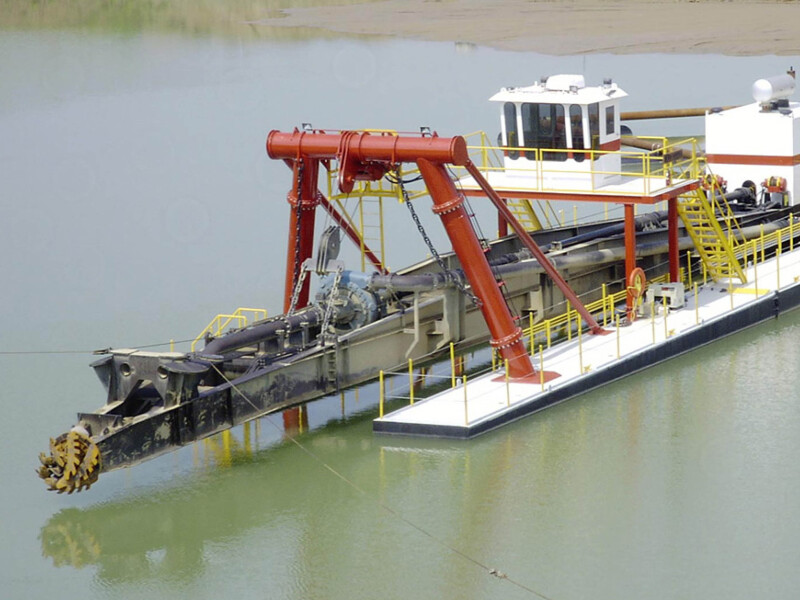
Dredge operators in the U.S. have expanded their fleets with a more diverse equipment offering, giving them the ability to take on different types of jobs. They’re replacing old equipment with new, more efficient technologies and even using processes that allow them to access and operate equipment remotely.
“The basic dredge hasn’t changed in a long time,” said Bill Wetta, senior vice president of product development and chief technology officer at DSC Dredge LLC, Reserve, La. “The big trend is less people or no people on the equipment.
“I’ve got a thousand dredges that I can run from my phone,” Wetta added. “We can troubleshoot, operate, help with placement all from our phone.”
In 2025, the North American dredging industry, comprised of Jones Act-qualified operators, continued to be a competitive market. U.S.-owned companies executed $1.8 billion in federal dredging projects, according to The U.S. Dredge Report.
While 2024 featured major deepening and widening projects in Norfolk, Va., Brazos Island and Sabine Pass in Texas, and Mobile, Ala., financial year 2025 marked a transition, the report noted. Instead of fewer large-scale channel expansions, the industry’s core of maintenance dredging held steady, providing safer movement of commerce on U.S. waterways.
Additionally, demand surged for beach renourishment, flood control, and wetland creation projects to combat climate change impacts. Many U.S. Army Corps of Engineers projects incorporate beneficial use, funneling dredged sand to rebuild shorelines, with 74% of projects recycling materials. Additionally, environmental dredging — the specialized removal of contaminated sediments from rivers and lakes — is a significant and growing sector across the U.S. and Canada
“With 56 companies awarded work, the Jones Act framework is fostering real competition that delivers value to taxpayers while maintaining a robust domestic industrial base,” said William Doyle, CEO of the Dredging Contractors of America (DCA). “That same fleet is essential to our national and economic security, keeping America’s military installations and port gateways open, reliable, and resilient.”
According to The U.S. Dredge Report, hopper and dustpan dredges accounted for 34% of all work, representing contracts totaling $608.5 million. While this segment declined from FY 2024’s peak, it remained consistent with long-term averages. Each job averaged three bidders, and the report said the competitive environment resulted in $773 million in savings to the federal government, an average savings of 26% per project. Some 63% of projects awarded were below the government’s estimate, and 68 of those were more than 10% below the estimate.
Doyle noted that the results underscore that the Jones Act gives small businesses a chance to stay competitive, with $294.6 million of 2025 dredging work awarded to small businesses across 135 projects.
NEWBUILDS
In 2025, a pair of noteworthy, large dredge projects started at Eastern Shipbuilding Group Inc. (ESG), Panama City, Fla. The company began work on two hopper dredges, one for the Dutra Group, San Rafael, Calif., and another for the U.S. Army Corps of Engineers.
The dredge Adele is a 10,464-cu.-yd. trailing suction hopper dredge named in honor of Adele Coelho, mother of Bill T. Dutra, Dutra Group’s founder and chairman.
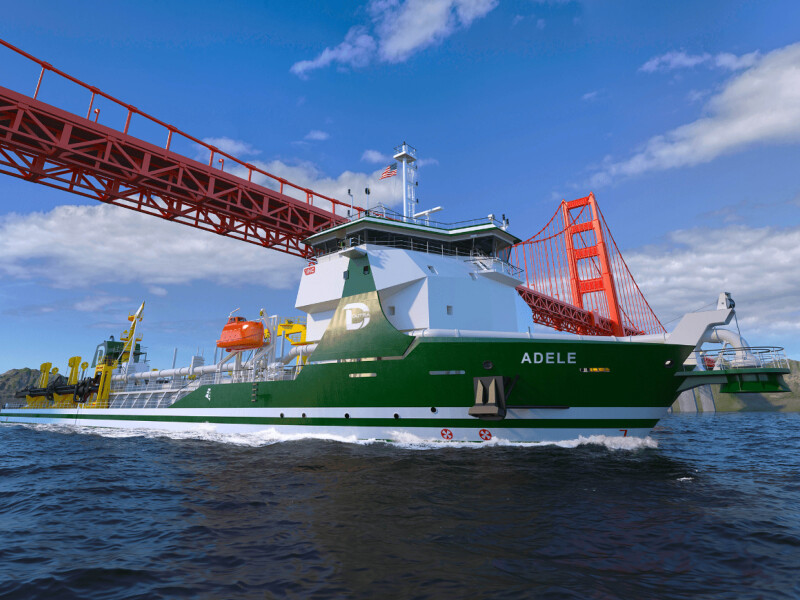
Adele is a 347'x79'6"x37' twin-screw vessel based on the Beagle Mk2 design from Royal IHC, Kinderdijk, the Netherlands. The hopper has a V-shaped cross-section with bottom doors that facilitate offloading dredged material. She also has a bow connection for more efficient material pump-off. The hull has a bulbous bow that helps reduce drag and improve fuel efficiency.
Accommodations and the pilothouse are forward, with the latter equipped with separate consoles for navigation and dredging. The wheelhouse is designed for the helmsman and dredge master to have clear views of their operations. The ship has a single engine room with the dredge pumps in a dedicated compartment. They are driven by the main diesel engines through a gear reduction. Total power for Adele is 13,290 hp. Upon delivery, Adele will join Dutra’s 9,870-cu.-yd. hopper dredge Stuyvesant, which has been in service since 1981. The company also owns clamshell and cutter suction dredges.
Eastern has also partnered with the Corps for a new medium-class hopper dredge, the Donnelly. The 320'x72'x28' trailing suction hopper dredge has been under construction since April 2025.
Expected for delivery in 2027, the Donnelly will replace the 57-year-old 318.9'x73.9'x32.9' McFarland, one of four oceangoing hopper dredges owned and operated by the Corps. The dredge will support the Corps’ navigation mission of maintaining federal channels and waterways that underpin U.S. commerce and national security. The vessel is scheduled to enter service in the federal fiscal year 2028.
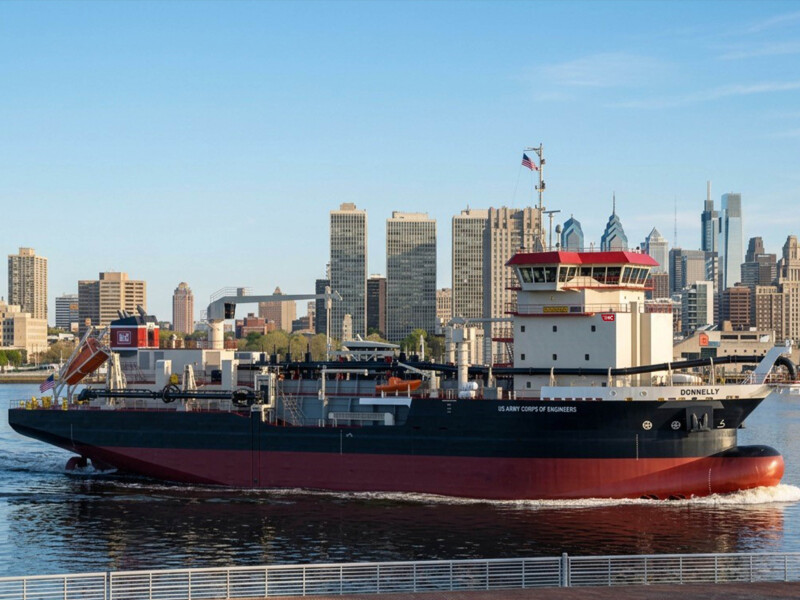
Ray Donnelly, the vessel’s namesake, was the former chief of resource management for the Corps’ Philadelphia District. He retired in 2020 after a 44-year career spanning the U.S. Navy and the Corps. An ESG press release noted that Donnelly played a key role in analyzing the Corps’ hopper dredge fleet and evaluating recapitalization needs, as well as overseeing financial management of the McFarland.
Donnelly’s draft will range from 11'3" when light to 25'6" fully loaded. The vessel will carry up to 6,000 cu. yds. of dredged material and operate at depths of up to 65' using twin trailing suction pipes. Accommodations will be provided for a crew of 26, with an endurance of about 18 days.
Diesel-electric propulsion will consist of one 3,150-hp Wabtec 12V250MDC engine and two 2,250-hp Wabtec 8L250MDC engines. Power will be delivered to two Schottel SRP 460 L-drives fitted with 98.4" fixed-pitch, 4-bladed stainless steel propellers, each driven by 1,800-kW electric motors. The vessel will feature two 375-kW Schottel STT 1 tunnel thrusters forward equipped with 49" fixed-pitch impellers. The vessel is expected to make about 12 knots with the hopper empty and 10 knots when fully loaded. Ship’s service power will include a Cummins QSB7-DM emergency generator rated at 120 kW.
The steel hull will be longitudinally stiffened and built to ABS class for unrestricted service under the society’s 2023 Rules for Building and Classing Marine Vessels, including notation for hopper dredgers and advanced control and automation systems.
The dredging plant will include two trailing suction pipes with gantries, dragheads fitted with hydraulically actuated visors and turtle exclusion devices, and two electrically driven high-efficiency dredge pumps (Type HRCS 156-33-65) with 25.6" suction diameter and 13.8" sphere passage. A Plumigator anti-turbidity overflow system will be used to reduce environmental impact during operations. An IHC Mission Master automated dredge system and integrated control and monitoring system will manage dredging functions, supported by a full navigation and communications package also supplied by Royal IHC.
POWERFULLY PORTABLE
The portable dredge market is a key contributor to continued growth in the industry. For instance, Ellicott Dredge Enterprises LLC, Baltimore, has three portable dredge brands: Ellicott, Mud Cat, and IMS.
Philip Grove, director of business development at the parent corporation, said the company is experiencing growth across its Ellicott cutter suction dredges as well as Mud Cat and IMS auger units. “Despite constant supply chain disruptions and international trade volatility, the market for portable dredges is booming,” he said.
For efficiency, Ellicott integrated operations at two shipbuilding locations. The company has its own engineering department to develop proprietary and patented dredge components. They are supported by fabrication and machine shops.
To stay current, the company uses emission-compliant diesel engines and modern “digital dredging” features including GPS-guided precision, remote monitoring and real-time data diagnostics.
While companies like Ellicott, VMI Inc., Cushing, Okla., and SRS Crisafulli Inc., West Glendive, Mont., build for stock, DSC Dredge builds to order. Wetta, who is an owner at the company, said DSC’s niche is dredging equipment with a pipeline diameter ranging from 8" to 24".
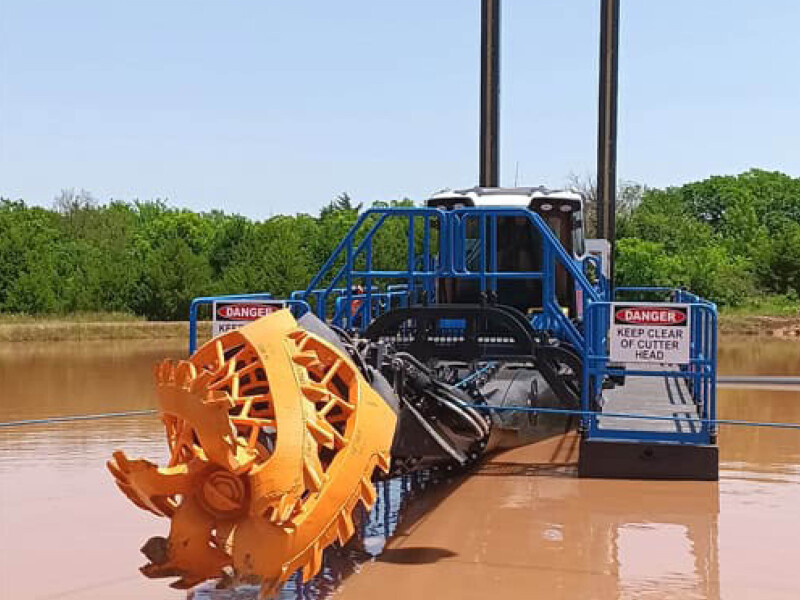
“Most everything we do is portable and can come apart and go over the road,” Wetta said. “When you consider that a truck carrying a portable dredge can run 55 mph and a barge typically goes about 6 to 10 mph, that’s a big savings in time and efficiency.”
When it can pull electricity from marina docks or another source in a yard, DSC runs dredges off the power grid to reduce direct emissions. DSC built a 24” dredge for a client that can run off its own diesel genset or off plug-in power.
The company is also looking at natural gas and LNG as potential fuel options.
Advances have also been achieved in both the precision guidance of dredging equipment and the capacity for real-time operational visibility.
“The big technology on those pieces of equipment is multi-beam sonar where you can see the material ahead of it and the material behind it, and you can tell what you’re removing and the rate you’re removing it,” said Wetta. “Ours are run with buttons and a chair and sometimes by voice.”
Satellite-based communications have given companies the ability to remotely access equipment virtually anywhere in the world.
“As soon as we get outside of cellular service, Starlink is our go-to,” Wetta said. “We can troubleshoot, operate, and help with placement all from our phone.”
On any piece of equipment it sells, DSC is offering Starlink free for a year, after which the annual cost is less than $2,000 per year to have the service available.
VMI recently introduced its Titan 8 and 10 cutter suction dredges, which are built with a modular design and can be held in place with anchors or spuds. Optional available equipment includes a suction valve and density meters. Both models range from a maximum depth of 20' to 51'3". The Titan 8 has a dry weight of 5,385 lbs. to 82,665 lbs., while the Titan 10 checks in at 56,380 lbs. to 87,810 lbs. Power choices from Caterpillar, John Deere, and Cummins range from 375 hp to 536 hp.
