



For much of the 20th century, U.S. Navy and commercial merchant vessels shared similar equipment and supply chains. This led to innovation, maintenance, and procurement moving fluidly between the defense and commercial maritime sectors. Recently, some of those ties have been severed with modern Navy platforms relying mostly on defense-specific systems.
In June 2024, collaboration between the Navy and Siemens Energy started the process of applying technology currently used in the commercial market to military vessels. The Navy was looking for an energy-storage system (ESS) for its Long Operation Combatant Naval Energy Storage System (LOC-NESS) initiative. Rather than going through the extended process of developing its own technology, it looked to a commercial provider.
“The Navy said, ‘The commercial guys have been doing this for a decade,’” said Bryant Fuller, director of federal marine solutions for Siemens Energy. “They said, ‘Maybe we should go look at getting a commercial provider who’s doing this right now for a living.’”
Siemens Energy’s BlueVault ESS was fast-tracked for prototyping through the U.S. military’s Defense Innovation Unit (DIU), also known as Unit X. Established in 2015, DIU identifies commercial technologies that can be quickly adapted for military use. Headquartered in Mountain View, Calif., with offices in Austin, Texas; Boston; Chicago; and the Pentagon, DIU partners with organizations across the Department of Defense to deliver advanced commercial solutions for national security.
On June 3, 2024, the Navy began accepting applications for a prototype energy storage system (ESS). Siemens Energy submitted a white paper, and in early August it was invited to make a presentation. Following the presentations, the company was asked to respond to a request for prototype proposal and, by the end of September, was awarded a contract to deliver a 4-MWh ESS for the Navy.
“Partnering with the Navy and leveraging commercially available battery technologies through DIU’s unique process has allowed us to bring this critical war-fighting capability to the Navy quickly,” said Andrew Higier, DIU energy portfolio director.
Siemens Energy winning the contract could be a sign that more commercial suppliers are getting military business. “This is possible because it’s a proven commercial solution,” said Ed Schwarz, Siemens Energy’s head of marine sales for the U.S. and Canada, about the deal. “We’re able to validate that there’s a commercial product that can work for defense.”
Schwarz said maritime suppliers would benefit by having a less siloed approach to product development. “The Navy is a large business opportunity as a buyer of maritime products, equipment, and solutions.”
OPENING DOORS
The project requires Siemens Energy to deliver a “ruggedized” ESS prototype ready for installation on a Navy ship in September 2026. Ruggedized means the ESS cabinets need to pass the Navy’s shock and vibration requirements. The DIU uses what’s called “other transactional authority” to streamline the acquisition process. Upon completion of the design and qualification process, the first LOC-NESS prototype will be installed by the Navy in FY27.
Over the last decade, Siemens Energy has found a niche in low-voltage direct current (LVDC) and medium-voltage alternating current (AC) realms. In the U.S., a medium-voltage system distributes 4,160 volts or 13.8 kilovolts. In Europe, the rating is 6,000 volts or 11,000 volts.
“LVDC has special applications for offshore vessels where reliability and efficiency become paramount because time is money,” said Fuller.
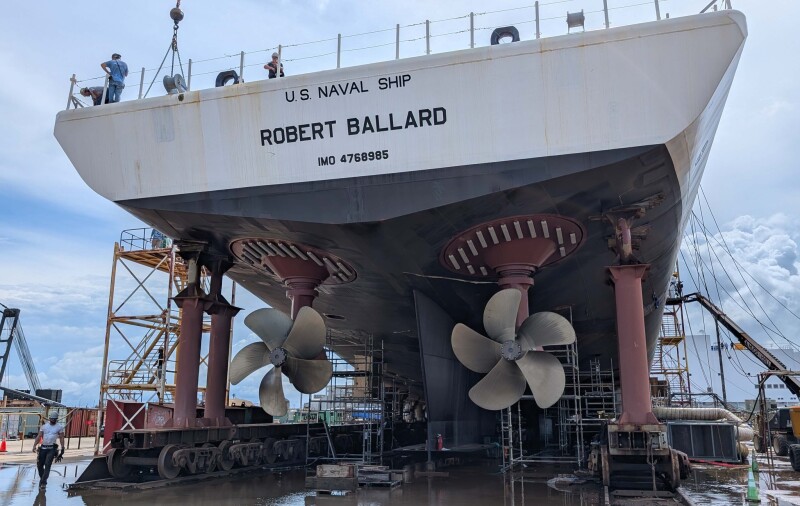
Siemens Energy has proven its LVDC capability in ferries and other commercial vessels. Its LVDC solution is also being installed aboard the Navy’s 353' USNS Robert Ballard (T-AGS 67), a Pathfinder-class oceanographic survey ship that is under construction at Bollinger Mississippi Shipbuilding, Pascagoula, Miss., for scheduled delivery in 2026. The technology could be incorporated in other Navy designs.
LVDC differs from a conventional AC system because it operates at a variable frequency that improves efficiency. A typical diesel generator, gas turbine or other power source operates at a standard 60 hertz. The LVDC system converts AC power coming out of a generator, rectifies it to 1,000 volts on a bus network, and distributes the voltage on a switchboard. All the converters that power the rest of the ship are embedded in the switchboard lineup for the propulsion and ship service-power requirements.
For high-energy components like bowthrusters, converters are integrated into the switchboard network. “There’s a DC bus that makes it easier to bring energy on and off because you don’t have to worry about matching frequency,” said Fuller. “You’re matching voltage, and you can bring on other sources like batteries, super capacitors or fuel cells.”
The energy savings with LVDC typically range between 20% and 30%, depending on the ship’s operational profile. Reliability is also improved because Siemens Energy uses a fast-acting solid-state switch on the DC bus instead of a circuit breaker. The system will split the DC bus in 15 to 20 microseconds if a fault is detected, while a conventional AC circuit breaker will trip in 70 to 80 milliseconds.
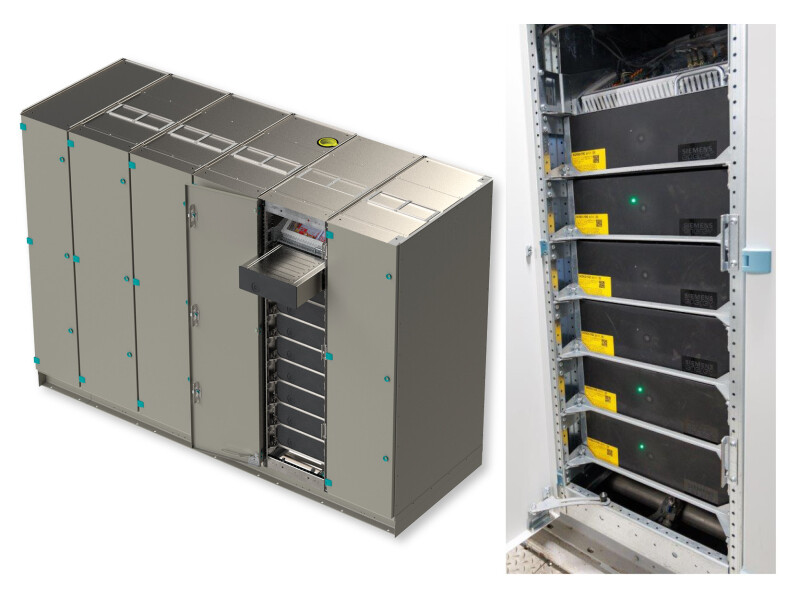
The BlueVault ESS operates between 930 and 1,030 volts and can be integrated onto a DC or AC bus. An ESS can be used for peak shaving, generator bridging, improved response, spinning reserve or short-term backup power.
For the batteries that make up the heart of the storage system, Siemens Energy uses lithium-ion units in cases. The batteries used in the BlueVault system are based on a lithium-ion chemistry of nickel, manganese, and cobalt (NMC). NMC, along with lithium iron phosphate and lithium titanate oxide, are commonly used chemistries for marine applications.
Siemens Energy offers 40-, 60-, and 66-kWh cabinets, each containing six, nine, or 10 battery modules, respectively. Each module holds 28 cells, delivers 6.6 kWh, and can be configured to meet a vessel’s specific requirements.
“It’s a bit of an exercise to go figure out how much energy storage a ship needs,” said Fuller. “It’s because there are a lot of things you use energy storage for. It’s what we call a spinning reserve. It can operate as a backup diesel generator. It can do what we call ‘gen bridge,’ so it’ll pick up the load in case you lose the diesel.”
Fuller estimates that Siemens Energy is incorporating energy storage into about 75% of its current projects, working with the operators to determine the required size for energy storage. The BlueVault system can operate in either AC or DC applications. For the former, the power comes from the batteries, passes through an inverter, and is then connected to the AC bus network.
Cost is figured on a dollars-per-kilowatt-hour basis, Siemens Energy said. With more battery cabinets, the cost per kWh can be reduced. An AC bus will increase the price because it requires power inverters. For battery life, Siemens Energy plans for 10 years, but that can vary depending on the frequency and depth of charge and discharge rates.
The supply of shore power to vessels for rapid charging remains a challenge in both military and commercial settings, as existing infrastructure is not yet capable of delivering the high power levels required in short timeframes. As a result, many ferries in the U.S. operate as hybrids, using ESS to supplement fuel and reduce overall consumption. Some of these vessels are designed to transition to fully electric operation once shoreside infrastructure — including high-capacity charging systems — is upgraded to support them.
Looking ahead, research vessels are strong candidates for systems like BlueVault since they often operate on battery power for short periods during tasks such as fish surveys.
On a larger scale, hybrid-electric or fully electric ferries are also well-suited for ESS.
In addition to LOC-NESS and the LVDC power and propulsion system for T-AGS 67, Siemens Energy is supplying shaft generators for the Navy’s John Lewis-class T-AO fleet replenishment oilers being built by General Dynamics NASSCO, San Diego.
The T-AGS and T-AO systems are classed by the American Bureau of Shipping, Spring, Texas, for commercial ship designs.
