


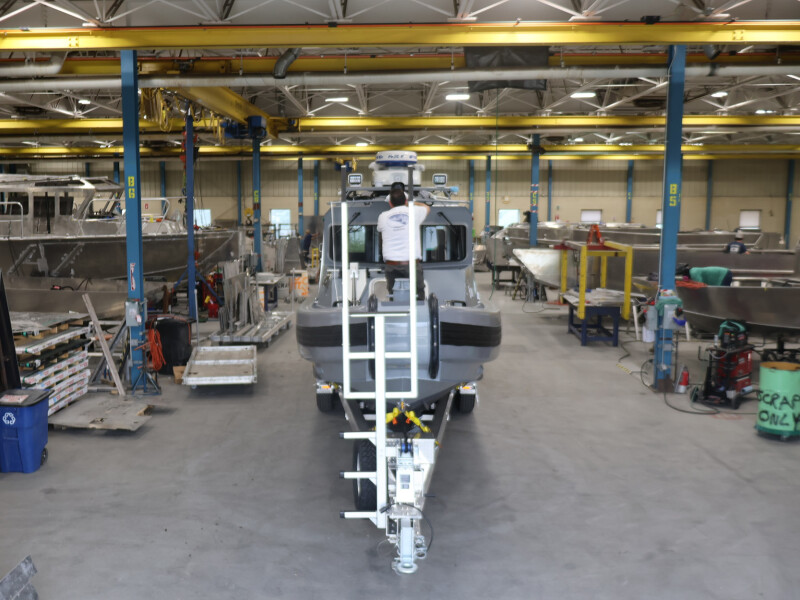
MetalCraft Marine is ramping up production at its Watertown, N.Y., shipyard as it builds force-protection boats, oil-spill response vessels, and long-range interceptors for the Navy and Coast Guard. During a recent tour, workers rolled a 40' Navy Force Protection Large (FP-L) hull out of the production area one day and began construction on the next boat within 24 hours.
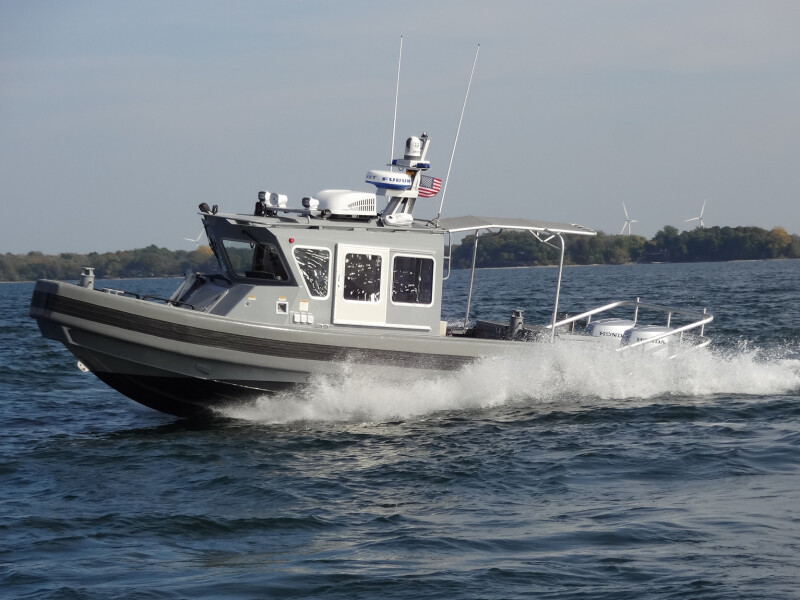
MetalCraft builds two force-protection models for the Navy: the 27' Force Protection Small (FP-S) and the 40' FP-L. The program was designed for commonality between the two, said Ryan Hunter, director of engineering and program management. Both feature twin outboards with similar controls and cabin layouts so personnel can move between platforms. The Navy orders FP boats with different outboard brands depending on the receiving unit’s requirements.
“From a user perspective, you wouldn’t know the difference when you’re in the cabin because the look and the feel is pretty much the same,” Hunter said.
The force-protection program originally covered 85 boats. MetalCraft has delivered more than 26 of the smaller models and nearly 10 of the larger ones and is developing a 33' version to fit between the two designs. Hunter said vessel size alone doesn’t determine capability as both boats meet ISO 12215 structural and ISO 12217 stability and buoyancy standards, and Metal-Craft has built much smaller boats with similar performance, including a 20' Cutter Boat-Large for the U.S. Coast Guard, designed to operate in Sea State 4 (4'-8' waves) and survive Sea State 5 (8'-13' waves).
“You’re trying to balance structural integrity with speed and weight. Our core competency from an engineering perspective is striking the balance between operational objectives and balancing weight, power and the layout of the boat.”
Hunter said seeing Navy boats still in service years later, including a force-protection boat delivered roughly a decade ago that was patrolling a harbor during a recent industry conference, reinforces the value of repeat government work. “To see it in service was pretty rewarding,” he said.
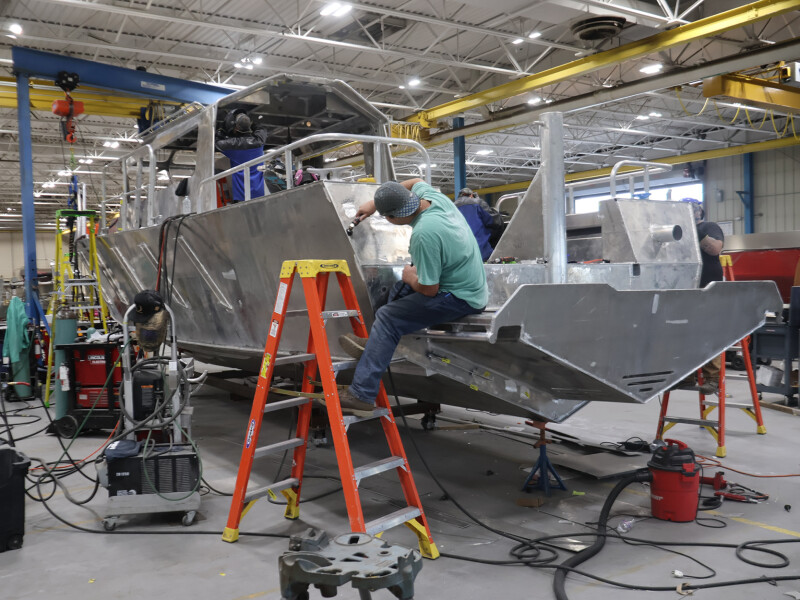
MetalCraft is also building two types of Navy oil-spill response vessels under a contract for 154 boats: about 112 25' utility boats that tend and position containment boom, and more than 40 larger boom deployment boats with a landing craft-style bow door that carries the spooled boom. The 25-footer runs twin 115-hp outboards and can exceed 35 knots, with engine brand varying by unit depending on each base’s training, parts, and service setup.
Boats are delivered to Cheatham Annex at Naval Weapons Station Yorktown, Va., before fleet distribution. The current award follows an earlier, similar contract, with mostly minor safety and stability changes added. “We always work with the Navy to try to improve our platform and meet their requirements,” Hunter said.
For the Coast Guard, MetalCraft is producing its third-generation Long Range Interceptor (LRI-III), designed to deploy and recover from the stern ramp of national security cutters. An indefinite-quantity indefinate-quantity contract initially contemplated up to 17 boats; total production is now expected to be about 14 or 15, based on cutter fleet size.
The first LRI-III went to the cutter James, deployed for 112 days on a drug-interdiction mission. The vessel helped seize $510 million worth of narcotics over 11 interdictions. MetalCraft later incorporated crew feedback into production boats, including rotating an aft-deck hatch 90°.
The LRI-III replaces the LRI-II, of which MetalCraft delivered 13 starting in the early 2010s. Navy and Coast Guard vessels make up an estimated 70% of MetalCraft’s annual unit deliveries, according to General Manager Mike Reed, with fireboats, patrol boats, pilot boats, and other vessels rounding out the rest.
GROWTH SUPPORT
MetalCraft expects to deliver about 60 boats companywide in 2026, up from 23 in 2024 and 43 in 2025. The company’s longer-term goal is at least 100 deliveries a year within 18 months to two years.
“The government sent a message about shipbuilding capacity,” Reed said. “They’re talking a lot about bigger ships, but they’re not ignoring what we do. The MetalCraft story is: ‘We listened, we heard you, and here we are.’”
Reed joined in July 2024 from the broader manufacturing industry, bringing scaling experience to a company with established designs and contracts that needed more structure to increase output. The reorganization focused on hiring managers with manufacturing, project, program and supply-chain backgrounds while pinpointing strengths among longtime MetalCraft employees and placing them in roles where they could thrive. That approach built on boatbuilding knowledge developed within the existing team over years and decades. Reed also implemented a detailed multiboat scheduling system spanning roughly five years to forecast workforce, material, and equipment needs.
“When you’re delivering a boat every week, you’ve got to have the parts when you need them, where you need them,” Hunter said.
Scaling meant moving away from requiring every worker to be a complete boatbuilder. MetalCraft standardized production tasks, allowing employees to specialize and receive role-specific, on-the-job training. Reed said workers could focus on defined responsibilities, such as wiring, without needing to master the entire boatbuilding process. Hunter said this approach has helped MetalCraft maintain quality while onboarding employees without prior marine manufacturing experience.
Deficiencies recorded at delivery fell 76% through the third quarter of 2025, bringing the rate to the lowest in company history.
“Our aim is zero,” Reed said.
MetalCraft has invested about $8 million in Watertown, where its new roughly 90,000-sq.-ft. facility sits on 13 acres with room to grow. The Watertown workforce has doubled from about 18 to 36 over two years.
“Capacity only gets you so far,” Hunter said. “You’ve got to have the manpower to do the work.”
The goal is for Watertown to eventually handle full production, from keel-laying through delivery, as the company’s Kingston, Ontario, waterfront site does, though large fireboats that require waterfront access and heavy lifting will continue to be built in Kingston.
“We’re investing in the U.S.,” Reed said. “We’re building boats in the U.S. for the U.S. government with U.S. taxpayer money. We should be building here.” MetalCraft has built boats in the U.S. for nearly 20 years and operated for almost four decades.
UNCREWED FLEETS
Uncrewed surface vessels are a growing part of MetalCraft’s government business.
Working with Huntington Ingalls Industries, the company developed an unmanned version of its 20' Cutter Boat-Large, now marketed by HII as Romulus 20, which completed a 30-day maritime-domain-awareness demonstration off Oahu, Hawaii, detecting and tracking vessels and transmitting imagery ashore.
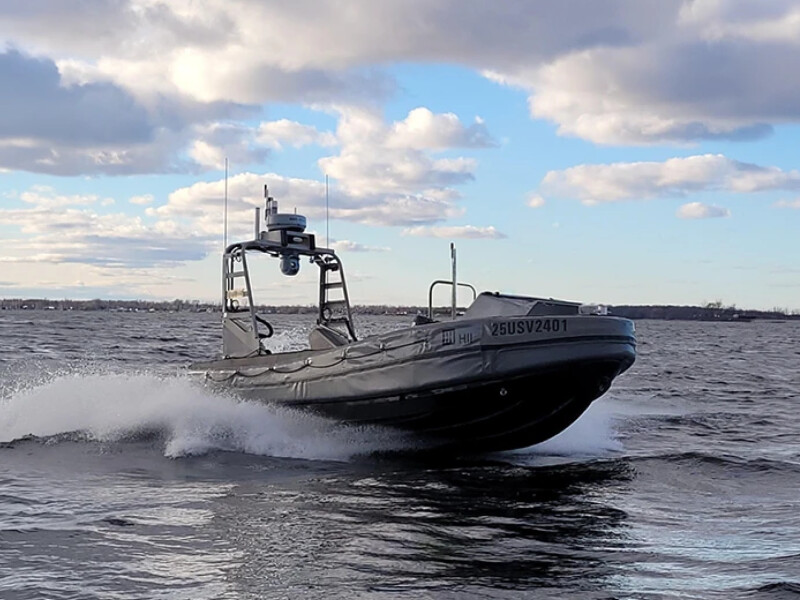
That led to the Romulus 25 for the Marine Corps, adapted from a 25' over-the-horizon boat with a flat deck and diesel-waterjet propulsion. Against a requirement for a 500-lb. payload at 35 knots in Sea State 4, the delivered boat hit nearly 40 knots, carried up to 1,000 lbs., and had roughly 500 nautical miles of range at cruise speed, earning a success memo from the Marine Corps.
MetalCraft has also delivered a 27' uncrewed vessel and the first of two 40' uncrewed vessels to the Navy’s Autonomous Lab Integration Center at Naval Station Norfolk, Va. Reed said the company aims to supply proven hull platforms paired with partners’ autonomy systems and payloads, and Hunter said most of its 20'-90' designs could be adapted for uncrewed service.
“Whatever somebody is looking for, we’ve probably already built it,” Hunter said. “Adapting it to an uncrewed platform is relatively straightforward with the expertise that we have in house.”
MetalCraft is also investing about $9.5 million to consolidate its Kingston facilities into a new 50,000-sq.-ft. waterfront plant. In Watertown, Reed said the expansion will increase U.S. production capacity and throughput to meet demonstrated demand from federal agencies for small boats.
“We want to match our U.S. manufacturing capacity to U.S. demand,” he said.
