



Marine hybrid-electric propulsion combines more than one power source in place of the standard diesel engine propulsion package. The hybrid-electric combination is designed to burn cleaner and save fuel compared with diesel propulsion alone.
Instead of just a diesel engine or engines, the hybrid marries diesel power with an electric motor or motors, depending on how much power is needed, allowing for a mix of energy sources arranged to deliver fuel efficiency, minimize emissions, and improve performance.
“In most cases, a standard diesel engine propulsion system will be less expensive than hybrid electric systems. However, as technology evolves, we are seeing the cost of electric systems decrease, and we expect this to continue,” said Grant Pecoraro, Incat Crowther’s managing director, North America. “The reason electric systems are more expensive today is the need to integrate a range of cooling and off-gassing systems, as well as power conversion and control equipment with the battery management systems and electric propulsion equipment.”
LAYOUTS
Boat owners have their choice of hybrid electric systems, such as parallel hybrid and series hybrid arrangements.
The parallel hybrid system features a traditional engine and an electric motor connected to the same shaft, and either one or both can provide power to the propeller or wheel.
With the series hybrid, the traditional engine’s sole purpose is to act as a generator, charging onboard batteries or directly powering the electric motors that drive the propulsion system.
“Parallel hybrid systems typically utilize diesel engines as the primary means of propulsion with battery-powered electric motors supplementing the primary propulsion system. Generally, battery-powered electric motors are utilized for low-speed operations such as docking, navigating no-wake zones and maneuvering in tight spaces,” Pecoraro said. “Series hybrid systems utilize electric motors as the primary form of propulsion. These electric motors may receive power from either a diesel generator or a battery system. The battery system’s size dictates the duration for which the vessel may operate in battery-electric mode.”
These propulsion systems are designed to deliver improved fuel efficiency, reduce emissions, increase power and flexibility, and lower noise levels.
Hybrid systems use a combination of power sources to increase performance, leading to lower fuel consumption. And by burning fuel more efficiently and allowing for electric-only operation, hybrid systems help lower emissions.
In addition, electric motors can provide high torque, while traditional engines can handle longer-range cruising. Anyone who has been around an electric car can attest that it’s quieter than a combustion-engine vehicle.
BOATS
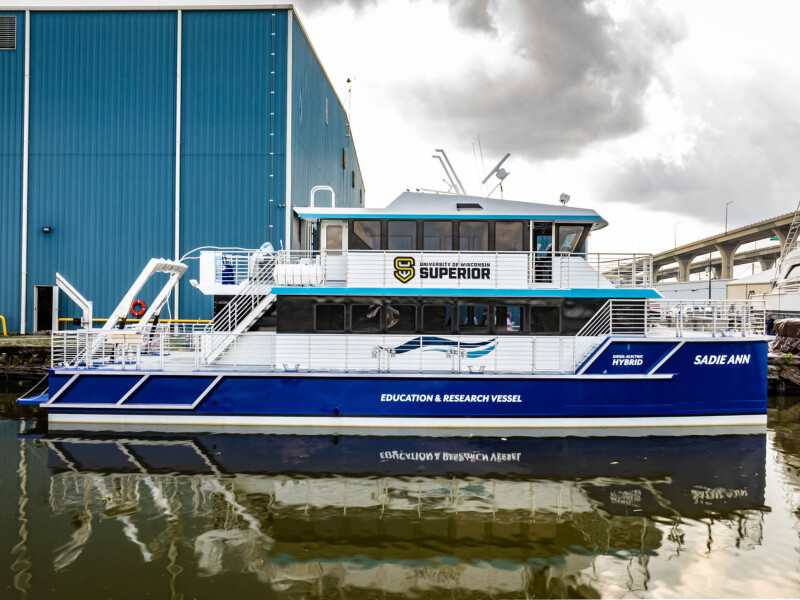
Midship Marine, Harvey, La., launched a new battery-hybrid research vessel in late 2024 for the Lake Superior Research Institute at the University of Wisconsin-Superior.
The 65'x24', 49-passenger, eight-crew aluminum catamaran, Sadie Ann, will support the university’s on-water education and research in Lake Superior.
The vessel was designed by Incat Crowther and is equipped with a parallel hybrid-battery propulsion system that includes John Deere diesel engines and Esco Power electric motors. Sadie Ann has a maximum speed of 18 knots and has a range of 690 miles at 12 knots.
“Sadie Ann’s diesel engines supply the vessel’s primary propulsion power while electric machines are integrated into the transmission system to provide slow-speed propulsion power,” said Pecoraro. “The electric machines can also take power from the diesel engines to charge the onboard battery system, enhancing the operational flexibility, efficiency, and capability of the vessel. Shoreside battery charging is also provided via a standard AC shore-power system and an onboard AC/DC converter.”
The new research vessel will be delivered sometime this spring after the winter thaw, when it will travel by barge to Chicago, then under its own power to the institute.
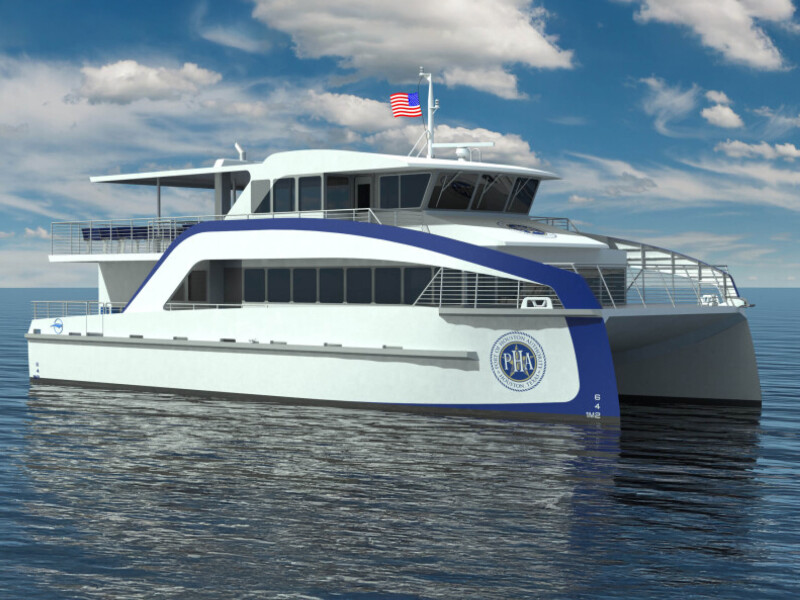
Breaux Brothers Enterprises, New Iberia, La., is building a 73'x28' aluminum catamaran, designed by Incat Crowther, for Port Houston. The vessel will be equipped with a Twin Disc battery-hybrid propulsion system featuring two 265-kW propulsion motors that will drive fixed-pitch propellers through Twin Disc MGE-5065 SC gearboxes. The vessel will have a maximum speed of 12 knots.
The new catamaran will be built with an energy storage system with a capacity of 768 kWh, enough to run entirely on battery power during its standard two-hour educational tours, offering a quiet, zero-emission ride. It will recharge between trips using a custom shoreside charging system equipped with AC/DC converters.
To ensure reliability and extended range when needed, the vessel will also include two Caterpillar C9.3 backup generators, each producing 300 kW, for added operational flexibility.
Port Houston offers free tours twice per day, Tuesday through Saturday, with additional special tours available as needed. The tours focus on maritime education and industry awareness.
“The tour boat we designed for Port Houston utilizes a series hybrid-propulsion system consisting of an onboard battery system, diesel generators, and electric propulsion motors,” said Pecoraro. “The challenge was to design a vessel that could conduct Port Houston’s regular two-hour tours in a quiet, all-electric mode while ensuring the vessel has the capability and flexibility to conduct longer tours — which is where the onboard diesel generators help to extend the vessel’s range. Operational flexibility is also enhanced via the installation of shoreside AC charging connections with onboard AC/DC converters.”
Would it be possible to use the same hybrid-electric propulsion system on both the research vessel Sadie Ann and the tour boat that’s currently under construction for Port Houston? Pecoraro said no. Each vessel has been tailored to its specific operational requirements and local environmental conditions.
“For example, Sadie Ann has longer range requirements and is designed for on-water research and education. This means the vessel needed higher sprint speed capabilities in addition to low-speed operational requirements, so it was more cost and energy-efficient to utilize diesel engines for higher-speed operations and low-power, battery-powered electric motors for shorter duration, slow-speed requirements,” he said. “The Port Houston vessel, however, is a tour vessel and will mainly operate on shorter trips with more modest speed requirements. This means we could include larger battery-powered electric motors for vessel propulsion, with the diesel generators serving predominantly as the onboard charging system and then used to power longer trips when needed.”
Hybrid electric propulsion systems are also used on retrofits. For owners or operators trying to decide whether to switch out their engine package or start from scratch, Drew Orvieto, director of marine solutions for Siemens Energy, said a boat’s age and responsibilities hold the key to that question.
“It starts with the operation of the vessel,” he told his audience during the conference session, “Opportunities and challenges implementing hybrid propulsion for refits and newbuilds,” at the International WorkBoat Show in New Orleans in December. “What’s the why of what you’re doing?”
As far as the age of the vessel, Orvieto said that, in general, a retrofit is ideal for midlife (15-25 years) vessels, and a newbuild is for boats that are aged out or if a company is going through fleet expansion.
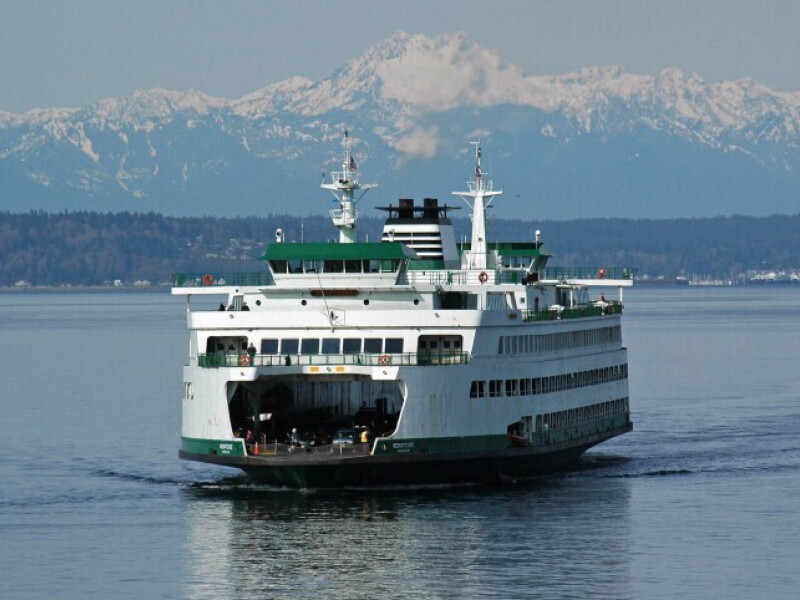
One of the most talked about recent conversions involved the 460'2"x90' Washington State Ferry (WSF) Wenatchee, originally built at Todd Pacific Shipyards, Seattle, in 1998. The vessel is one of WSF’s three Jumbo Mark II-class ferries — the largest in its fleet, with capacity for 2,499 passengers and 202 vehicles. In 2023, as part of WSF’s $4 billion electrification plan, the Wenatchee entered Vigor Marine’s Seattle shipyard to begin the process of conversion to hybrid-electric propulsion.
Design and integration of the new battery-hybrid system and propulsion controls were led by Siemens, which hired naval architects Glosten for the preliminary, contract, and functional design work.
In the shipyard, two of the ferry’s four EMD L16-710G7A diesel generators were removed, and new battery rooms were constructed on both ends. Siemens supplied 864 Blue Vault energy storage modules that deliver 5,702 kWh in total, a pair of energy storage switchboards, and a 12.47-kV NXPLUS C switchboard for charging. The vessel also received transformers from TMC as well as thousands of feet of electric and fiber-optic cable.
The finished product stubbed its toe several times coming out of the gate this summer, but now seems to be operating as advertised. “It’s the largest hybrid-electric vessel in the U.S.,” said Orvieto. “That ferry was responsible for using 25% of WSF’s entire fuel allotment.”
Another Siemens Energy project that got plenty of attention involved the 190'x62'2"x13'3" newbuild ferry Harbor Charger — New York’s first diesel-electric hybrid ferry. Built at Conrad Shipyard, Morgan City, La., and designed by Elliott Bay Design Group, Seattle, the $33 million double-ended car and passenger vessel is owned by a trust for New York Harbor’s Governors Island. NY Waterway operates the trust’s ferry fleet.
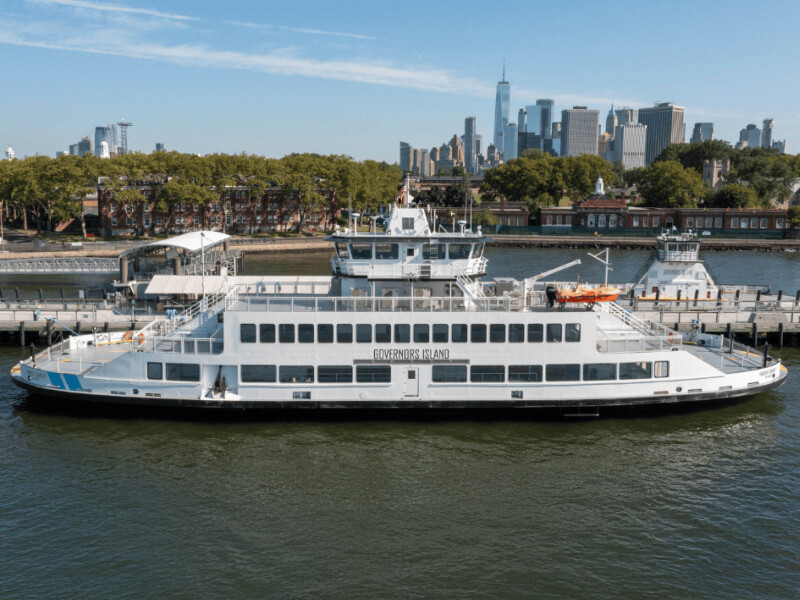
The Harbor Charger runs on Siemens Energy’s BlueDrive Eco diesel-electric propulsion system, supported by the company’s battery systems and digital control platform — the “brain” of the ferry.
Equipped with 870 kWh of Siemens Energy BVES-V3X batteries (split evenly between two battery rooms) and a pair of Cummins QSK 19 diesel generators that provide 656 kWm at 1,800 rpm, the vessel can toggle between three modes of operation: fully battery-powered, hybrid electric with diesel assist, and diesel backup. In hybrid mode alone, it’s expected to cut carbon emissions by nearly 600 tons annually.
Whether retrofit or newbuild, “it’s the people that make the operation work,” said Orvieto. “It comes back to that.”
