



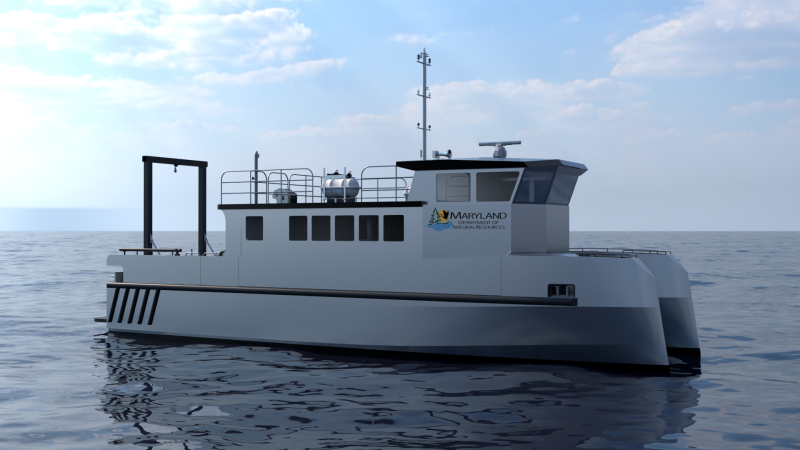
The Maryland Department of Natural Resources has contracted Lyman-Morse Workboats, Thomaston, Maine, to build a 59' aluminum research vessel for year-round scientific operations on Chesapeake Bay and near-coastal Atlantic waters.
Designed by Chartwell Marine, Southampton, U.K., the vessel will support water-quality monitoring, habitat research, sampling, buoy work, and other field operations. Construction will take place at LM Workboats’ 15,000-sq.-ft. metal fabrication facility in Rockland, Maine, followed by final outfitting and systems integration at the company’s Thomaston waterfront facility.
The vessel measures 59.06' LOA with a 19' beam and a maximum draft of 4.92'. Twin MAN diesels will provide propulsion, with the boat designed to reach at least 20 knots at 90% rated engine power.
A dynamic station-keeping system will allow crews to hold position during sampling and data collection in tidal and current conditions. The aft working deck will include an A-frame for deploying and retrieving sampling equipment, buoys, and other research gear.
“This project reflects the growing demand for highly specialized aluminum workboats,” said Jonathan Egan, division manager of LM Workboats. “Maryland DNR came to us with a genuinely complex brief—a vessel that had to perform as a research platform, meet rigorous Coast Guard and UNOLS standards, and operate reliably year-round on the Bay and near-coastal waters.”
The vessel will be built to U.S. Coast Guard Subchapter T, ABYC, AWS, and UNOLS standards and is expected to receive a Certificate of Inspection for as many as 20 passengers on inland and near-coastal waters.
Preliminary specifications list a full displacement of 44 tons. Capacities include 1,000 gals. of fuel, 80 gals. fresh water, 50 gals. black water, and 45 gals. hydraulic oil.
LM Workboats is a division of Lyman-Morse and builds aluminum commercial vessels for government, municipal, and institutional customers.
