



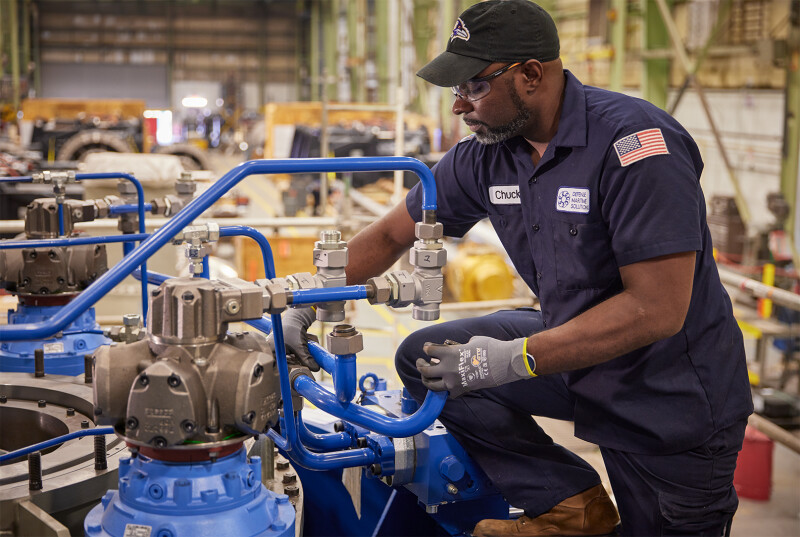
Defense Maritime Solutions plans to invest more than $30 million at its Chesapeake, Va., operations to establish a U.S. manufacturing and testing capability for large Wärtsilä medium-speed marine engines.
The expansion will add manufacturing, assembly, integration, testing, finishing, packaging, and lifecycle support capabilities for engines serving government and commercial marine markets. DMS expects the project to create 32 jobs, with the first engine targeted for delivery from the expanded facility in 2028.
DMS President Noble Davidson said the company is not yet disclosing the full details of its production approach, but the engines will incorporate materials sourced from the U.S. and countries that qualify under federal defense acquisition rules. The majority of the manufacturing work will take place at the Chesapeake operation, he said, with the goal of meeting federal requirements for domestically manufactured engines used on government contracts.
“Ultimately, a vast majority of the overall manufacturing inputs will be conducted at the DMS facility,” Davidson said.
DMS, a wholly owned subsidiary of Finland-based Wärtsilä, currently operates from its Chesapeake headquarters as well as facilities in Poulsbo, Wash., and San Diego, Calif. The company supplies propulsion, power generation, shaft-line, maneuvering, and other shipboard equipment to U.S. Navy, Coast Guard, Military Sealift Command, NOAA, and other maritime customers.
The Chesapeake project will involve both new and existing facilities. Davidson said DMS has acquired property a few doors down from its current operation in the same industrial park, giving the company room to add buildings while also upgrading existing space.
The investment will also cover cranes and specialized equipment for engine manufacturing, lifting, and handling. A significant portion will go toward construction of a test cell capable of running the completed engines and conducting factory acceptance testing before they are delivered to customers.
“We’re targeting the first engine to deliver from the facility in 2028,” Davidson said, adding that he expects the infrastructure work to take roughly 18 months to two years, with workforce development taking place alongside the construction and equipment installation.
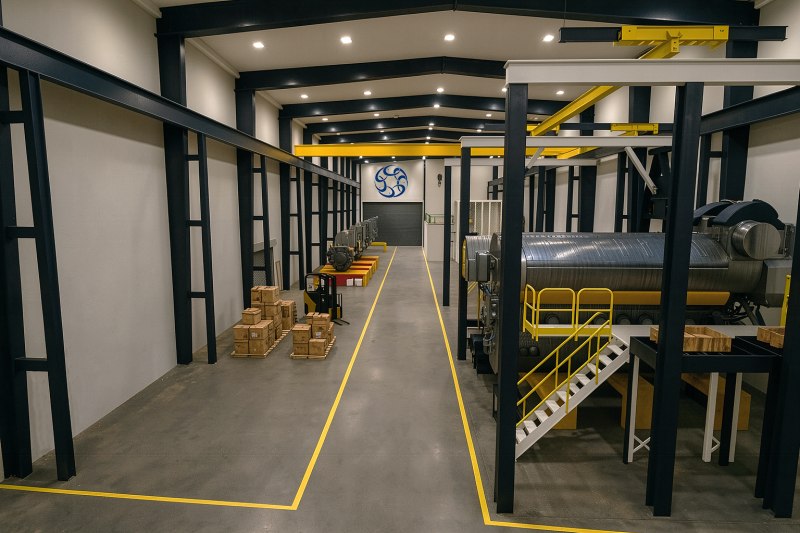
The engines planned for the operation will range from about 1 MW to 10 MW, putting them well above the smaller high-speed engines commonly used aboard tugs and pushboats.
Davidson said the physical size can vary considerably.
“Some of the engines are the size of a 10-foot box truck and some of them are the size of a 53-foot trailer,” he said.
That variation makes it difficult to put a simple annual number on production, since capacity will depend on the size and mix of engines required by vessel programs at a given time. Davidson said DMS believes the facility could initially move more than 100 MW of engine power through the operation each year, with room to scale beyond that if demand supports it.
The investment is aimed in part at federally funded shipbuilding programs with domestic manufacturing requirements. Davidson said DMS is pursuing opportunities with the Navy, Coast Guard, Military Sealift Command, and other government vessel programs, while the company also plans to serve commercial marine customers.
“There’s really only one other supplier today that manufactures engines of this size and scale for the marine defense market in the U.S.,” Davidson said.
DMS is also linking the expansion to the Icebreaker Collaboration Effort, or ICE Pact, the trilateral U.S., Canada, and Finland initiative intended to strengthen allied icebreaker construction and maritime industrial capacity.
The company already supplies equipment for the Coast Guard’s Polar Security Cutter program and is talking with shipyards involved in the Arctic Security Cutter program about additional equipment it could provide. Davidson said the engine project offers another route for transferring Finnish maritime technology into U.S. production, particularly for vessels operating in Arctic conditions.
“Finland is a world leader in not just icebreaker construction, which is often talked about in the ICE Pact program, but also the supporting technologies for those ships,” Davidson said. “Wärtsilä has highly capable engines with Arctic operation capability and things like that that we could bring into the U.S. Coast Guard fleet through this particular investment.”
The 32 jobs expected from the project will span manufacturing engineering and supervision, hands-on assembly work, and specialized positions operating and monitoring the new test cell. DMS plans to work with the Virginia Economic Development Partnership, Hampton Roads Alliance, and the City of Chesapeake on workforce development as the project moves ahead.
Davidson said access to the existing Hampton Roads workforce and supplier network helped drive the decision to expand in Chesapeake rather than establish a new operation elsewhere. DMS has operated in the area for more than four decades, and he said the expansion gives the company an opportunity to build on the team and manufacturing base already in place.
“It speaks to the trust that we have in our existing workforce and our existing local supply partners and business partners in the region,” Davidson said. “We just see this as an ability for us to continue to provide for them and their families.”
