



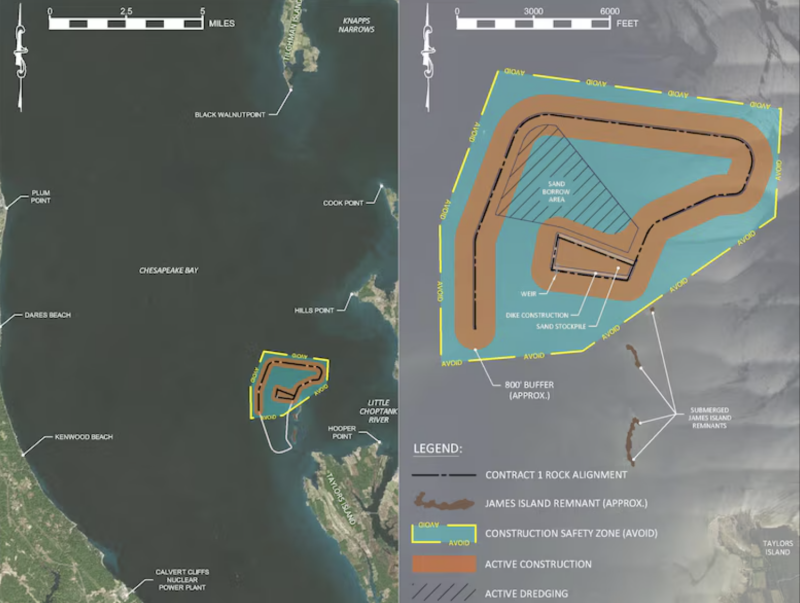
The Army Corps of Engineers Baltimore District on April 2 awarded a $53.83 million base contract to C&C Joint Ventures, LLC, of Gloucester, Virginia, for restoration work at James Island. It’s part of the corps’ Mid-Chesapeake Bay Island Ecosystem Restoration project in Dorchester County, Md., using dredge material from Port of Baltimore channels for ecosystem benefits.
The contract award marks a first phase of restoration work on James Island including mobilization, hydrographic surveys, perimeter dike construction, dredging and the creation of a sand stockpile to be used for future dike construction work.
Corps officials say the total base contract amount is $122.19 million plus options, including additional upland toe dike construction and seeding of the sand stockpile area, using funds from the Fiscal Year 2025 Work Plan for Army Civil Works.
“We are proud to announce this contract award which supports vital maintenance dredging for the approach channels leading to the Port of Baltimore,” said Baltimore District Commander Col. Frank Pera. “Our continued partnership with the Maryland Department of Transportation’s Port Administration on Mid-Bay will build on innovative and proven solutions that serve and strengthen national security and will energize the economy, while also benefitting the Chesapeake Bay’s ecosystem for generations to come. It is a win-win project.”
Construction activities are expected to begin in late April, and the Army corps is issuing advisories for mariners “to use extreme caution and reduce speeds surrounding the James Island Construction Safety Zone and fully avoid the area within the zone as underwater construction activities may cause damage to vessels as well as boating and fishing equipment.”
The Mid-Bay project, a 65% federal, 35% state cost-share partnership with the Maryland Department of Transportation, includes restoration of 2,072 acres of lost remote island habitat on James Island and 72 acres of remote island habitat on Barren Island, using material dredged from the Port of Baltimore approach channels and shallow draft federal navigation channels, respectively. Those habitats marked for restoration include mudflats, low marsh, high marsh, islands, ponds, channels and upland areas.
Upon completion, James Island will be 55% wetlands and 45% upland area, with an upland dike height of approximately 20’.
"This represents the latest significant milestone in the long-awaited Mid-Bay project, which will benefit commerce and the environment," said Maryland Port Administration Executive Director Jonathan Daniels. "Working alongside the Army Corps of Engineers, Maryland has become a leader around the world in beneficially reusing sediment dredged from our shipping channels to rebuild and restore long-eroded islands while creating habitats for wildlife to flourish."
Barren Island is anticipated to begin acceptance of dredged material from the Honga River in fall 2026, with James Island accepting dredged material around 2030, after wetland cell construction efforts to contain the material are completed.
The Mid-Bay project is anticipated to be completed in 2067 – a timeline to provide more than 30 years of capacity to place nearly 95 million cubic yards of dredged material, according to Army corps planners.
Poplar Island, an ongoing ecosystem restoration project by the Army corps and Maryland DOT, wrapped up construction of an expansion effort in January 2021 that is providing “substantial ecosystem benefits and additional dredge material capacity for the approach channels to the Port of Baltimore until 2032.”

