


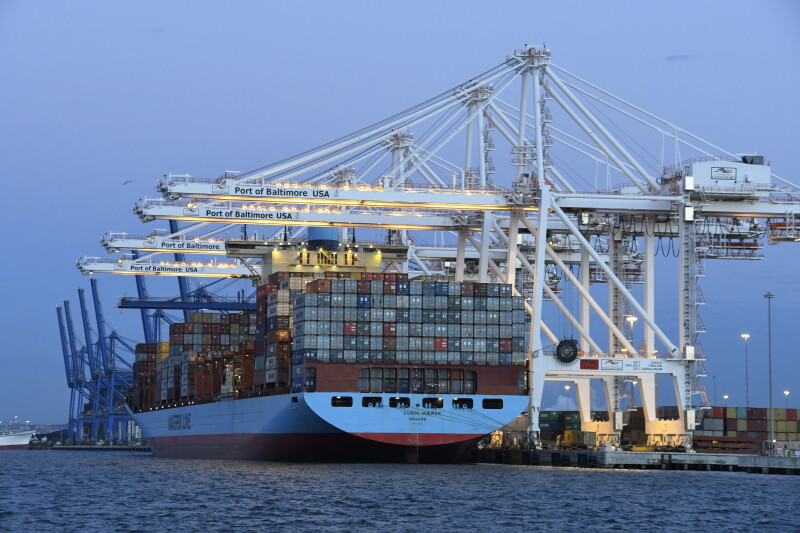
Maryland Gov. Wes Moore has created a statewide maritime task force aimed at attracting shipbuilding, port, defense, and other maritime investment to the state.
The Maryland Maritime Task Force, established by executive order, will be administered by the state Department of Commerce and co-chaired by Commerce Secretary Harry Coker Jr. and Rep. Sarah Elfreth, D-Md.
Its work will include identifying barriers facing maritime companies pursuing federal and commercial opportunities, recommending legislative and regulatory changes, coordinating workforce and grant programs, and evaluating tax credits and other business incentives.
The task force will also prepare Maryland to seek designation as a federal Maritime Prosperity Zone if Congress establishes the proposed program.
Maritime Prosperity Zones were outlined in the White House’s 2026 Maritime Action Plan as a way to encourage private investment in shipbuilding, repair, maritime manufacturing, and waterfront communities through tax incentives modeled on existing Opportunity Zones. Legislation introduced in July would authorize up to 100 such zones, but the proposal remains pending in Congress.
“Maryland’s infrastructure is perfectly suited to lead the nation’s maritime industry, from building in-demand ships to creating positions for welders, mechanics, and engineers,” Moore said.
The task force will include representatives from state transportation, commerce, labor, natural resources, military, and economic development agencies, along with representatives from the Port of Baltimore, maritime businesses, research organizations, workforce programs, and labor or trade groups.
Federal organizations including the Navy’s Naval Surface Warfare Center Carderock Division, Coast Guard operations at Curtis Bay, the U.S. Naval Academy, and the Army Corps of Engineers’ Baltimore District may also participate.
The executive order requires the group to submit an initial assessment of Maryland’s maritime sector by Feb. 1, 2027, followed by an action plan identifying opportunities and barriers by April 1. Its first progress report is due June 1, with additional reports required every six months.
Maryland said its maritime industries contribute more than $10.2 billion annually to the state economy and support about 115,000 jobs across marine transportation, shipbuilding and repair, defense, logistics, research, and recreation.
The initiative comes as several large maritime investments move forward in the state.
Anduril Industries announced this month that it plans to invest $3.7 billion in Arsenal-2, a two-million-sq.-ft. manufacturing complex at Sparrows Point in Baltimore County. The facility is intended to expand production capacity for the Virginia-class submarine program and is expected to create more than 3,100 direct jobs.
The Coast Guard is also planning a $1.5 billion modernization of its Curtis Bay shipyard, while the Port of Baltimore is building on the completion of the $495 million Howard Street Tunnel project, which allows double-stack intermodal trains to move to and from the port.
Elfreth said the task force will build on efforts already underway to bring shipbuilding work to Maryland and expand investment at Coast Guard Yard Baltimore and other maritime facilities.
The Port of Baltimore handled record container volumes and ship calls in 2025, according to the state.
