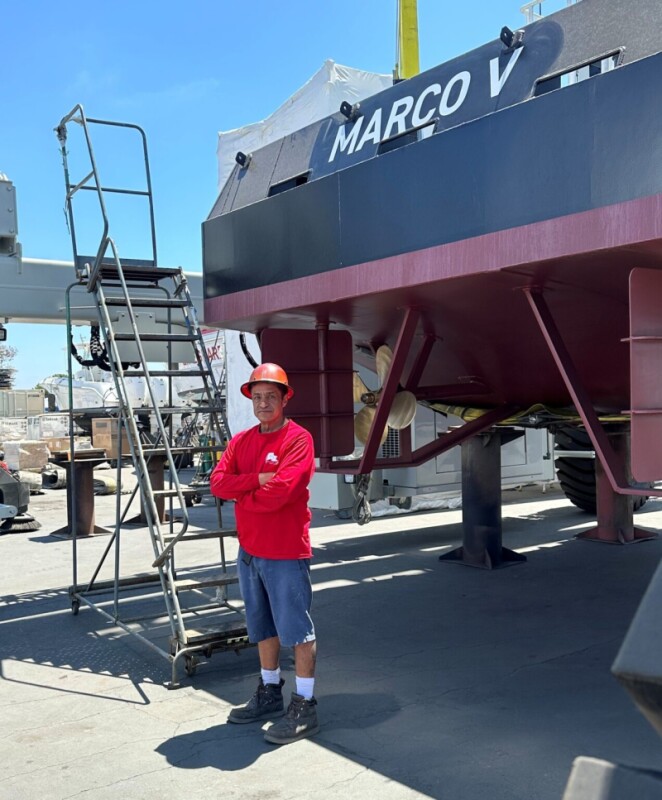
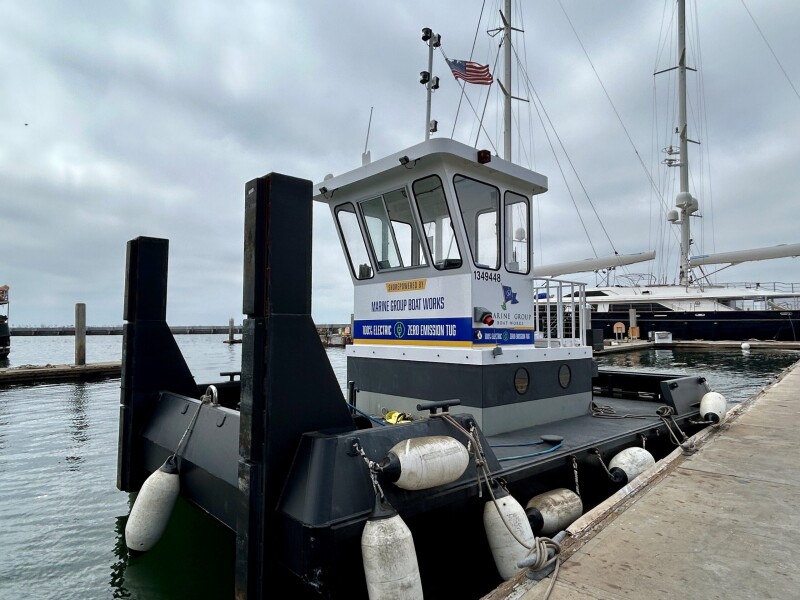
Marine Group Boat Works (MGBW), Chula Vista, Calif., has completed the conversion of its diesel-powered yard tug Marco V to full battery-electric propulsion. The retrofit replaces the vessel’s original Tier 3 diesel engines with four electric motors using Torqeedo Deep Blue 100i inboard systems and battery modules, each generating 135 hp at 900 rpm.
The vessel, originally built by Progressive Industrial Inc., Memphis, Fla., was operated briefly with its factory diesel engines before being stripped and converted to electric. MGBW president Todd Roberts said the shipyard considered building the electric tug in-house but determined it was more cost-effective to purchase a ready-made truckable tug.
The repower required over 2,000 labor hours and included removing the engines, clearing the engine room, and installing a modular electric drive system and charging infrastructure. The 25’x14’x5’ tug now operates daily at the yard and charges overnight using 480V shore power through a five-pin Hubbell plug.
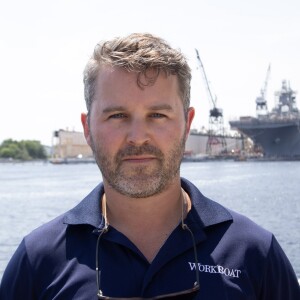
Roberts told WorkBoat that the decision to electrify the tug was part of a broader effort to develop a standardized battery-electric propulsion package for small workboats, passenger vessels, and truckable tugs.
“The goal was to build a platform that we could have as an off-the-shelf solution,” he said. “We’ve been involved in so many electrification projects. … ABB wanted to do one. Corvis battery wanted to do one. BAE hybrid wanted to do one. And everybody had custom parts. Nobody … could tell you what it cost.
“There was no matrix for an intelligent boat owner to say, ‘Hey, how do I do this?’” he continued. “We thought, ‘Man, there is such a huge opportunity’ in the dinner cruise, charter, ferry fleet, and truckable construction tugs…if you could just tell them what you were selling.
“In other words, ‘Hey, if you buy this package for X dollars, I can get you eight hours of an 800 horsepower equivalent tug … for $752,000.’ ‘Or I can give you a dinner cruise boat operating at clutch ahead on a three-hour wedding tour … for $748,000,’” Roberts said. “Now that's something that a boat owner can grab onto and can say, ‘Okay, I can make a business case for this,’ or ‘I can apply for a grant for this’…but that didn't exist.”
Roberts said the California Air Resources Board’s South Coast Air Quality Management District funded roughly half of the project, after Marine Group Boat Works decommissioned an older Tier 0 tug as part of its clean air compliance.
“We actually had another tug that we started the project with,” said Roberts. “That hull was so compromised that we went back to the [California] Air Resources Board and said, ‘instead of converting our existing boat, let us take this brand-new boat and build this demonstration platform that we could then take out to market and really be able to encourage more people.’”
When asked about possible weight differences and engine control room reconfigurations, Roberts said there were essentially none. “Everything floats at the same point,” he said, noting the vessel weighs within 10% of its original build. “We removed the diesel tanks and the diesel engines. The shaft line didn’t change. The fendering didn’t change,” he said, “it just worked.”
Additionally, MGBW mounted the battery packs on a removable skid for ease of servicing, and the bolted pilot house can be removed with a crane for maintenance access.
As for change in horsepower, Roberts was quick to respond. “If you look at the torque equivalent … their [the Torqueedo's] torque equivalent is greater than that of the 400-horsepower Cummins at 1,800 (rpm),” he said, noting the existing diesel props were spinning faster than expected.
The Marco V is now outfitted with 28" Michigan Wheel four-blade propellers.
“We ordered new propellers, and we’re actually torquing the propellers up. The boat was going too fast. … It was nose-diving when we put it in the water.”
Roberts highlighted the sectors where he believes this type of repower will be most effective, specifically dinner cruises and truckable tugs.
“All (of) those truckable tugs that go work little marsh work where they … got to bring the tug in and … they may have emissions issues. … This thing stacks just on top of a semi, just like any other truck, but you don't have to fuel it. … If you've got generators working on-site anyway, you just run this thing off of your generator, so you don't have to worry about the logistics of bringing diesel in,” he said, highlighting efficiency benefits in addition to environmental benefits.
Roberts said it takes roughly eight hours to charge the tug from zero to full battery.
Additional projects at MGBW include a 750kW solar array scheduled to come online later this year. The system is expected to support yard operations by powering the tug’s charging station and supplying electricity to more than 85% of the shipyard’s electric vehicle and forklift fleet.