



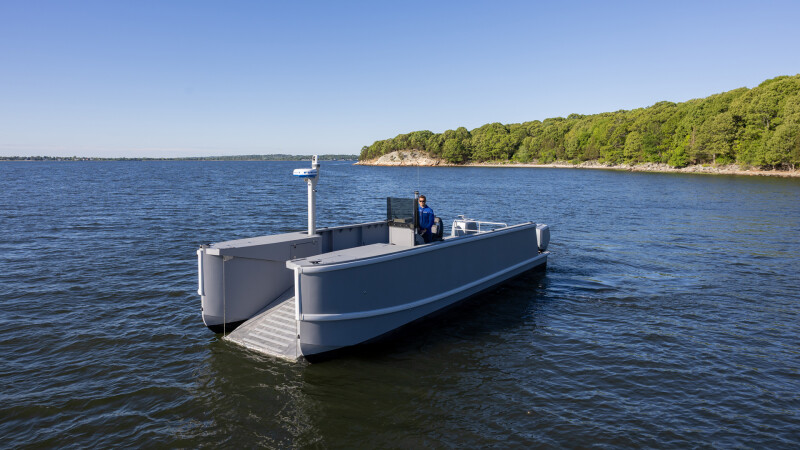
The U.S. Marine Corps has received the first prototype of the SHARC, a 38' autonomous amphibious vessel developed to move personnel, equipment, and supplies into areas without usable port infrastructure.
Tactical Composites, Bristol, R.I., developed the Small High-Speed Amphibious Role-Variant Craft through the Marine Corps’ Small Business Innovation Research program. Safe Harbor Front Street built the vessel in Belfast, Maine, and launched it for initial sea trials in April.
The 37.75'x13.45' catamaran draws 2.41' and can carry up to 14,000 lbs. of cargo. An automated bow ramp allows equipment and supplies to be placed directly onto a beach or into the water.
Twin 300-hp OXE diesel outboards provide a cruising speed of 20 knots and a maximum loaded speed of 25 knots in Sea State 3 conditions. Tactical Composites lists the vessel’s range at more than 1,000 nautical miles.
Potential military uses include transporting food, water, fuel, munitions, unmanned ground vehicles, and other equipment to shorelines where harbor access is unavailable. The vessel could also support casualty evacuation, the launch and recovery of aerial and underwater drones, and coordinated operations with other unmanned systems.
“The future battlefield demands logistics solutions that are resilient, adaptable, and capable of operating where traditional infrastructure is unavailable,” said Rich O’Meara, principal at Tactical Composites. “The SHARC was designed from the outset to be mission-flexible and capable of evolving with operational needs.”
The SHARC uses an open autonomy architecture designed to accommodate cameras, radar, GPS, sonar, and other sensors. Robosys Autonomous Marine Solutions, North Kingstown, R.I., developed the autonomy system.
Mode 3 Design, Annapolis, Md., handled the vessel design, while Waterfront Composite Solutions, Edgewater, Md., provided engineering services. Cay Electronics Inc., Portsmouth, R.I., and DQ Yachts Inc., Miami, Fla., supplied electronics work.
The hull was built from vacuum-infused fiber-reinforced plastic using fire-retardant vinyl ester resin and foam-core construction. Carbon fiber reinforces the deck, which includes several cargo tie-down arrangements and alloy rail protection for tracked equipment. The bow ramp is designed to support the vessel’s full payload while under cantilevered loading.
The vessel can be transported over the road on a low-boy trailer, although its beam requires a wide-load permit.
The Marine Corps plans to conduct additional sea trials, autonomy validation, payload testing, and operational demonstrations during summer and fall 2026.
Additional SHARC vessels are on order for delivery in 2027 and 2028, according to Tactical Composites. The company is also developing a larger variant and evaluating commercial applications in offshore energy, wind farm support, remote island logistics, and personnel transportation.
Tactical Composites is targeting a production cost of approximately $1 million per vessel and plans to work with U.S. shipyards on future manufacturing.
The company is a division of ROM Innovation & Development LLC. Safe Harbor Front Street operates a shipyard in Belfast and a composite fabrication facility in Bucksport, Maine.
