



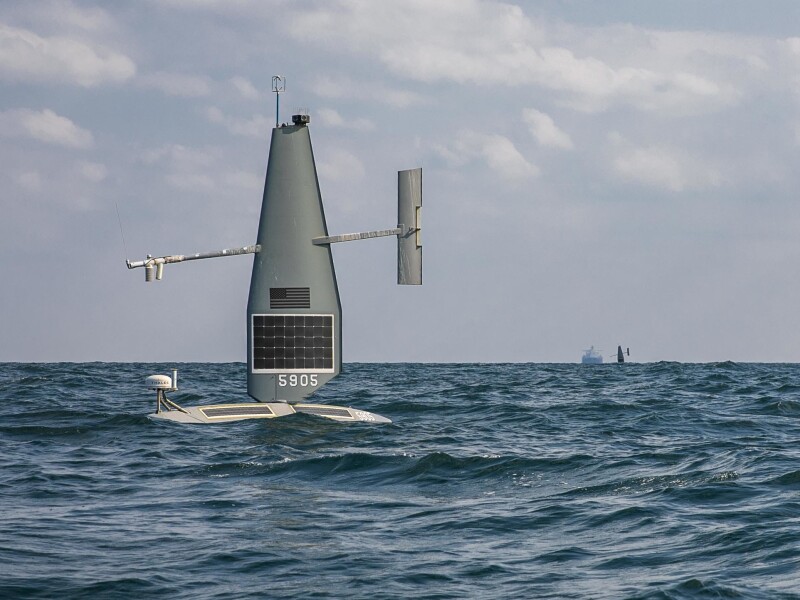
Lockheed Martin, Bethesda, Md., has announced a $50 million investment in Saildrone, a California-based developer of autonomous surface vessels, as part of a new partnership aimed at integrating advanced defense systems into unmanned platforms for the U.S. Navy.
The collaboration will pair Lockheed Martin’s defense technology with Saildrone’s long-endurance, ocean-tested unmanned surface vehicles (USVs). The companies plan to conduct integrated, on-water live-fire demonstrations in 2026.
Under the agreement, the two companies will apply an open-architecture approach and secure command-and-control systems to integrate Lockheed Martin’s JAGM Quad Launcher (JQL) onto the 65’ Saildrone Surveyor USV.
Larger Saildrone platforms now in development are expected to carry heavier payloads and systems such as Lockheed Martin’s Mk70 vertical launch system and towed sonar arrays for anti-submarine missions, the companies said in a press release.
Lockheed Martin said it will serve as lead mission integrator while Saildrone continues to handle all vessel construction.
The effort aligns with the Navy’s growing interest in unmanned surface and undersea vessels to support fleet defense, reconnaissance, and undersea surveillance missions. The integration of lethal payloads marks a new phase in blending commercial autonomous platforms with U.S. military systems, the companies noted.
Saildrone USVs have operated continuously in ocean environments since 2013 and began U.S. Navy service in 2021. The company says its vessels have logged more than 2 million nautical miles and are currently deployed alongside manned ships in operational theaters worldwide.
“Lockheed Martin and Saildrone are leading the way to answer President Trump’s call for the defense industry to act differently and leverage the strength of all of industry for our national defense,” said Stephanie Hill, president of Lockheed Martin’s Rotary and Mission Systems. “Together, we are combining sophisticated commercial and defense technologies to deliver a lethal naval solution at speed and scale.”
Saildrone founder and CEO Richard Jenkins said the company’s proven autonomous technology is ready for the next step. "With our technology proven, de-risked and mission ready, now is the right time to augment Saildrone USVs with sophisticated payloads to meet warfighter needs,” Jenkins said. “This collaboration will give Saildrone the tools we need to transform the capabilities of our platforms, to include electronic warfare, anti-submarine warfare, sophisticated surveillance and reconnaissance, as well as deploying kinetic effects, all seamlessly integrated with Lockheed Martin’s trusted command, control and fire control systems.”
Lockheed Martin said its investment aims to accelerate development of larger, more capable USV platforms and enable faster fielding of autonomous maritime systems. The company also plans to upgrade its own payloads for fully autonomous operation.
