



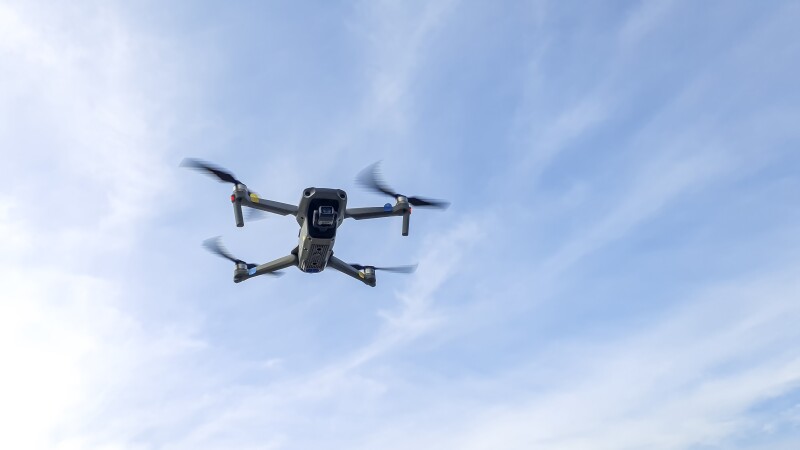
Federal lawmakers and the nation's largest port industry trade group are advancing efforts to give U.S. seaports stronger authority to detect and stop unauthorized drone flights over their facilities.
U.S. Reps. Jimmy Patronis, R-Fla., and Mike Haridopolos, R-Fla., introduced H.R. 9229, the Seaport Security Act of 2026, on June 30. The bill would establish controlled or restricted low-altitude airspace — below 400' — over critical seaport areas and direct the Federal Aviation Administration (FAA) and the Department of Homeland Security (DHS) to coordinate enhanced drone detection and mitigation capabilities at ports, while preserving authorized commercial, governmental and emergency drone operations.
"In Northwest Florida, our ports are critical to our economy, our military, and our national security. Yet here and across the country, growing drone threats are exposing dangerous gaps in our ability to protect this vital infrastructure," Patronis said.
Haridopolos said the bill "closes dangerous security gaps by giving our ports the tools they need to detect, deter, and respond to unauthorized drone activity while ensuring legitimate commercial and emergency operations can continue safely."
The bill's sponsors point to Port Canaveral as an example of the scale of the problem. The port recorded more than 500 drone incursions in 2025, including unauthorized flights over nationally strategic aerospace and military operations and cruise terminals serving up to 60,000 passengers daily.
Port Canaveral CEO Capt. John Murray said the port handles a heavy mix of vulnerable traffic. "Thousands of cruise passengers, millions of tons of high value cargo, energy supplies, aerospace recoveries, and military cargos are regularly moving in and out of our port," he said.
JAXPORT CEO Eric Green and Port of Pensacola Director Lance Scott also backed the bill, along with Florida Ports Council Chairman Michael Meekins, who said Florida's seaports "need clear federal authority and coordinated tools to detect and respond to unauthorized drone activities."
The legislative push came as the trade group American Association of Port Authorities (AAPA) submitted formal comments June 29 to the FAA on a separate, ongoing rulemaking process tied to unmanned aircraft flight restrictions around critical infrastructure, including ports. That rulemaking implements Section 2209 of the FAA Extension, Safety, and Security Act of 2016.
In the letter, AAPA President and CEO Sang Yi said port facilities face elevated risk given the traffic they handle. "Ports routinely handle hazardous materials, military cargo, cruise passengers, energy products, chemical shipments, and essential consumer goods that are vital to national economic and homeland security," Yi wrote, adding that "the threat posed by attack drones is particularly acute in the cruise sector, where a single vessel may carry several thousand passengers and crew."
AAPA's comments laid out eight recommendations, including streamlining eligibility for facilities already regulated under the Maritime Transportation Security Act, recognizing port authorities, rather than individual tenants, as eligible applicants for flight restrictions covering multi-tenant port property, and allowing restriction boundaries to extend beyond strict property lines to cover berths, channels and waterside operations.
The group also flagged a gap in the FAA's proposed altitude limits. Under current drafting, restrictions would generally cap at 400' unless a facility has structures taller than 300' — a threshold AAPA said many ports with 150' to 250' ship-to-shore cranes would not meet, potentially leaving drones legally authorized to fly above port operations while still capable of conducting surveillance.
Yi also argued the stakes extend well past the terminal fence line. "The consequences of unauthorized drone activity at a port may extend far beyond the immediate facility and impact broader economic resilience, defense readiness, and homeland security objectives," he wrote.
While AAPA said it supports the FAA's proposed framework for designating restricted airspace, the group noted the rulemaking alone does not grant ports any new authority to actually detect or disable unauthorized drones, and urged federal agencies to pair the airspace designations with expanded detection and mitigation tools, additional counter-drone training capacity, and stronger coordination among the FAA, DHS, the Department of Justice, the Transportation Security Administration and the U.S. Coast Guard.
