


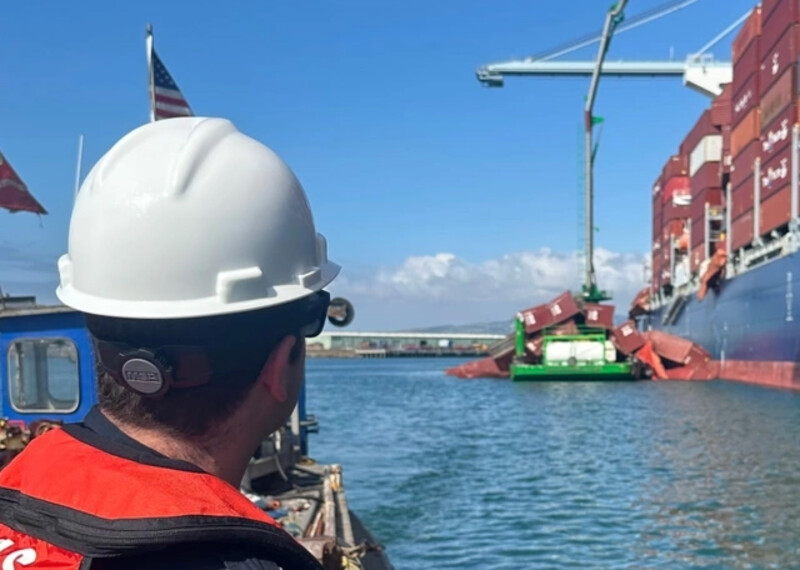
As it turned out, despite how bad things looked for the emissions-reduction barge alongside the Mississippi, the dramatic container avalanche of 95 boxes at Pier G in the Port of Long Beach proved to be not only non-fatal but nearly injury-free. And the one reported injury — a sprained ankle sustained by a crewmember on the barge who was fleeing on deck from the falling boxes — was minor, considering what could easily have happened.
I attribute this remarkable fact to three things. First, the spudded-down position of the barge STAX 2 was abeam the ship’s superstructure so the crew could reach the exhaust funnel with their articulated boom. This effectively provided narrow but likely critical protection as the barge wasn’t struck by falling containers simultaneously over its entire length. Second, the barge crew was maintaining enough situational awareness that getting out of the way of the falling boxes was possible. It pays to pay attention. And third, dumb luck — which can never be counted on to save you, and therefore shouldn’t be — but nonetheless will continue to do exactly that, intermittently, completely at random, and without obvious favor.
Which of these was the deciding factor? It could have been any or all of them, to varying degrees, and I would bet on all. Any number of known or unknown factors could have easily altered the outcome significantly.
Risk analysis is challenging. We can’t know everything that might affect an activity, or how to quantify it. I’ve heard plenty of people say, “I’d rather be lucky than good.” I disagree, because with all the things you can’t control, your knowledge and skills are among the very few things you can.
Still, don’t ever discount luck.
