



For generations, naval architects worked at the drafting table, where lines on paper slowly gave shape to a vessel that did not yet exist. Hull form, stability, structure, machinery, and mission requirements were worked through, revised, and worked through again until the drawings were ready to move into a shipyard.
Though the drafting table has largely disappeared, the design spiral remains. These days, what has changed most dramatically is how much of the vessel can be modeled, analyzed, reviewed, and prepared for production before the first piece of steel or aluminum is cut.
“Our competitor was paper and pencil and drawing boards,” said Bruce Hays, a naval architect and cofounder of marine design software developer Orca3D, Annapolis, Md. “We were really trying to educate people about the benefits of moving off of the drafting table and onto the computer for the purposes of hull modeling and fairing and lofting.”
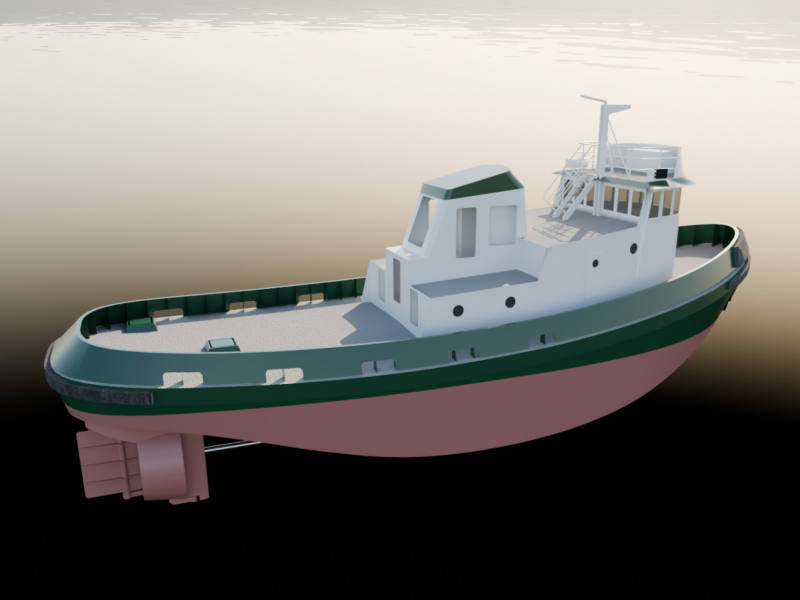
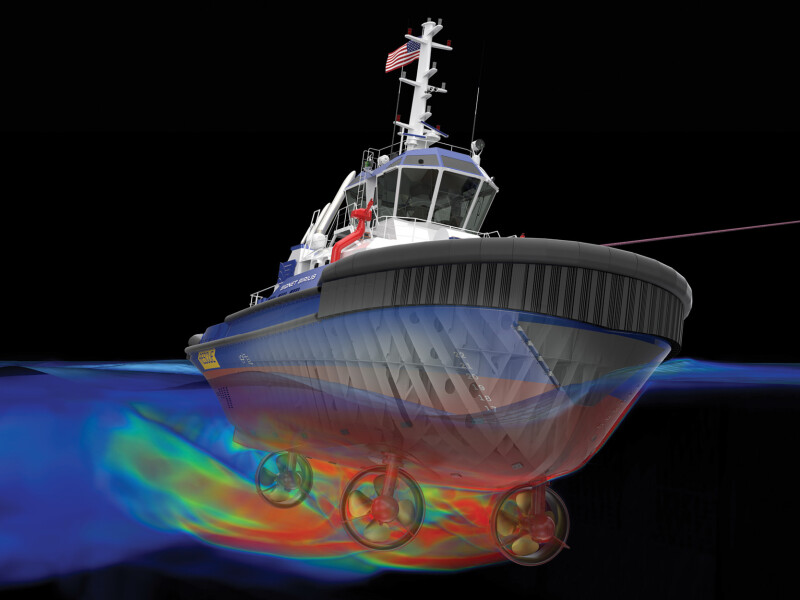
Today’s tools go further. Naval architects can model hull geometry, calculate stability, track weight, run computational fluid dynamics, assess resistance and powering, coordinate onboard systems, and produce information that moves directly into fabrication.
That gives owners, yards, class societies, and production teams a chance to resolve issues while the vessel is still digital.
“It is more efficient and cost effective to resolve those items while it is a virtual boat,” said Lawren Best, director of business development at naval architecture firm Robert Allan Ltd., Vancouver, British Columbia, “instead of steel being cut and assembled in a shipyard.”
EARLIER IN THE SPIRAL
Software has not eliminated naval architecture’s tradeoffs. Changes in hull form, fuel, machinery, weight, and arrangement can affect performance, stability, structure, and maintainability.
Hays described the design spiral as repeated passes through competing requirements, with higher-fidelity tools entering sooner while choices remain open.
“What all of this does is [take] friction out of the design process,” Hays said. “Anytime we can not only shorten that time and take friction out, that improves the design process. But along the way, we can also provide insights to the naval architect that he or she might not have gotten just by going through the process repeatedly, even if it’s faster.”
At HydroComp Inc., Newmarket, N.H., technical director Donald MacPherson approaches the vessel from the performance side. NavCad 2026 and PropElements support resistance, propulsion, and propeller analysis.
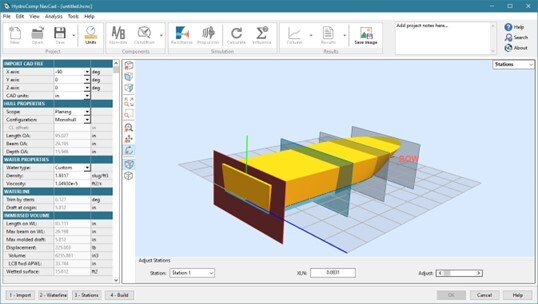
“We’re making answers more precise,” MacPherson said. “We’re evaluating broader design spaces, which is great for the product, and it allows us to find optimizations and eliminate risk.”
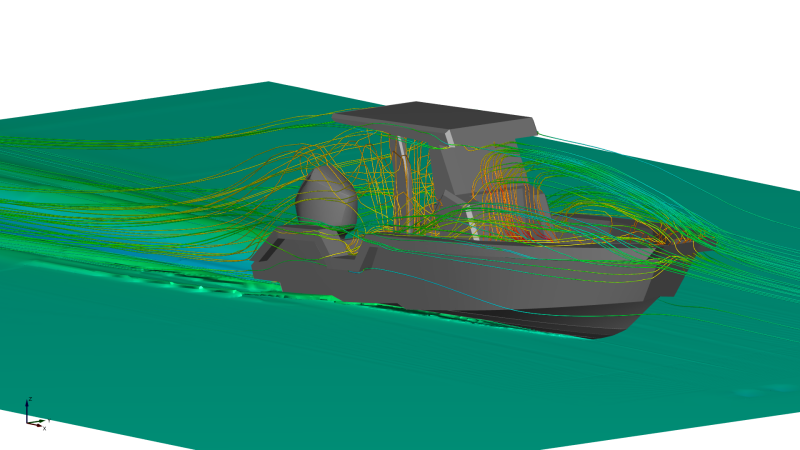
Earlier analysis can narrow the choices that later reach physical testing. Orca3D’s marine CFD tools can compare hull variations, inspect pressure distribution and flow, and narrow alternatives before model testing.
Repair brings different constraints. During the repower of the 77' Edith Foss, Darren Monzingo, president of engineering firm Faro Industrial, Friendswood, Texas, had to fit modern propulsion and Tier 4 emissions equipment into a tug built in 1980 with virtually no unused machinery space. Adding diesel exhaust fluid storage meant sacrificing some fuel capacity.
“We used ORCA 3D to test out different tank partitioning strategies,” Monzingo said. “Once we were satisfied with those partitioning boundaries and volumes, we could immediately proceed to basic stability analysis to determine what, if any, penalties it created for intact stability or vessel trim.”
FROM MODEL TO PRODUCTION
The digital vessel becomes more consequential in production. Juan Nunes Prieto, regional manager, Americas, at Cadmatic’s North Vancouver, British Columbia, office, said the model can carry structural, piping, electrical, and outfitting information together and feed production machinery.
“The biggest change is that software used to be a tool mainly for producing drawings,” Prieto said. “Increasingly, the tool is becoming a single source of truth that holds the vessel together, with the drawing as just one output of that model.”
At Silver Ships, Theodore, Ala., naval architect Clay Danielson said the boatbuilder develops a functional model and extracts CNC-ready parts and assembly information as the design matures.
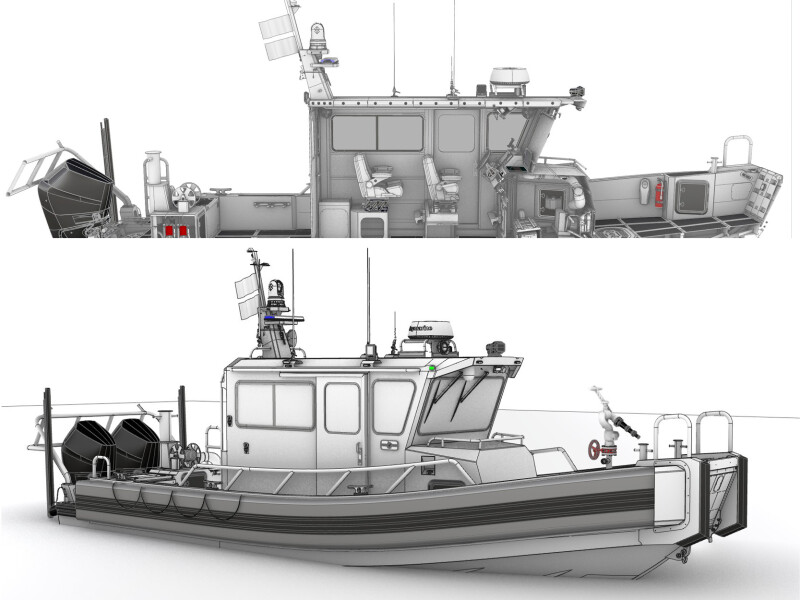
“3D modeling at the level we’re doing it is essentially building the boat first with the software and analytical design tools that we use,” Danielson said. “In that process we have the opportunity to optimize the boat for equipment layouts, ergonomics, for production, et cetera, and also to find and fix conflicts where they arise.”
Silver Ships is applying that approach to a patrol boat under construction for Calcasieu Parish, La. Its digital model combines vendor equipment with components modeled from drawings and technical information, allowing the yard to examine arrangements before fabrication reaches those portions of the build.
Best said earlier shipyard participation similarly reduces the gap between a naval architect’s design and how a particular yard will build it.
“You’re getting something designed that is going to be far closer to the end product, and you’re getting that product faster,” Best said. “Everyone is on the same page and can make those agreements so there are no surprises down the road.”
Production personnel at Silver Ships can also access the model on workstations and tablets.
“We’re developing the model in the engineering department, but it’s being referenced and used as a build tool for all production stakeholders inside the company as a supplement to the construction drawings,” Danielson said.
Prieto said the digital twin can continue after delivery, updated during repair and supplemented with operational information to give owners and yards a current representation of the vessel.
“The idea is that this model shouldn’t stop being used at delivery,” Prieto said. “It should continue to represent the vessel throughout its operational life.”
IN THE LOOP
Digital tools do not relieve naval architects, builders, or operators of responsibility for design decisions. Every tool works within assumptions, and every optimization affects the vessel.
“Software is not a replacement for expertise,” MacPherson said. “It takes expertise and provides it to a larger community, but that larger community needs to have some minimum level of understanding and appreciation of the discipline.”
Larry Leibman, an Orca3D co-founder and naval architect, said software can compare alternatives, but human experience remains central to design decisions.
“The human comes into play, especially humans with vessel design experience,” Leibman said. “They’re going to guide the decisions that have to be made. The human is still in the loop during the most critical portions of the design optimization process.”
Best said Robert Allan Ltd. is testing AI for efficiency, but not entrusting it with design, and still puts designers aboard vessels and into shipyards.
Danielson said experience remains central.
“Our designers are professional boatbuilders with decades of experience in the boatbuilding trades, who learned the software and 3D modeling component of the business,” Danielson said. “There is no software tool or AI platform that can replace the knowledge and experience they build into their designs. The software and digital tools that we use to create the designs ultimately serves our purpose to support production, and to support the boatbuilders and craftsman who build each boat by hand.”
