




Huntington Ingalls Industries (HII), Newport News, Va., has introduced ROMULUS, a modular, AI-enabled family of unmanned surface vessels (USVs) powered by HII’s Odyssey Autonomous Control System (ACS) software suite.
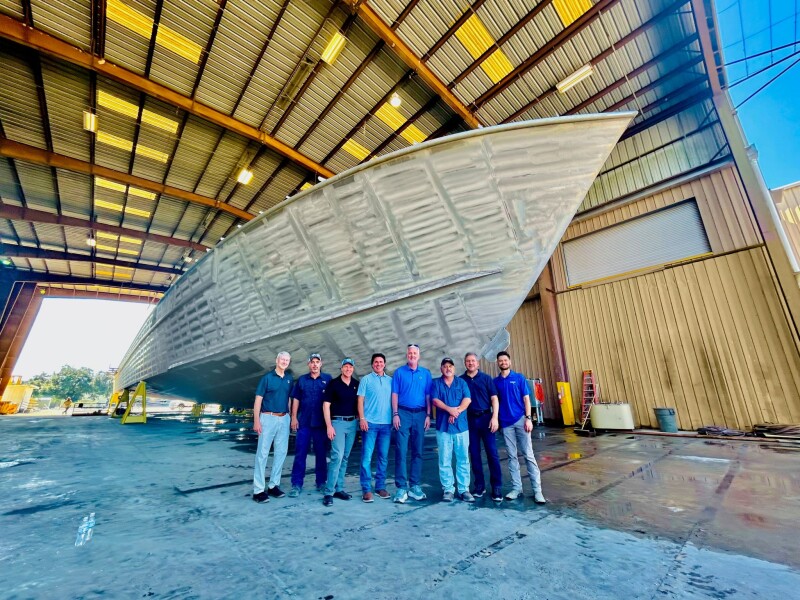
ROMULUS 190, the flagship of the ROMULUS family, is currently under construction at the Breaux Brothers Enterprises shipyard in New Iberia, La. Built on a commercial-standard hull, it is engineered for rapid, repeatable production and immediate mission readiness. Designed for speeds exceeding 25 knots, the 190' vessel will be capable of a minimum range of 2,500 nautical miles carrying 4'x40' ISO intermodal containers on the payload deck. ROMULUS 190 is being developed in partnership with Breaux Brothers as well as Beier Integrated Systems, Mandeville, La., and Incat Crowther, Lafayette, La.
ROMULUS is designed to meet the current and emerging requirements of the Navy, Marine Corps, joint forces, and allies, according to HII. It delivers high-endurance, sustained open-ocean autonomy with a focus on lethality, cost efficiency, and scalability.
“The future fight demands speed, agility, and resilience, all embedded in the Odyssey-powered ROMULUS family,” Chris Kastner, HII president and CEO, said in a prepared statement. “By matching world-class shipbuilding with decades of unmanned systems expertise, we are delivering a mission-ready, swarm USV capability built for the next generation of operations.”
Odyssey ACS software suite has demonstrated performance on more than 35 USV platforms with over 6,000 operational hours in Navy, Marine Corps, Coast Guard, and international allied programs. Odyssey’s intuitive interface and enhanced, customizable features generate the required mission behaviors for greater lethality and survivability with simplified control of unmanned swarms across domains, making it a force multiplier for the modern fleet.
The software suite’s open-access, government-aligned architecture enables rapid integration of new sensors, payloads, and third-party autonomy technologies. It allows industry, government, and academia to test and refine capabilities, ensuring ROMULUS evolves in step with emerging naval concepts of operations.
ROMULUS integrates technologies from Shield AI, Applied Intuition, and C3 AI with HII’s Odyssey for enhanced autonomy, object classification, and lifecycle sustainment.
ROMULUS’s reconfigurable design supports teaming across surface, subsurface, and air domains for missions including counter-unmanned air systems (C-UAS), intelligence, surveillance and reconnaissance (ISR), strike operations, and the launch and recover of unmanned undersea vehicles (UUV) and unmanned aerial vehicles (UAV).
Paired with HII’s REMUS UUVs, ROMULUS extends undersea reach, closing anti-submarine warfare sensing gaps and keeping manned platforms at a safer standoff distance. REMUS’s decades-long track record in mine counter-measures (MCM) missions accelerates clearance operations and reduces fleet risk. Together, ROMULUS and REMUS deliver a scalable dual-domain solution across surface and subsurface missions, according to the HII statement.
Developed with support from HII’s Dark Sea Labs Advanced Technology Group, ROMULUS takes its place alongside the proven REMUS UUV line, of which more than 700 have been delivered to over 30 nations and more than 90% are still operational after more than two decades. Together, ROMULUS and REMUS, powered by HII’s Odyssey autonomy, form a dual-domain family of unmanned platforms that expands operational reach, maximizes mission flexibility, and ensures dependable performance across the full maritime spectrum.
Built on open standards, including Unmanned Maritime Autonomy Architecture (UMAA), Robot Operating System (ROS), and Data Distribution Service (DDS), Odyssey ensures compatibility with Navy autonomy requirements and control stations now and into the future. Odyssey’s modular architecture also allows for rapid reconfiguration and integration with modular payloads, new sensors and systems.
Odyssey enables control of either individual assets or swarms, a key capability for enabling the future fight. Odyssey’s mission library delivers high-level autonomy with ease in executing rapid single-agent tasks or complex, multi-agent scenarios in coordination with crewed and unmanned platforms. Secure data management enables instant analytics or detailed post-mission review, while its modular design supports seamless integration of customer or third-party sensors, payloads, algorithms, and interfaces.
Autonomous health monitoring, sensor fusion, and perception deliver intuitive mission planning, real-time situational awareness, and diagnostics. Navigation is compliant with the International Regulations for Preventing Collisions at Sea (COLREGS), ensuring operational reliability in all conditions.
