


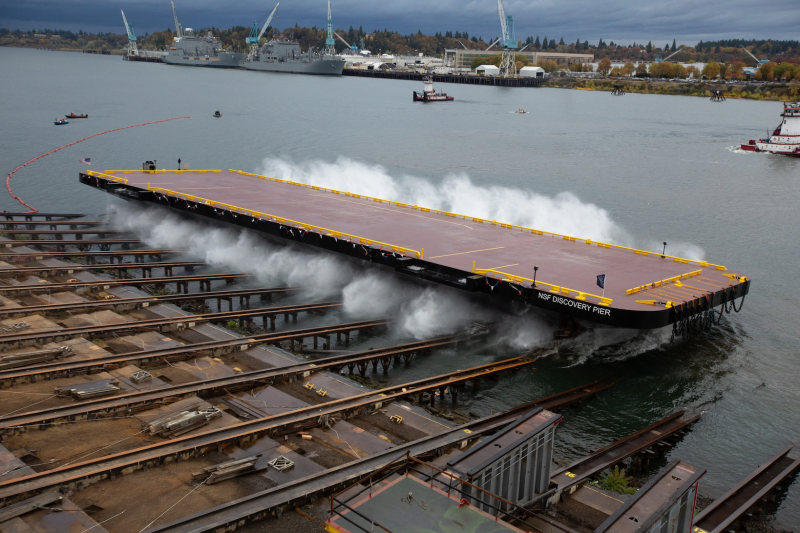
Gunderson Marine & Iron, Portland, Ore., has completed construction of a new 328'x100'x18' steel barge pier for the National Science Foundation’s McMurdo Station, marking the end of the site’s decades-old tradition of building seasonal ice piers to support annual resupply operations.
Gunderson president Dee Burch spoke to WorkBoat about the NSF’s current pier system. “It’s incredibly unique. Nowhere else in the world does somebody moor to a pier made of ice… But with changing ice conditions, that’s become a real problem. It’s labor-intensive, it breaks down early, and it’s getting harder and harder to make it work.”
The U.S. Army Corps of Engineers contracted Seattle-based designer Glosten for the build, developing what Burch described as a barge “shaped like a soup bowl.” The raked hull’s sloped design is engineered so that as sea ice grows around the structure, the upward force lifts the barge rather than crushing it. A Gunderson spokesperson also noted TAI Engineers, New Orleans, contributed detail drawings from the Glosten design to facilitate shop drawings.
“Most of the features are tied to extreme temperature and ice loads,” Burch said. “But that also means the barge sees a lot more force than a normal barge—probably two to three times what we’d typically design for.”
The shipyard fabricated the barge and heavy-duty steel struts that will connect the structure to foundations installed by the Corps and U.S. Navy Seabees once the barge arrives in Antarctica. Burch noted the Corps will handle all foundation and installation work on site. “We’ve been focused on the struts and the barge,” Burch said. “Getting people down there to do construction is a challenge in itself, so it makes sense for the Corps and the Seabees to handle that.”
McMurdo Station’s website notes the barge is “equipped with several ballast bins inside the hull — these are to be filled with a heavy iron-ore based slurry (weighing 300 lbs. per cu. ft.) once the barge is in place at McMurdo.”
Delivery from Portland is set for mid-December. Tradewinds Towing, New Orleans, will handle the tow. Tradewinds vice president of operations Ryan Babcock confirmed with WorkBoat the company will be deploying their 110'x31'x13.5' tug Rachel for the transport.
The Coast Guard’s heavy icebreaker Polar Star will escort the tow south, though at the time of writing it is undetermined when and where it will join the Rachel. The icebreaker routinely opens a channel each year for McMurdo’s resupply vessel and will provide the same support if ice conditions require it. “Last year the ice had mostly broken up by the time ships arrived, so the icebreaker may not have to do much. But it’s there if we need it,” Burch said.
According to the station’s website, the contract awarded to Gunderson Marine totaled $43.5 million in November 2023, while NSF’s total contract award to the Corps for the project was approximately $55 million.
McMurdo’s harsh climate underscores the engineering challenge for the pier’s delivery and installation. The station has a mean annual temperature of 0°F, with summer highs near 46°F and winter lows reaching -58°F, and averages 12-knot winds. According to a Gunderson statement, the journey from the shipyard to the station spans nearly 6,000 miles across the Pacific and the Ross Sea.
Despite the extreme logistics, Burch described the project as one of the shipyard’s most fulfilling. “I’m really proud of our company and the results we’re getting,” he said. “This is a high-risk delivery — anytime you do something that’s never been done before, you don’t know if you’ve covered every angle. But we’re delivering on time. We have no disputes with the Corps. Everyone’s on the same page.”
