



President Trump last March told Congress his administration would jumpstart U.S. shipbuilding, shaking off decades of budget constraints and overwhelming competition from faster and cheaper builders.
“We are also going to resurrect the American shipbuilding industry, including commercial shipbuilding and military shipbuilding,” Trump said. “We used to make so many ships. We don’t make them anymore very much, but we’re going to make them very fast, very soon. It will have a huge impact to further enhance our national security.”
U.S. shipbuilders and their political allies responded with enthusiasm. “We must stabilize shipbuilding programs, adopt commercial best practices, and incentivize the shipyards to address workforce and productivity issues in a collaborative rather than combative manner,” said Sen. Roger Wicker, R-Miss., chairman of the Senate Armed Services Committee. “And we can quickly inject innovation into naval procurement, particularly on unmanned ships.”
Rebuilding U.S. maritime capability has been a bipartisan project for years, but missing has been a consensus on how to achieve this. The question is whether the new promise can be fulfilled by an often-chaotic Trump administration, divided Congress, and an industry anxious for an epic, generational turnaround.
The Trump administration’s first moves followed the introduction of the bipartisan Shipbuilding and Harbor Infrastructure for Prosperity and Security (SHIPS) for America Act, in December 2024. Maritime advocate lawmakers sought to revitalize the U.S. shipbuilding industry through federal oversight, funding, workforce development, and incentives for domestic production, which they say have been weakened by decades of neglect.
Having grown by dint of furious World War II shipyard production, the U.S. merchant fleet boomed in the postwar years, carrying about 43% of global trade in 1950. The U.S.-flag fleet peaked at 1,288 privately owned ships in 1952 and 10.31 million gross tonnage, according to government records.
Foreign competition ate steadily into the U.S. share, even as trade soared in the relatively peaceful world created by the U.S. and its allies. From its No. 1 position, the U.S. fleet slipped to number 13 in rankings by the end of the 1980s. The fleet was down to 320 ships by 1996, according to a report by the Congressional Budget Office.
That number now is down to just 178 U.S.-flag cargo ships, or 0.57% of worldwide commercial shipping tonnage, according to the nonprofit think tank Center for Maritime Strategy.
An executive order in April called for rebuilding the United States’ once-prominent shipbuilding industry and breaking China’s dominance of the global sector.
The order outlined a Maritime Action Plan coordinated by the U.S. Department of Transportation’s Maritime Administration, including a new Maritime Security Trust Fund, shipbuilding tax incentives, and the launch of strategic commercial fleet programs.
A proposed 210-day deadline passed on Nov. 5, with a full plan still awaited by the industry. The basic framework covers financial incentives and subsidies to support shipyards and other infrastructure, as well as workforce development. The Shipbuilders Council of America (SCA) endorsed the executive order as critical to reversing decades of decline.
“A strong U.S. shipyard industry is essential not only for our economic security but also for our homeland and national security,” said SCA president Matthew Paxton.
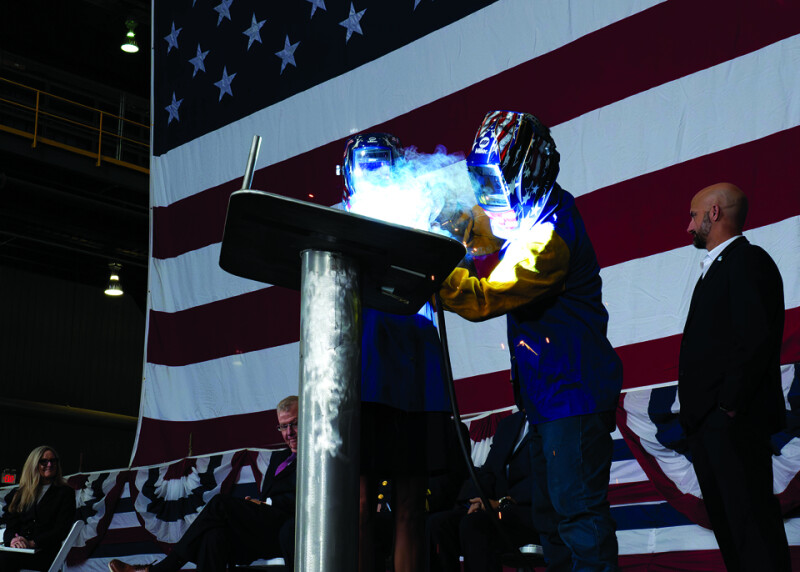
Industry innovators responded fast with proposals for autonomous fleets. In August, Saronic held a keel-laying of its first 150' Marauder vessel at the company’s Franklin, La., yard, acquired in April from Gulf Craft.
Saronic pitched its venture as a new class of fully autonomous ships for U.S. defense, allied forces, and commercial maritime operations. The Marauder has a payload capacity of 40 metric tons and can travel up to 3,500 nautical miles or loiter for over 30 days.
“The keel-laying of our first Marauder marks a significant milestone in autonomous maritime capability,” said Dino Mavrookas, co-founder and CEO of Saronic. In early December, Saronic announced a $300 million investment to increase production capacity and add 1,500 skilled jobs to its workforce by early 2027.
Austal USA held a keel-laying ceremony at its Mobile, Ala., facility for Pickering, the first Coast Guard Heritage-class Offshore Patrol Cutter (OPC) to be built at the company’s Mobile shipyard. The cutter is being constructed under a contract covering up to 11 vessels with a potential value of $3.3 billion. The Coast Guard has exercised options for six cutters so far.
The 360' OPCs are to become the backbone of the Coast Guard’s offshore presence, performing law enforcement, drug and migrant interdiction, and search-and-rescue missions. With a range of 10,200 nautical miles at 14 knots, and endurance up to 60 days, the cutters can serve as mobile command-and-control platforms for surge operations, including hurricane response and support Arctic mission requirements.
The progress comes after months of troubles for the OPC program. In November, the Eastern Shipbuilding Group, Panama City, Fla., said financial constraints forced the company to break off its construction for four of the cutters.
“Eastern Shipbuilding Group has made the difficult decision to suspend work on the Offshore Patrol Cutter program due to significant financial strain caused by the program’s structure and conditions. Despite our best efforts, continuing under the current circumstances is not sustainable,” Eastern CEO Joey D’Isernia said in a statement to WorkBoat. “Unfortunately, we also had to reduce our workforce — an extremely hard step, as our people are the strength of this company.”
Efficiency, automation, robotics, modular construction, and vessel construction management in place of government oversight are being driven by the imperative to move the U.S. industry back to its old rankings.
So, too, are new partnerships with international shipbuilders. The Trump administration made a decisive move with an October agreement with Finland to build up to four new Arctic Security Cutters there, and “leveraging … Finnish expertise to construct up to seven new ASCs in shipyards located in the United States,” according to a White House statement.
Canadian shipbuilder Davie and its Helsinki Shipyard in Finland will build five ASCs (two in Finland and three in the U.S.). Bollinger Shipyards, Lockport, La., with Rauma Marine Constructions and Aker Arctic Technology Inc. of Finland, and Seaspan Shipyards in Canada were selected to design and build six Arctic cutters (two in Finland and four in the U.S.).
It’s a new era, several shipbuilders said Dec. 3 at the International WorkBoat Show in New Orleans. Kai Skvarla, CEO of Davie Defense, announced that Davie had acquired the Gulf Copper shipyard in Galveston, Texas, adding to its yards in Quebec and Finland that build icebreakers and commercial ships.
When a question came on the possibility of building a U.S. warship in a foreign yard, Skvarla responded: “As recently as 10 years ago, the thought of building a U.S. ship in another country didn’t compute.”
