



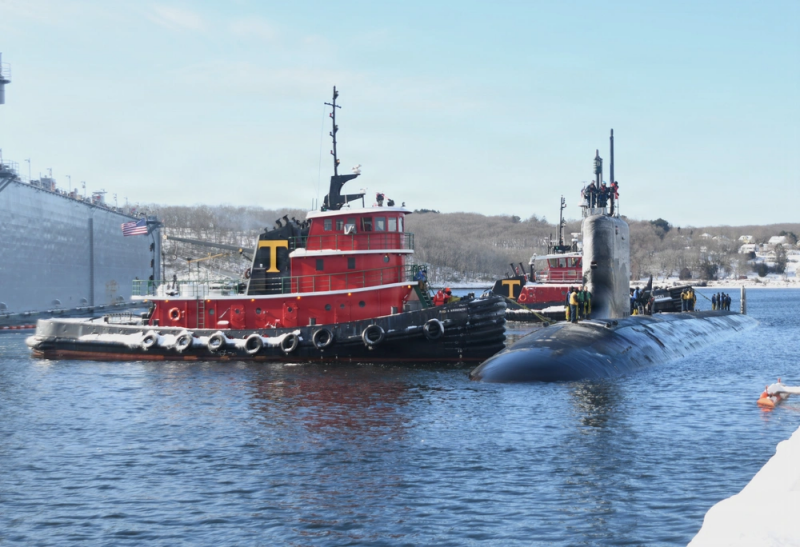
The Navy spent an estimated $4.2 billion over 10 years supporting attack submarines delayed in maintenance or sitting idle while waiting for shipyard capacity, according to an Aug. 27 Government Accountability Office report.
The GAO report found that maintenance delays and idle time affected the readiness of the Navy’s 44 attack submarines, which included 20 Los Angeles-class and 24 Virginia-class boats as of fiscal year 2025.
From fiscal years 2016 through 2025, the Navy lost more than 15,000 operational days because of depot maintenance delays and idle time involving active submarines. The service spent an estimated $3.4 billion to crew, maintain and support those vessels while they provided no operational capability.
Including submarines awaiting decommissioning, the Navy accumulated 18,687 days of delays and idle time at a total estimated cost of $4.17 billion.
The Navy completed about 11% of attack submarine depot maintenance periods on time at public shipyards during the decade. Maintenance delays totaled 6,494 days, while the average depot maintenance period increased from 744 days during fiscal years 2016 through 2020 to 809 days during the following five years.
The Navy’s four public shipyards — Portsmouth, Norfolk, Puget Sound and Pearl Harbor — perform depot maintenance on nuclear-powered submarines and other vessels. General Dynamics Electric Boat, Groton, Conn., and HII’s Newport News Shipbuilding, Newport News, Va., also perform some attack submarine maintenance.
GAO separated submarine idle time into two categories. Active idle time occurs when a submarine expected to return to service cannot enter a shipyard for maintenance. Inactive idle time applies to a submarine awaiting decommissioning that cannot enter a public shipyard drydock to have its reactor defueled.
The Navy accumulated 8,906 days of active idle time during the decade. The total peaked at 1,518 days in fiscal year 2022 but declined to 166 days in fiscal year 2025.
Inactive idle time, however, reached 1,260 days in fiscal year 2025 and is expected to grow as aging Los Angeles-class submarines reach the ends of their service lives.
The USS Pasadena entered inactive status Jan. 1, 2025, but is not expected to enter Norfolk Naval Shipyard for decommissioning until Nov. 15, 2028. GAO estimated that the nearly four-year delay will cost more than $300 million. The Navy is using the fully crewed submarine as a training platform while it waits.
Without further action, the Navy projects that 15 attack submarines will enter inactive idle status from fiscal years 2026 through 2030. GAO estimated they could accumulate more than 14,000 idle days and cost another $3.1 billion. The report attributed the projected increase largely to Los Angeles-class retirements and seismic restrictions at Puget Sound Naval Shipyard.
New construction delays are also limiting availability. The Virginia-class production rate stood at about one submarine annually as of June 2025, half the Navy’s goal. Although two submarines were delivered in 2025, both arrived more than three years late.
The Navy has considered defueling reactors outside traditional drydocks, using floating drydocks, reducing crews assigned to inactive vessels and extending selected submarines’ service lives. GAO found that the service had not fully evaluated those alternatives or established an implementation plan.
GAO recommended that Naval Sea Systems Command evaluate alternative decommissioning methods that could free shipyard capacity for operational vessels and develop an inactivation plan to reduce idle time. GAO said the Navy verbally agreed with both recommendations but did not submit written comments.
