



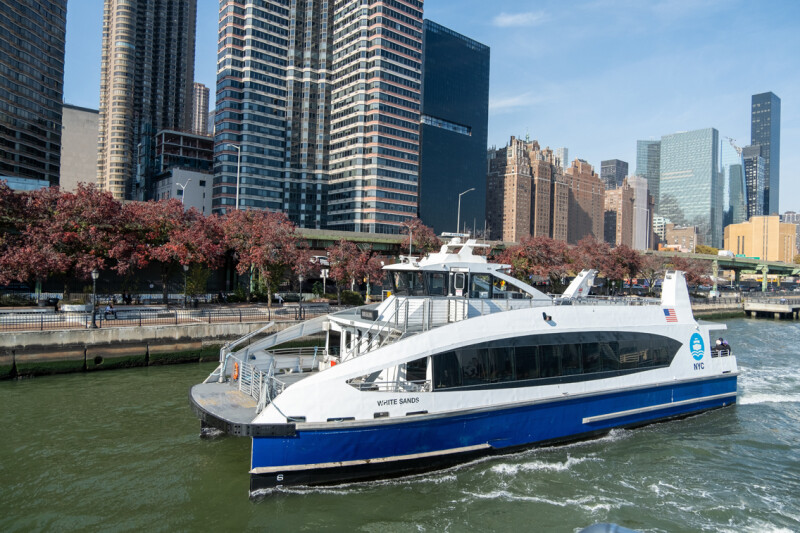
A ferry operator can test a new fuel, swap a lubricant, or update a maintenance protocol, but the vessel still has to make the next run.
That is the practical test behind every change to the fuels, lubricants, and related fluids used across the U.S. workboat sector. Engine oils, hydraulic fluids, gear oils, greases, coolants, and environmentally acceptable lubricants all have to fit into maintenance programs built around reliability, equipment protection, environmental rules, and operating cost.
Those decisions remain central to the maintenance planning for Hornblower Group, which operates NYC Ferry and other passenger vessel systems.
“As the operator of the nation’s most reliable and complex commuter ferry systems, Hornblower takes a continuous, comprehensive look at the ways we can reduce waste, limit emissions, and increase environmental and financial sustainability without ever sacrificing safety, reliability, or customer service,” said Timothy O’Brien, senior vice president of ferries and concessions at Hornblower.
Hornblower said fuels, lubricants, and related fluids “continue to be key components” of its operations and maintenance planning. The company said uptime, equipment protection, fuel quality, environmental requirements, and service intervals all matter because ferry operations depend on both long-term system sustainability and the rider waiting at the dock.
Hornblower has put that approach into practice with new fuel testing. Alongside New York City Economic Development Corp., the company completed a renewable diesel pilot at NYC Ferry before any broader fleet transition.
The pilot program was designed to make sure the new fuel type “did not negatively impact system performance or damage equipment and machinery.”
Suppliers see a similar focus from the product side. Mike Guggenheimer, president of BioMax, said rising costs have pushed more operators to look beyond the initial price of a lubricant and think instead about total cost of ownership.
“Operators are looking for technologies that will last longer,” Guggenheimer said. “Equipment will last longer, the oil will last longer, whether it’s longer drain intervals or sealing materials, or even wear of parts.”

BioMax is being positioned as a standalone brand under the Lubrication Engineers (LE) umbrella after a series of acquisitions. Lubrication Engineers acquired the Royal Purple Industrial brand from Calumet, including the BioMax environmentally acceptable lubricant product line. LE also acquired RSC Bio Solutions, and the company is combining RSC Bio Solutions with BioMax under the BioMax brand.
The combination brings together two product lines with deep experience in environmentally acceptable lubricants (EAL) while also tying into Lubrication Engineers’ broader service and asset reliability capabilities, Guggenheimer said.
“When we combine the BioMax product line and RSC Bio Solutions, essentially you have a brand platform that has the broadest array of performance environmentally acceptable technologies,” he said.
The workboat application is not necessarily replacing a fleet’s main engine oil supplier. Guggenheimer said many operators already have a supplier for main-grade oils. BioMax is focused more on specialty and auxiliary products, including EALs, greases, hydraulic fluids, and lubricants used in propulsion and deck systems.
Those products matter most where performance, water exposure, and environmental rules overlap.
Under the EPA’s Vessel General Permit (VGP), covered vessels must use EALs in all oil-to-sea interfaces unless technically infeasible. The Vessel Incidental Discharge Act (VIDA) is expected to replace the current vessel discharge framework once EPA and Coast Guard regulations are final, effective, and enforceable.
On workboats, Guggenheimer said the most obvious EAL applications include stern tubes, thrusters, and controllable pitch propellers. Other systems can also come into play, including deck machinery, hydraulics, greases, gear oils, and equipment used in offshore energy work.
“There are two types of applications,” Guggenheimer said. “The first would be any application where there’s either a high likelihood that it’s ending up in the environment or the water, or if it did, it would be a big problem.”
Propulsion equipment has a direct interface with the water. Deck machinery creates a different kind of exposure. Guggenheimer said crew safety and the potential for lubricants to reach the water make those systems critically important.
“A lot of people don’t realize that the VGP regulation does require deck machinery to use an environmental lubricant,” he said. “The VIDA update is going to clarify that and enforce that, and so I think looking at deck machinery is important.”
The issue becomes more visible in offshore energy markets, where vessels may carry tools with significant hydraulic and grease demands. Guggenheimer pointed to pile drivers and grabbing equipment as examples.
“They have lots of hydraulics and lots of grease,” he said. “It’s a big deal.”
Regulation started much of the EAL conversation, but it is no longer the only driver. Guggenheimer said customer expectations and bid requirements are pushing operators to pay closer attention, especially in offshore oil and gas and offshore wind.
“Their clients now are demanding it,” he said. “Sometimes sustainability and environmental acceptance is part of the bid process, so it can be a differentiator.”
That is where Guggenheimer sees a role for specialty suppliers. A workboat operator may not need a new commodity oil supplier but may need help understanding regulations, customer expectations, and the best fit for specific vessel systems.
“What a workboat operator sometimes needs is a partner that can guide them through all that,” Guggenheimer said. “It doesn’t replace the sort of traditional commodity oil supplies. It’s all about how do you chart a pathway.”
EALs still carry a perception problem. Some operators continue to assume environmental products cost more and perform worse than conventional lubricants. Guggenheimer said the products have matured, and the comparison is no longer that simple.
“I think people assume environmental technologies means it’s going to cost more and not work as well,” he said. “But I think there are definitely applications where there is a performance benefit.”
He cited hydraulic fluids with full synthetic-type performance and water-resistant extreme-pressure grease for wire rope. In that kind of application, a more expensive grease can stay on the rope longer while also bringing biodegradability and lower toxicity.
Attitudes are changing as operators gain experience with the products.
“The norm probably is more understanding the regulations and recognizing that the latest technologies do different things,” Guggenheimer said. “There are really good technologies out there today that are better for the environment, check boxes our clients are asking for, and actually perform very well.”
Performance is where broad environmental claims meet the daily conditions of a workboat. Lubricants may face heavy loads, heat, water ingress, long operating hours, frequent starts and stops, and tight maintenance windows. Guggenheimer said operators expect an environmental product to match or beat the conventional lubricant it replaces.
For stern tubes, thrusters, and similar systems, that means the right extreme-pressure characteristics, thermal stability, and hydrolytic stability, which is the ability to resist breaking down in the presence of water.
“As vessels get bigger, as applications get bigger, they’re seeing a lot of heat, they’re seeing more water ingress,” Guggenheimer said. “That’s important.”
Water stability can affect how often a crew must drain, top off, or otherwise manage oil. A product that breaks down faster in the presence of water can turn a compliance decision into a maintenance burden.
“Operators don’t want to have to comply with the regulation and then have some kind of operating headache that comes along with it,” Guggenheimer said. “They want something that just drops in, and they don’t have to worry about it.”
Compatibility is part of the same discussion. Fluids have to work with existing oils, seals, and equipment. Guggenheimer said future fuels will only add to that concern as engines and propulsion systems change.
“I don’t want to change seals, I don’t want to worry about it mixing with the fuel the wrong way or other oils,” he said. “That is an often-overlooked aspect of performance, this compatibility issue.”

One mistake, Guggenheimer said, is treating EAL as a single technology. It is a category with different chemistries and performance profiles. Seal compatibility shows why the distinction matters. Some EAL technologies may not work well with certain seal materials, especially natural rubber, while others may be compatible without forcing a broader changeout.
OEM approvals remain important, he said, but they do not make every product equal in every application.
“Just because it has an OEM approval does not always mean it is equivalent or better to what they’re used to,” Guggenheimer said.
For Hornblower, testing, analysis, and partner support are all part of its operating approach. “Hornblower works with our various partners to identify the best marine fuels, fluid programs, and propulsion technologies to serve each system’s unique characteristics and long-term goals to ensure exceptional system reliability,” a company spokesperson said.
That same discipline is expected to matter more as new fuels and propulsion systems enter the workboat market. Guggenheimer said dual-fuel and multifuel engines create more pressure on lubricant compatibility with different fuels and seals.
Over the coming years, operators should focus first on the differences among EAL technologies, Guggenheimer said. They should also watch the expansion of EAL-related attention into deck machinery and hydraulics, along with the way lubricants may complement future fuels and energy-efficiency goals.
Today, it’s the VGP and understanding the difference in the technologies, Guggenheimer said. “Tomorrow, or right around the corner, you should be looking at deck machinery and the opportunities there. And then the third is the engine oil category and combining with future fuels.”
For ferry operators, the standard remains systemwide performance. For Hornblower, every new fuel, fluid, and protocol must be evaluated across the vessel and the larger operation.
“Implementation of any new technology, protocol, or fuel/fluid should be done with consideration of the potential impact across vessel components and the larger ferry system,” the company stated. “Hornblower’s success evaluating and using new fuels, fluids, and propulsion methods is built on considering all factors and keeping safety, reliability, and performance at the fore.”
