Long-term monitoring of marine life in the Gulf of Mexico has shown some species declining by 60 to 85 percent through 2023 since the Deepwater Horizon oil spill in 2010, with little sign of recovery since then.
A cooperative effort of researchers from 11 institutions in the Gulf region recently issued findings from studies of deep Gulf waters down to 1,500 meters (5,000 feet). The catastrophic Deepwater well blowout and ensuing spill vented an estimated 4 million to almost 5 million barrels.
The Deep-Pelagic Nekton Dynamics of the Gulf (DEEPEND) Consortium focused on pelagic nekton, small fish, crustaceans, shrimp, and cephalopods like squid. The findings were published Oct. 19 by the National Academy of Sciences, titled “Immense but not immutable: A sudden and sustained decline in deep-pelagic life in a large oceanic ecosystem.”
“Clear differences were observed between the 2011 and 2015–2023 periods, with some declines appearing to occur as early as August 2011 (crustaceans and cephalopods), and with no evidence of any return to early 2011 numbers,” researchers wrote.
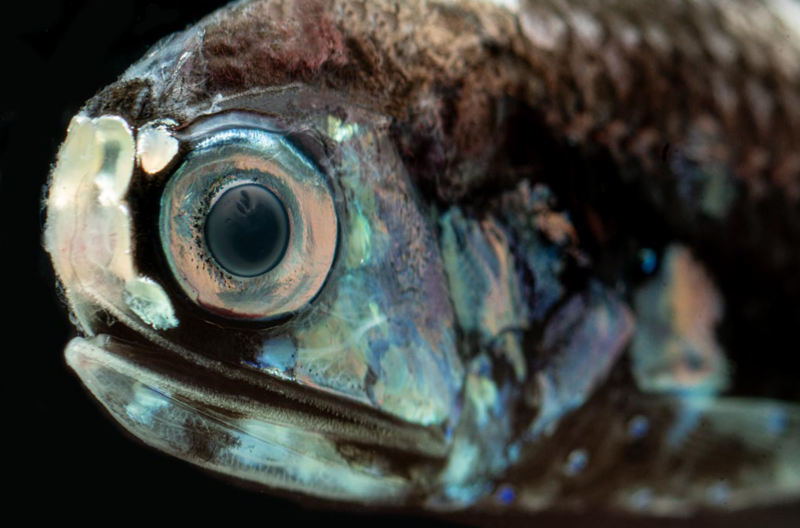
Total fish numbers declined by 63.5 percent, shrimps and krill declined 62 percent, and small cephalopods dropped by 59.7 percent. Other significant deepwater fish included lanternfish with a 62.9 percent decline, and bristlemouth fish that dropped off 72.8 percent.
All told the findings “indicate a sudden and persistent decline in the deep-pelagic fauna of a large marine ecosystem, resulting in a sustained, low-abundance state that meets the criteria for an ecological regime shift whose recovery time, if even possible, remains unknown,” the researchers reported.
“Further, given the tightly connected nature of oceanic life in the Gulf specifically, and low-latitude oceanic ecosystems in general, such declines are likely to reverberate through the system from top to bottom, altering ecosystem functions across multiple levels.”
“While these animals may be small in size, they are not insignificant. These fauna are the foundation of pelagic food webs – consuming smaller nekton and plankton and serving as prey for important Gulf predators such as tuna, billfish, oceanic dolphins, and many whale species.”
“In fact, the decrease of deep-pelagic prey parallels observed decadal declines of up to 80 percent in deep-diving marine mammals (e.g., sperm whales, beaked whales, and Rice's whales). This evidence may point to a system-wide ecological regime shift.”
“By examining numerous environmental variables, the team ruled out marine heatwaves, hypoxia, or food supply limitations as the cause of the decline. Since the declines followed the Deepwater Horizon oil spill, the authors suggest the spill as the most likely cause.”
NOAA quoted Tracey Sutton of Nova Southeastern University, the founder and chief scientist of the DEEPEND group.
“This represents the largest faunal decline recorded for Earth's largest ecosystem type, said Sutton. “These data show that despite their immense size, open-ocean ecosystems have become finely tuned over millennia with little disturbance, and thus are not equipped to handle sudden, large-scale changes. In essence, the deep-pelagic domain appears to be much more fragile than we had imagined.”
The first pelagic nekton sampling effort took place as soon as possible following the Deepwater Horizon spill, when sampling was then conducted almost continuously for 9 months in 2011. That data served as the benchmark of pelagic nekton, and was similar to data collected during the 1980s and 1990s.
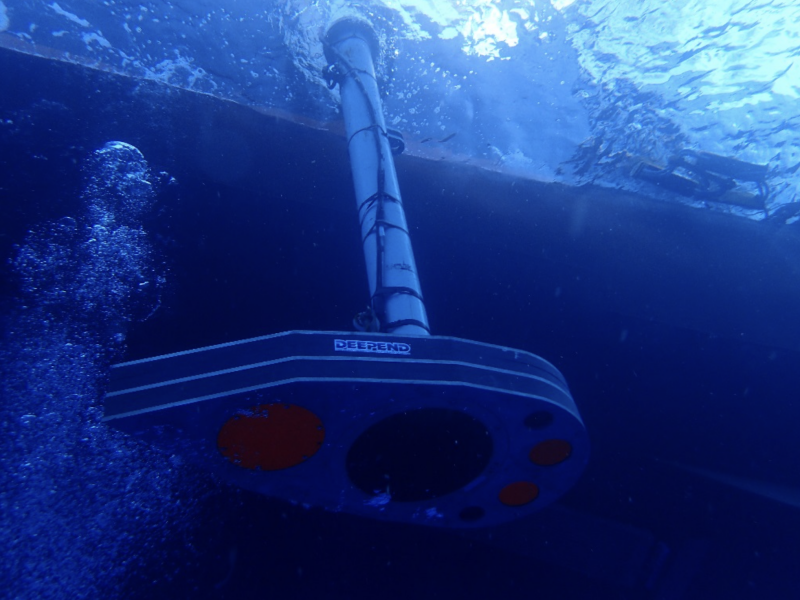
The next sampling rounds involved six efforts across 2015–2018, followed by three more in 2021–2023. The project team sampled at depths from the surface to 1,500 meters in the Gulf using a 10-square-meter Multiple Opening/Closing Net and Environmental Sensing System, or MOCNESS, with 3-millimeter mesh.
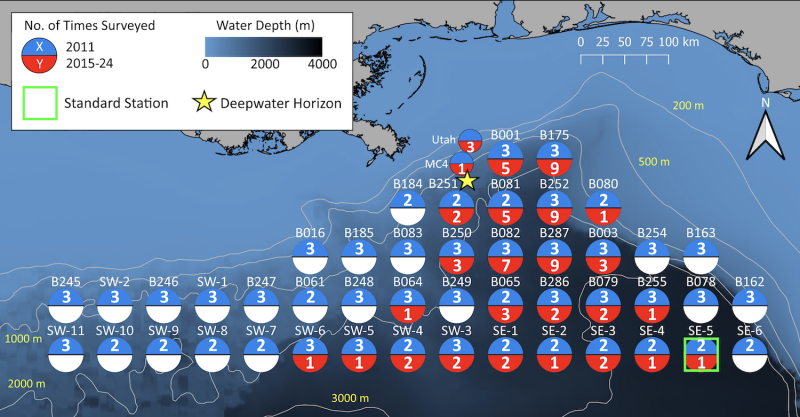
After each net tow the science teams identified and counted each of the animals collected in each sample.
In addition to net sampling method, the team also used echosounders to measure acoustic backscatter in the water column during the day and at night. The measurements independently estimated relative abundance of animals. Scientists also collected tissue samples from three dominant lanternfish species to monitor changes in genetic diversity.
That change in lanternfish species “revealed significant reductions in genetic diversity,” NOAA scientists noted. “This could lead to population bottlenecks and reduced ecological resilience – further eroding prey availability for the Gulf’s” larger animals including commercially important fish species.