



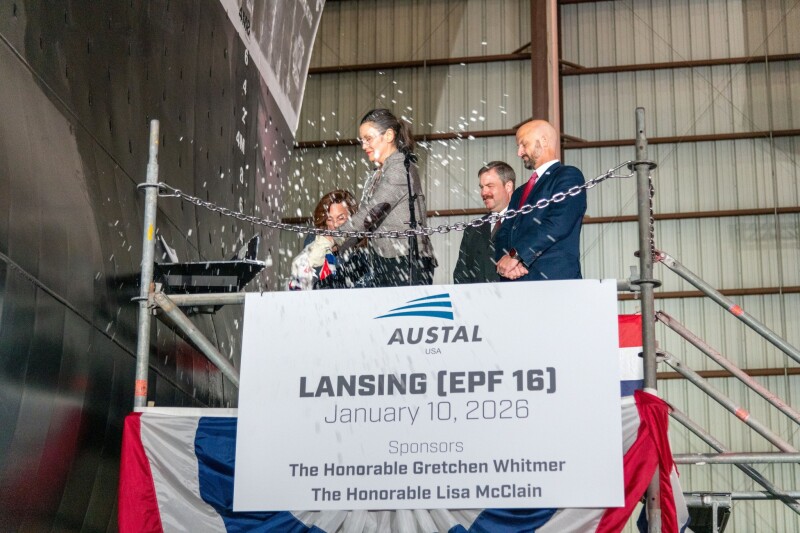
The U.S. Navy's final Flight II expeditionary fast transport ship, the future USNS Lansing (EPF 16), was christened Jan. 10 during a ceremony at Austal USA’s shipyard in Mobile, Ala.
The christening marked the final milestone in the Spearhead-class expeditionary fast transport (EPF) program, which provides the U.S. Navy and Military Sealift Command with high-speed, shallow-draft vessels for intra-theater transport of personnel and cargo, rapid response operations, and global mission support.
The ceremony featured two ship sponsors. Gov. Gretchen Whitmer, D-Mich., and U.S. Rep. Lisa McClain, R-Mich., simultaneously broke bottles of champagne on the ship’s bow and jointly declared, “For the United States of America, I christen thee Lansing. May God bless this ship and all who sail in her!”
Austal USA President Michelle Kruger said the event marked the conclusion of a major shipbuilding effort.
“I was especially honored to witness this tradition that means so much to our Navy and our Nation with the christening of the last ship of this great fleet. The Flight II Expeditionary Fast Transport ships represent a significant increase in naval auxiliary capability, designed to support a wide range of missions including medical operations, logistics, and troop transport,” Kruger said. “These ships are built by an exceptional team of dedicated men and women who consistently strive to be the best in the industry, delivering the most capable and cost-effective vessels to our superior Navy."
Speakers at the event included Hung Cao, under secretary of the U.S. Navy; Rear Adm. Benjamin Nicholson, commander of Military Sealift Command; Vice Adm. Seiko Okano, principal military deputy to the assistant secretary of the Navy for research, development and acquisition; Kruger; and Scott Bonk, director of future combatants and mission systems at General Dynamics Mission Systems.
“As we christen the future USNS Lansing, we celebrate another symbol of the unbreakable linkage that ties the workmanship of our shipyard workers to those of our American mariners who will man these ships,” said Cao. “This also marks the pivotal transition from the construction phase to the rigorous test and trials phase to ensure these platforms are ready to answer the call.”
The future USNS Lansing is the first Navy ship named after Michigan’s capital (the Edsall-class destroyer escort USS Lansing (DE-388), commissioned in 1943, was named after Aviation Machinist Mate First Class William Henry Lansing). In total, 32 naval ships have been named for the state or its cities, including the Navy’s first iron-hulled ship, commissioned in 1844.
The 337'11"x93'6" USNS Lansing is part of the EPF Flight II configuration, which adds a Role 2E enhanced medical capability. Features include primary surgical facilities, an intensive care unit, ward beds, and limited x-ray, laboratory, and dental support. The ship’s catamaran design provides stability for medical procedures while underway. Flight II vessels also support V-22 flight operations and the launch and recovery of 11-meter rigid-hull inflatable boats.
EPF Flight II ships are designed to support Distributed Maritime Operations and Expeditionary Advanced Base Operations, while retaining the logistics and transport capabilities of earlier EPF variants. The EPF program is one of four shipbuilding programs currently in serial production at Austal USA.
With the christening of EPF 16, the EPF program concludes after delivering a fleet of fast transport vessels that have become a key element of U.S. maritime logistics and expeditionary operations.
There have been 16 Spearhead-class EPFs, including the series' lead vessel, USNS Spearhead (T-EPF-1), delivered in December 2012. Eleven of the ships are currently in service.
In 2023, Austal USA was awarded a $868 million Navy contract for the design and construction of three expeditionary medical ships (EMS) based on the EPF design.
