



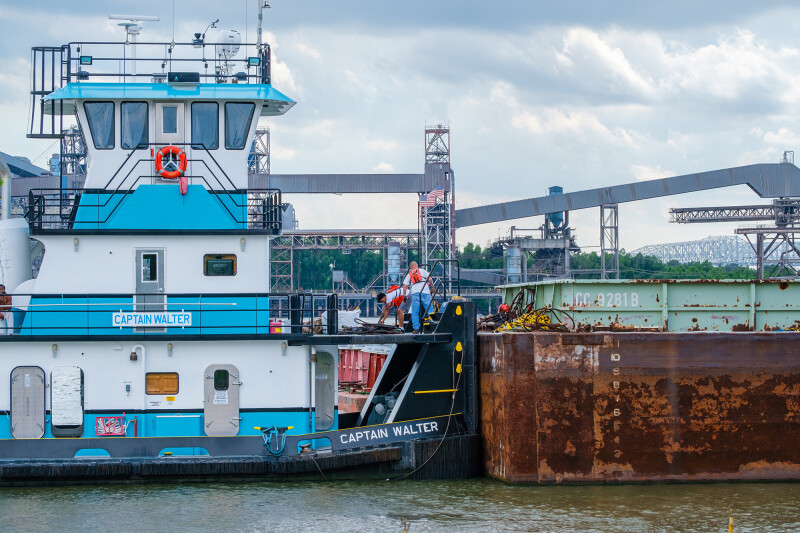
The inland industry is taking a deeper dive into improving crew safety, as falls overboard continue to be the leading cause of mariner fatalities on board barges.
In July, the American Waterways Operators (AWO), which represents the tugboat, towboat, and barge industry, released a comprehensive report examining causes of falls and recommending prevention strategies. Meanwhile, in August, inland companies across the country participated in a “Falls Overboard Safety Standdown Day” in which crews and company leaders discussed safety procedures and safe deck behavior, and reviewed the use of buddy systems, personal protective equipment, and fall restraints.
According to data collected by AWO and the Coast Guard, falls overboard are the top cause of crew fatalities in the tugboat, towboat, and barge industry, with 84% of overboard incidents involving slips, trips, or loss of balance at night or near unguarded vessel edges. The second leading cause (26%) was distraction or lack of situational awareness.
Most falls occurred on barges, as opposed to tugs and towboats, equipment, or facilities, and happened to both new and experienced mariners, mostly deckhands, according to the AWO report. Between 2012 and 2024, a total of 118 falls overboard were reported, with the most occurring in 2024 (20), followed by 2023 (12) and 2022 (12).
The industry has made big strides in reducing fatalities, due largely to a partnership between operators and the Coast Guard over the past few decades, but falls overboard continue to be a problem. AWO President Jennifer Carpenter, noting that the industry is “the safest mode of freight transportation in the United States,” said operators are committed “every day to doing better.”
The report identifies a common hazard that contributes to falls on all vessel types: the lack of effective barriers and other controls to guard the perimeter edge of vessels. This is a common hazard on unmanned barges.
The AWO report offers a multilayered approach to solutions tailored to a range of operations and vessel types, and extends guidance for integrating these strategies into a company’s safety management system. These include use of interior gunwales for transit rather than unguarded perimeters; hands-free mooring systems that raise or lower a barge while locking without crew intervention; installation of guardrails, restraint systems and scaffold board; use of non-stick deck coatings and visual alerts; improved de-icing procedures, training for situational awareness and crew fatigue, and expanded use of fall restraint systems and horizontal lifelines.
Improvements can also be made to future vessel design and construction by making walkways wider, relocating inboard working areas, and adding remote drafting and gauging devices that prevent the need for crew to access the edge of a barge for drafting or surveying.
