



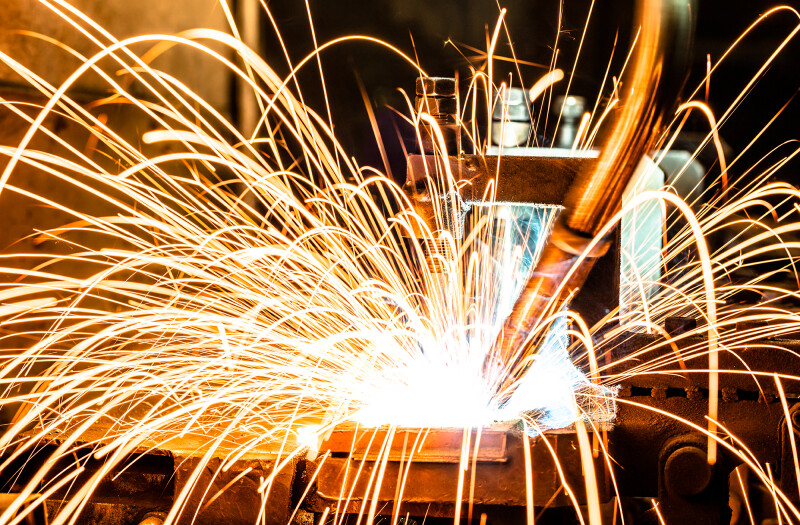
Fairbanks Morse Defense (FMD), Beloit, Wis., on Monday announced the expansion of its robotic welding program to support ship repair and maintenance for the U.S. Navy and allied fleets, aiming to reduce repair times, improve safety, and increase fleet readiness.
FMD's robotic welding technology uses automation, precision controls, and data-driven performance to reduce operational downtime and extend the service life of naval assets, the company said in a press release. The system integrates machine learning to enable automated weld control, consistent quality, and real-time weld fault detection, while operating under human oversight to meet naval standards.
“Robotic welding represents a fundamental shift in how we approach fleet sustainment. It allows us to complete repairs faster, more accurately, and more safely than ever before. This technology does not replace skilled technicians, but it enhances their capabilities, ensuring ships are returned to service in record time without compromising quality or safety,” said Keith Haasl, president of service and technology at Fairbanks Morse Defense.
According to FMD, the robotic welders are designed to operate in confined and challenging environments such as engine rooms and below-deck spaces. The company said the technology can perform welding tasks up to three times faster than manual methods and reduce crank bore repair time by as much as 75%, including on large-scale jobs.
FMD said its robotic systems maintain consistent heat distribution and weld spacing across extended weld sequences, reducing the risk of rework or failure. Each weld generates detailed data that can be used for quality assurance and predictive maintenance.
The company reported that the robotic welding technology has been used in high-pressure naval repair operations, including emergent crank line repairs on U.S. submarines. In those cases, FMD said the system achieved weld repairs three times faster than traditional methods under demanding conditions.
FMD said automating repetitive or high-risk welding tasks reduces worker exposure to heat and hazardous materials. Skilled technicians oversee robotic operations, conduct inspections, and handle complex or customized welds that require manual expertise.
The robotic welding initiative is part of FMD’s broader digital transformation strategy across its service and technology divisions, which also includes automation, extended reality trainin,g and predictive analytics, the company said.
