



Amid increasing U.S. energy demand and prices, voices are being raised in the name of greater consistency and predictability in the offshore energy permitting process.
Years of partisan feuding over fossil fuels and renewable energy yielded fitful moves toward reform and led the House of Representatives to pass the Standardized Permitting and Expediting Economic Development (SPEED) Act in December. Failing to win support for Senate passage over the winter, advocates were nonetheless seeing a burst of bipartisan support by spring.
At a Senate Appropriations hearing in late April, Interior Secretary Doug Burgum called reform legislation "absolutely essential… This is the moment."
Permitting reform negotiations stalled over the Trump administration's opposition to offshore wind projects but restarted in March when the Interior Department opened a review of solar projects.
In a joint statement, Sens. Martin Heinrich, D-N.M., and Sheldon Whitehouse, D-R.I., on March 5 called for bipartisan movement: "As we move forward, we expect that there will be no further interference with already-permitted wind projects and that the initial movement we've seen on solar project permitting will accelerate, and other renewable projects will move forward as well. Seeing permits continuing to be approved by the administration is critical for ensuring that talks can continue."
Interest groups ranging from the National Association of Manufacturers to National Association of Counties organized members to push Congress on various measures, from large-scale federal policies to land-use decisions. One example, the bipartisan Create Expedited Reviews to Transform American Infrastructure Now (CERTAIN) Act, introduced April 15, would strengthen county consultation and set actionable deadlines for federal environmental permitting processes, proponents say.
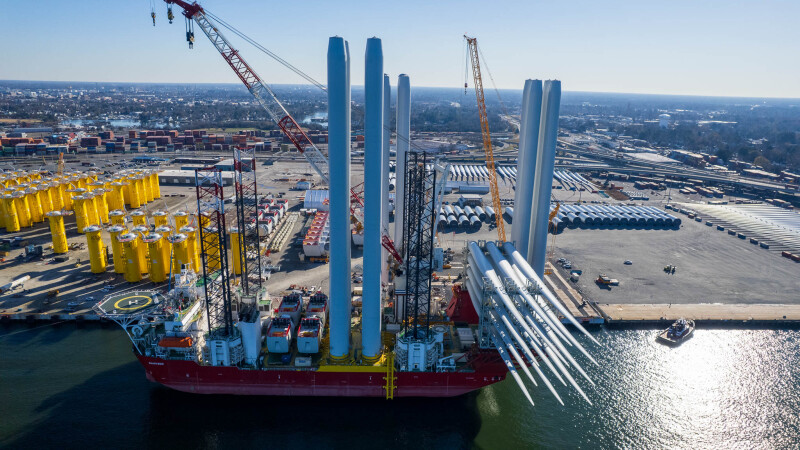
Meanwhile economic fallout continued from the wind industry's misfortune. In early April, a U.S. subsidiary of German steel fabricator EEW filed for federal Chapter 11 bankruptcy in New Jersey, a casualty of the demise of a $250 million state investment to build an offshore wind hub and port at Paulsboro on the Delaware River. EEW was to have built steel monopile foundations for New Jersey's now-canceled flagship wind projects.
New Jersey utility regulators said April 21 that they were requesting to end a 2021 agreement the Board of Public Utilities signed with PJM Interconnection, a regional electricity wholesaler, to develop offshore wind transmission projects, part of the drive by the administration of then-Gov. Phil Murphy to speed offshore wind energy development.
Although New Jersey was touted as the first state to align its offshore wind goals with regional grid planning, the agreement with PJM fell victim to the cancellation of Orsted's Ocean Wind New Jersey project. This was followed by the demise of the Atlantic Shores Offshore Wind Project, a joint venture by EDF Renewables and Shell, as a result of inflation, escalating costs, and supply chain shortages. Those business decisions were followed by the second Trump administration's all-out assault on remaining offshore wind projects, with just five off the East Coast surviving.
While remaining developers fought off the administration in federal courts, at the end of March TotalEnergies, the would-be developers of the Attentive Energy Two project off New Jersey, took up a legally novel offer from the Trump administration to give up its existing federal offshore leases in return for a $928 million refund. In announcing the bargain, administration and company officials said that refund would be re-invested in oil and LNG projects.
Backers of the Bluepoint Wind project off New York and New Jersey and the Golden State Wind array planned off California followed suit April 27, declaring they will "voluntarily end their offshore wind leases, with the respective affiliate companies agreeing to make financial investments in reliable conventional energy projects," according to a statement from the Interior Department.
New Jersey Gov. Mikie Sherrill's administration continues to tout solar and other renewable energy development. But with cancellation of the grid agreement, the state's offshore wind prospects are deeply set back.
"Given the Trump administration's aggressive and illegal actions to stop offshore wind projects in our region, including the recent agreement it reached with the firm TotalEnergies to use taxpayer dollars to buy back an offshore wind lease, the Sherrill administration had little choice but to cancel the agreement, given that there were no viable offshore wind projects to plug in and use the infrastructure," the nonprofit Regional Plan Association said.
Even with U.S. offshore wind going into hibernation, its advocates insist its long-term prospects still hold true with power demand steadily rising, particularly in the Mid-Atlantic and Northeast regions, driven by electrification trends and data center construction.
In an April 28 report, international energy analysts Wood Mackenzie foresaw the immense demands coming for North American energy supply.
"U.S. data center capacity is expected to increase from approximately 24 GW to 110 GW between 2026 and 2030, accounting for 68% of total load growth over the period," according to Wood Mackenzie. "With a projected increase of more than 400,000 GWh, data centers are expected to consume eight times more electricity than electric vehicles over the same timeframe — representing one of the most concentrated surges in electrical power demand in modern history."
While reliability and affordability concerns are escalating, "retirements of legacy generation are slowing, and new capacity additions, especially natural gas, are constrained by long lead times and equipment shortages," the wind industry group Oceantic Network noted in an April 14 briefing paper. "In that environment, offshore wind offers something increasingly rare: large-scale, shovel-ready power that can be deployed in coastal load centers where demand is concentrated."
The pressures for permitting reform come from both the wind and oil and gas sectors of the offshore industry. The possibility for changes unnerves some critics of offshore wind, who say there is danger of bypassing the National Environmental Policy Act (NEPA) and other safeguards.
Writing about the SPEED Act, Bob Stern of the New Jersey activist group Save Long Beach Island warned in March "this is not good law."
"In its present form, the bill creates confusion and does not foster wise decision-making. It would eviscerate NEPA, which has been a bedrock of national environmental policy for over 50 years, and stands in direct conflict with other law and the Constitution itself. Most importantly, the bill does not address the root causes of many delays, which can be fixed with more informed and cooperative applicant and agency staff work."
