



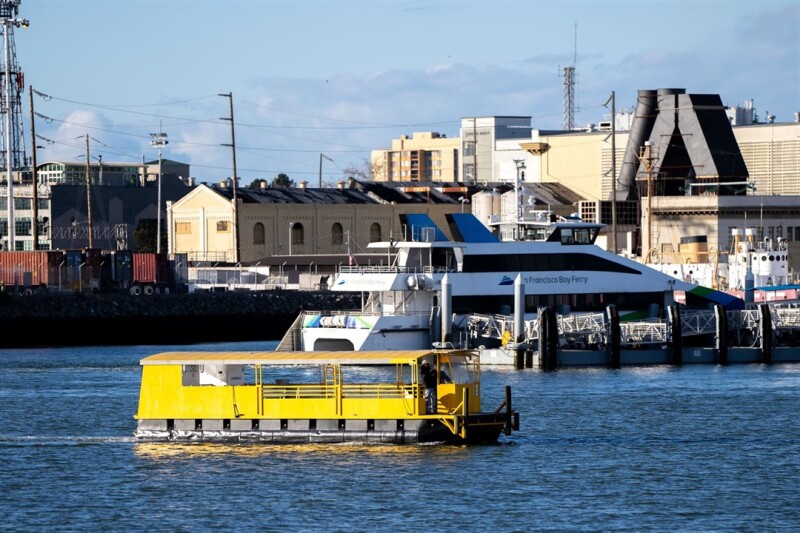
San Francisco Bay Ferry is replacing both outboard engines on the vessel serving its Oakland Alameda Water Shuttle route after a pair of failures took the boat out of service in early August. The operator expects the shuttle to resume running Friday, Aug. 21.
The 45', 31-passenger pontoon boat Woodstock, which runs the short cross-estuary route between Alameda Landing and Jack London Square in Oakland, is powered by twin Suzuki 140-hp outboards.
The first failure was a damaged head gasket that allowed saltwater to enter the engine, Tom Hall, director of operations and customer experience at San Francisco Bay Ferry, told WorkBoat. The second engine had trouble holding rpm. The operator never pinned down a cause on that unit, having pivoted to replacing both engines with new ones, Hall added.
The engines being pulled were relatively new but had accumulated substantial hours, mostly at low power given the short, slow-speed nature of the route, Hall said. They are being replaced like for like with new outboards supplied by local dealer H&M Marine Services, Sausalito, Calif.
The Woodstock is at San Francisco Bay Ferry's Central Bay Operations and Maintenance Facility in Alameda, where the engine swaps are scheduled to be completed this week.
No other equipment is being repaired, though engineers are using the downtime to perform scheduled in-the-water preventative maintenance. Service will resume after installation and testing.
No passengers were aboard when the malfunctions occurred. Service has been suspended since Wednesday, Aug. 5. In an Aug. 12 announcement, San Francisco Bay Ferry, the City of Alameda and the Alameda Transportation Management Agency said the shuttle would be down through at least Sunday, Aug. 16; two days later the operator set the Aug. 21 target after confirming replacement engines were en route.
The Woodstock was originally built as a tour boat named Captain Jack in Buffalo, N.Y., before being purchased and modified at Romero’s Welding, Vallejo, Calif., for use in the Bay Area. It launched on the Oakland-Alameda route in July 2024.
A two-year extension of the service was recently approved following a two-year pilot that exceeded projections. Over the coming year, operators plan to conduct a long-term feasibility study on how a more robust and reliable version of the service could be sustained.
