



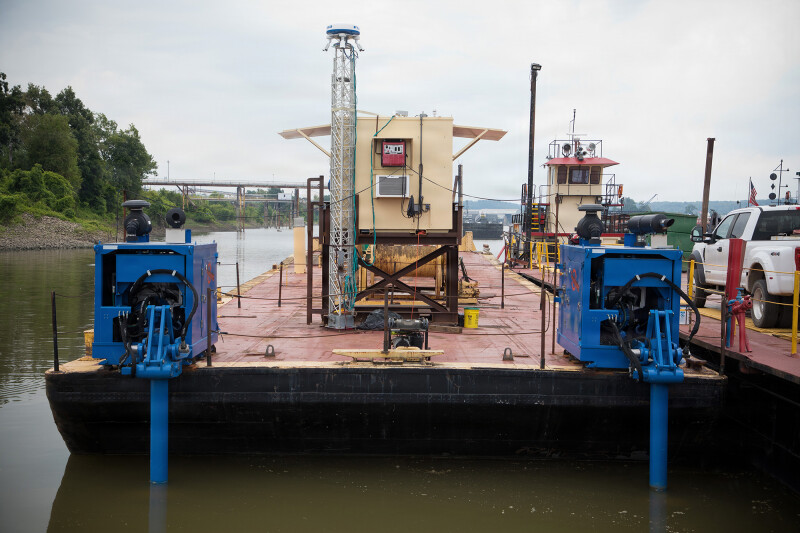
The U.S. Army Engineer Research and Development Center (ERDC) has partnered with U.S. Transportation Command (USTRANSCOM) to develop scalable autonomous modular propulsion kits for coastal and riverine operational logistics, known as SAMPOL.
The effort is aimed at addressing logistics vulnerabilities faced by U.S. forces operating in contested environments, where reliance on large vessels, fixed bases, and traditional supply routes can expose forces to disruption. ERDC and USTRANSCOM are focusing on autonomous, modular propulsion systems that can be rapidly deployed and installed on existing platforms to support distributed operations in denied or limited-access areas.
“Autonomy is a joint issue with the Army, Navy, and Marines,” said Thad Pratt, military technical director for coastal and hydraulics engineering at ERDC’s Coastal and Hydraulics Laboratory (CHL). “It's a watercraft issue, and we are figuring out how to plan, practice, and improve autonomy systems that are becoming a part of today’s operational landscape.”
SAMPOL is designed as a containerized kit that can be shipped into theater and installed on locally available floating platforms, primarily standard barges. “The Joint Force is looking for a kit that could be shipped in a single container and added to a floating platform already in theater,” Pratt said.
The system converts conventional barges into self-propelled, autonomous logistics platforms capable of transporting fuel and supplies to troops, aircraft, and other assets. ERDC worked with industry partners to integrate propulsion systems from Thrustmaster of Texas, Houston, and autonomous control technology from Sea Machines, Boston. The resulting configuration provides modular autonomous self-propulsion, enabling barges to operate with reduced or no onboard crew while maintaining cargo delivery and storage capabilities.
ERDC’s work on SAMPOL builds on more than a decade of autonomous vessel development. The organization has previously designed and deployed uncrewed surface vessels for civil works, including the U.S. Army Corps of Engineers’ Maritime Autonomous Survey System, a full-size autonomous survey vessel. Those technologies and lessons have been adapted for military logistics applications.
SAMPOL leverages the inherent characteristics of barges, including high payload capacity and independence from fixed infrastructure such as roads and bridges. The shallow-draft configuration allows operation in as little as 32" of water while carrying loads of up to 1,500 tons. The system is intended to support riverine resupply, tactical river crossings, and rapid port repair, with the ability to retrofit existing barges already operating in a region.
The autonomous propulsion system was demonstrated in August aboard a World War II–era barge provided by the Corps’ Vicksburg District during operations on the Mississippi River. The SAMPOL-equipped vessel operated without an onboard crew while navigating complex port and inland waterway environments.
“This has been a collaborative effort that included our U.S. Army Corps of Engineers partners at the Mississippi Valley Division and the Vicksburg District, the U.S. Coast Guard, industry, and academia,” said Dr. Ty Wamsley, director of CHL. “Bringing all these folks together with the additional expertise and access to resources is important from a strategic sense, not just for our military mission, but for our civil works mission as well.”
Future development of SAMPOL will incorporate artificial intelligence and advanced simulation tools to evaluate and refine autonomous navigation and decision-making algorithms. ERDC plans to use simulation to test sensor integration and vessel responses to complex riverine conditions, reducing development time and cost while improving system reliability.
“You don't realize how much your eyes and your ears process when navigating a boat,” Pratt said. “Recognizing a wake and realizing there's a submerged pile, or some submerged pinnacle or something underwater causing that wake, and deciding which way to turn or where to go takes training. Training an AI algorithm is not trivial, and capturing good data so you can train it is the trick.”
According to ERDC, SAMPOL’s autonomous propulsion approach can reduce transportation costs, limit risk to personnel and equipment, and strengthen supply chain resilience. The organization is also evaluating potential applications of the technology for civil works missions across U.S. waterways.
“Turning a WWII era barge into a scalable, autonomous watercraft is truly remarkable,” said Rear Adm. Chris Stone, director of strategic plans, policy, logistics, and warfighting development at USTRANSCOM. “This collaborative research not only strengthens logistical flexibility but also paves the way for a new era of efficiency and resilience in support of our joint forces.”
