



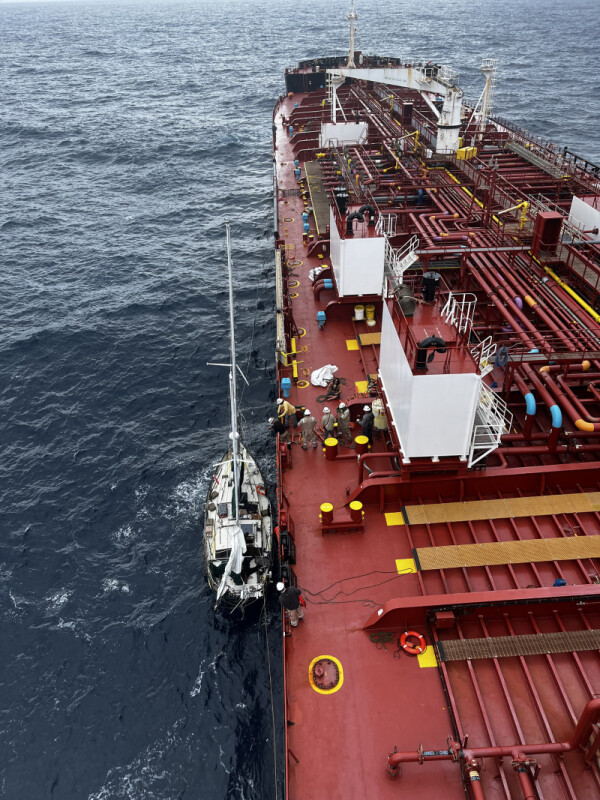
The crew of the tanker Florida, operated by Crowley Maritime Corp., Jacksonville, Fla., rescued three men and their three cats from a disabled sailboat Sept. 2 about 75 nautical miles off the Oregon coast.
The 41' sailboat Welcome Home had been at sea for five days when conditions deteriorated, according to American Maritime Officers (AMO), Dania Beach, Fla. Its battery had died, the bilge pump was unable to keep pace with water entering the boat, and rough seas had left the mast broken across the deck and torn away a dinghy secured alongside.
The three occupants, Gabriel Gonzalez, Gino Gonzalez and Gary Dixon, had recently left the U.S. Army and were sailing from Tacoma, Wash., to San Francisco, where they planned to attend college and live aboard the boat.
Weather along the Oregon coast was hazardous that day. National Weather Service offices in Portland and Medford had gale warnings in effect Sept. 2, forecasting seas of roughly 9' to 14' and wind gusts reaching 40 to 45 knots in portions of the coastal waters. AMO said the Florida encountered gusts as high as 60 knots during the rescue.
The Florida, carrying fuel from Tacoma to Martinez, Calif., received a distress relay at about 10:20 a.m. Capt. Ben Hopkins determined that the tanker was approximately 12 miles from the sailboat, altered course and assembled the crew to work out how to get the occupants aboard.
“It’s the law of the sea and at the heart of being a mariner is to assist people in need—be it fellow shipmates or others in distress,” Hopkins said.
Federal law requires a vessel master or person in charge to render assistance to an individual in danger of being lost at sea when that can be done without seriously endangering the assisting vessel or those aboard.
Once the tanker reached the Welcome Home, the crew rigged a long towline while Hopkins maneuvered the much larger ship into position to give the sailboat some protection from the weather. The crew then had to solve the more difficult problem of transferring three exhausted people from the damaged sailboat in rough seas.
One of the men had suffered a concussion after falling the previous night.
Five Florida crewmembers rigged a scramble net and line to bring him aboard first, while the other two men, both suffering from severe seasickness, were assisted up the tanker’s pilot ladder. The crew also recovered all three cats.
The men were given dry clothes, food, water, and medicine aboard the tanker before the Florida continued toward San Francisco. Hopkins estimated the entire rescue took about four hours and told AMO he believed the abandoned Welcome Home later sank.
“This was my first rescue, so I told the crew if anybody had better ideas, I was all for them,” Hopkins said. “They did a phenomenal job and we got them home safely.”
Hopkins singled out Chief Mate Zachary Jones and Seafarers International Union Bosun Samuel Duah for coordinating operations on deck, but described the response as an all-hands effort.
“The crew performed with absolute professionalism,” he said. “From expertly handling the heaving line in strong winds and bringing them alongside in challenging conditions, everyone immediately jumped into action.”
AMO identified Second Mate Brandon Locklin, Third Mate Megan Durrua, Chief Engineer Jason Brown, First Assistant Engineer Cody Pirtle, Second Assistant Engineer Cherokee Johnson, Third Assistant Engineer Nalu Keahi Ho and PIC observer Padric McGrath among its members aboard during the rescue.
The scale difference between the two vessels was considerable. Crowley specifications list the U.S.-flagged Florida at about 601' overall with capacity for approximately 330,000 barrels of petroleum products and chemicals. The Veteran-class tanker was built at Aker Philadelphia Shipyard and entered service in 2013.
The rescue came on what Hopkins had expected to be his final run before being relieved for vacation.
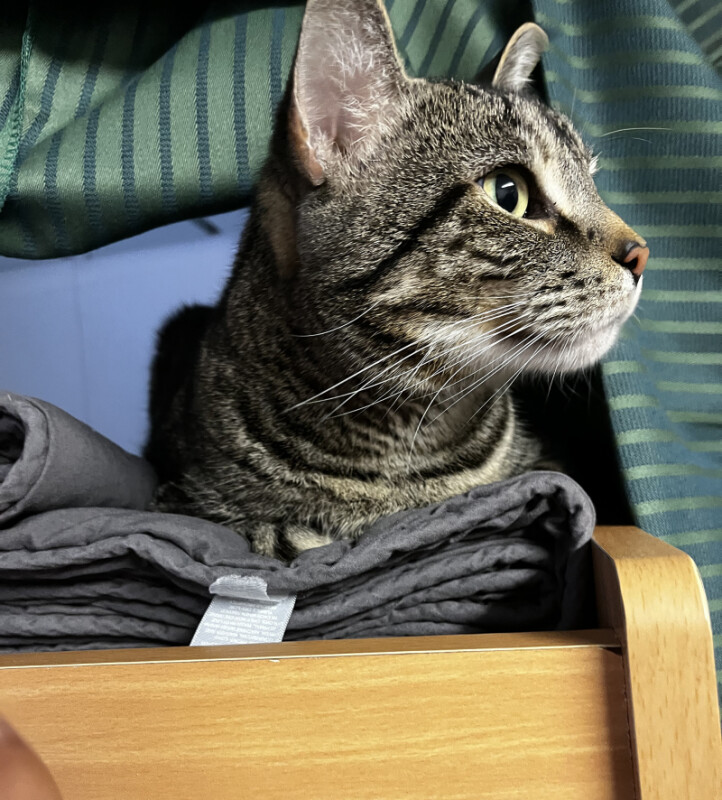
The names of the three cats were not released.
