



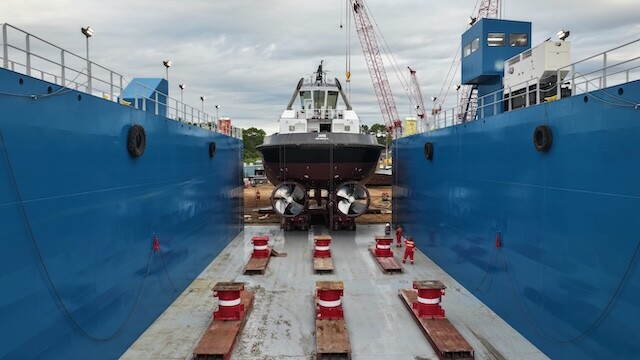
Master Boat Builders Inc., Coden, Ala., announced it has taken delivery of a new, state‑of‑the‑art floating drydock, giving the company direct control over launch schedules and accelerating vessel deliveries.
Designed and built by Conrad Shipyard, the drydock measures 155'x66' with 41' tall wing walls, features a 2,000‑ton lifting capacity, and incorporates a barge bow to enable efficient towing. Master Boat will use the dock to launch recently constructed vessels.
Previously, Master Boat rolled vessels onto a barge and towed them to third-party facilities in Alabama and Mississippi for launch — forcing Master Boat to be dependent on the availability and schedule of other yards. Now, Master Boat will have the ability to launch directly from its facility along the Theodore Industrial Canal, eliminating external constraints while improving reliability and cadence.
“This is about improving our capacity, schedule certainty and cadence of delivery, especially as we begin to take on more work, especially government and defense programs,” Garrett Rice, president of Master Boat Builders, said in a statement announcing the delivery. “By modernizing how we launch and bringing that capability under our own roof, we’re now able to deliver critical vessels with greater predictability and certainty.”
The new drydock complements Master Boat’s recently announced strategic partnership with Austal USA, Mobile, Ala. The two companies aim to strengthen the domestic maritime industrial base by increasing the ability of proven, regional shipyards to take on large, complex programs for the U.S. government. Under the MOU, the companies will collaborate on current programs under contract to Austal USA as well as on future efforts, enabling greater flexibility to meet evolving fleet requirements.
By distributing work across complementary facilities, Austal USA and Master Boat aim to reduce bottlenecks, shorten production schedules, and create surge capacity for future demand. The companies also intend to co-invest in workforce development initiatives.
“This is one more step in de‑risking schedules for our customers,” added Rice. “When we control launch windows on our term, we protect delivery momentum, reduce bottlenecks, and keep our focus where it belongs – building hardworking boats, on time.”
